
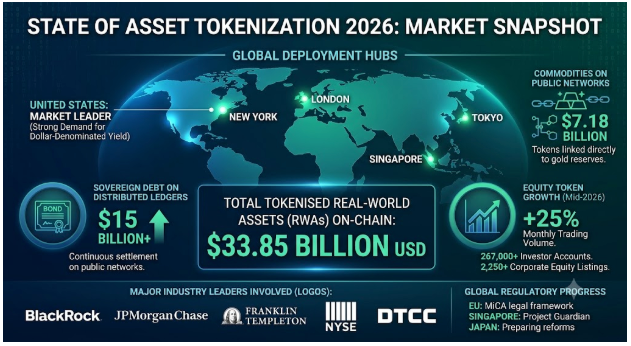
Financial institutions convert debt instruments, commodities, and money market funds into programmable tokens on distributed ledgers. The market capitalisation for tokenised real-world assets reached $33.85 billion during 2026. This operational migration marks a structural transition as capital markets adopt public and private blockchain rails for transaction clearing.
Asset managers place sovereign debt, commercial real estate equity, and physical bullion into digital units that settle trades continuously. BlackRock, an investment management firm managing $11 trillion globally, expanded its USD Institutional Digital Liquidity Fund to more than $2.6 billion in assets. This balance sheet expansion demonstrates market confidence in tokenised product structures as commercial banks follow BlackRock into distributed ledger technology.
Market infrastructure operators, including the Depository Trust and Clearing Corporation and the New York Stock Exchange, build exchange venues for continuous secondary trading. These initiatives replace paper certificates, spreadsheets, and central clearing depositories with cryptographic records of ownership. Network validators verify transactions directly on distributed nodes without central clearing intermediaries.
- Sovereign debt on distributed ledgers expanded beyond $15 billion across public networks. Institutional products like Circle USYC and BlackRock BUIDL attract corporate treasury liquidity through automated distribution mechanisms.
- Commodities on public networks reached $7.18 billion in circulation during 2026 trading cycles. Issuers like Paxos and Tether anchor this market sector by linking tokens directly to vault-stored gold reserves.
- Equity tokens generated a 25 per cent rise in monthly trading turnover during mid-2026. Digital market operators now register more than 267,000 investor accounts across 2,250 corporate equity listings.
- Private credit protocols deployed $12.4 billion into business lending pools across global trade corridors. Borrowers access liquidity directly through collateralised smart contracts on public chains.
The Power of Tokenisation
Tokenisation restructures how retail and wholesale market participants interact with wealth generation tools. Individual market participants access institutional debt funds that previously required minimum balance commitments exceeding $5 million. Lower entry thresholds allow individual savers to earn sovereign treasury yields through digital wallets without intermediary brokerage fees.
Legacy settlement systems lock capital inside trade queues for two business days under conventional market settlement rules. Blockchain networks eliminate this settlement delay by finalising payments and asset transfers simultaneously within seconds. Atomic settlement reduces counterparty risk and frees up balance sheet capital for immediate deployment across financial markets.
 State of Asset Tokenisation in 2026
Smart contracts execute dividend payments, corporate voting administration, and interest calculations automatically. Market participants incur lower administrative expenses and gain continuous liquidity for previously illiquid asset holdings. Investors also monitor portfolio exposure in real time through publicly verifiable cryptographic registers.
- Fractional ownership allows investors to purchase $100 slices of commercial real estate assets. This distribution structure removes balance sheet concentration barriers for ordinary market participants.
- Continuous market hours replace standard exchange trading schedules. Investors execute trades during weekends and public holidays across international time zones.
- Transparent ledgers eliminate auditing delays for private fund holdings. Account holders verify asset collateral backing directly on chain at any hour.
The Key Players
Global asset management corporations drive this operational transition alongside technology infrastructure firms and sovereign regulatory bodies. BlackRock manages its $2.6 billion institutional liquidity vehicle on the Ethereum blockchain in collaboration with Securitize. Chief Executive Officer Larry Fink previously outlined this strategic direction, stating: “We believe the next step going forward will be the tokenization of financial assets.”
Commercial banking institutions construct internal distributed ledgers to process commercial lending, trade finance, and cross-border settlements. JPMorgan Chase processes $1 billion in daily transactions through its Kinexys platform. Franklin Templeton maintains its OnChain U.S. Government Money Fund across multiple network environments to increase capital velocity.
Technology consortia and decentralised protocols provide the underlying virtual machine architecture for asset issuers. Chainlink develops interoperability standards that connect legacy Swift banking messaging systems to public blockchains. Securitize, Ondo Finance, and Superstate issue tokenised treasury securities and private credit vehicles directly to international institutions.
- Sovereign wealth funds allocate balance sheet capital to on-chain money market vehicles. These sovereign entities target yields of 4.8 per cent to 5.2 per cent through digital short-term paper.
- Commercial banks partner with fintech firms to build custodial deposit tokens. These hybrid payment tokens settle institutional interbank transactions around the clock.
- Custodial trust companies safeguard physical assets, including gold bars and treasury certificates, in vaults. Independent auditors issue monthly attestation reports to confirm one-to-one reserve balances.
Global Adoption Hotspots
The adoption of tokenised traditional assets spans financial capitals across North America, Europe, the Asia-Pacific region, and the Middle East. The United States leads total distributed asset values due to strong investor demand for dollar-denominated treasury yields. Financial centres such as New York, London, Singapore, Sydney, and Tokyo serve as primary deployment hubs for these digital funds.
The European Union establishes legal operating parameters for tokenised instruments under the Markets in Crypto-Assets regulatory framework. The European Central Bank executes trials with commercial lenders using distributed ledger technology for wholesale central bank money settlement. Germany and Switzerland authorise digital securities registers that operate without central securities depositories.
Singapore advances institutional deployment through the Monetary Authority of Singapore and its Project Guardian pilot series. Hong Kong issues digital green bonds through its monetary authority to demonstrate capital market efficiency. The United Arab Emirates expands licensing frameworks through the Virtual Assets Regulatory Authority in Dubai to attract tokenisation firms.
Australia tests digital asset settlement rails through collaboration between commercial banks and domestic market infrastructure providers. The Reserve Bank of Australia explores central bank digital currency settlement alongside wholesale tokenised asset platforms. Australian institutional managers allocate funds to tokenised treasury pilots to modernise domestic transaction pipelines.
The Institutional Timeline
The transition gained operational momentum between 2024 and 2026 after institutional pilots yielded production software. BlackRock launched its flagship digital fund in March 2024, prompting market participation from rival investment managers. By early 2026, on-chain real-world assets expanded fivefold to surpass $33.85 billion.
Legislative bodies accelerated regulatory timetables throughout 2025 and 2026 to accommodate digital securities trading. The United States Congress advanced regulatory frameworks that clarified custody requirements for depository institutions. Regulatory clarity spurred institutional allocations from pension funds and university endowments during late 2025.
Market analysts identify 2026 as the transition boundary between experimental trials and live balance sheet execution. Asset issuers now deploy enterprise software that processes continuous trading volume rather than test token issuance mechanics. Commercial banks plan full integration of distributed settlement rails into core banking systems before 2028.
The Future of Finance
Asset managers tokenise physical and paper-based instruments by depositing real assets with regulated trust custodians. Software engineers write smart contracts that generate digital tokens matching the exact value of the custodian reserves. The smart contracts enforce transfer limitations, investor identity verification, and compliance rules directly at the protocol level.
Trading venues combine blockchain settlement rails with cash-equivalent stablecoins to execute immediate delivery-versus-payment transfers. Citi Institute projects that regulated stablecoins will reach $1.9 trillion by 2030 to settle these transactions. The institution models a baseline tokenised asset market of $5.5 trillion by 2030, with a bull scenario reaching $8.2 trillion.
Boston Consulting Group estimates that tokenised illiquid assets will reach $16 trillion by 2030, representing 10 per cent of global gross domestic product. The consultancy firm further projects growth to $88 trillion by 2035 as institutions that avoid tokenisation forfeit balance sheet scale. Traditional market makers, sovereign wealth funds, and commercial lenders must connect with distributed protocols to preserve profit margins.
- Financial markets will operate continuous twenty-four-hour liquidity pools for debt, real estate, and equity shares. Investors will trade fractional ownership stakes on digital exchanges without waiting for market opening bells.
- Custodians will link physical vault holdings to cryptographic ledger registries through automated proof mechanisms. Audit firms will inspect balance sheet verifications on-chain in real time rather than conducting retrospective quarterly reviews.
- Banking platforms will merge off-chain account databases with interoperable distributed networks. Financial institutions will settle domestic and cross-border transactions with minimal manual administration.
- Cross-chain liquidity routers will transfer assets across independent blockchains. Capital will move between sovereign debt tokens, commercial real estate tokens, and digital cash in single atomic transactions.
Disclaimer: This article is for informational purposes only and does not constitute financial, investment, tax, or legal advice. The information regarding tokenized assets, market capitalizations, and projections is based on current market trends and external analyses, which are subject to change. Investments in digital assets and blockchain-based financial products involve significant risks, including the potential loss of principal. All investment decisions should be made after consulting with a qualified professional and conducting independent research. Past performance or projected growth of any asset class is not indicative of future results.