

Proof-of-stake networks require participants to lock tokens into validator software to guarantee consensus and network security. Liquid staking protocols resolve this restriction by minting receipt tokens in return for deposited assets. These tokens grant holders the ability to trade assets on exchanges and access liquidity pools while collateral earns rewards on the consensus network.
Capital velocity measures the speed at which units of currency circulate through an economy during a calendar quarter. Liquid staking derivatives accelerate this circulation by transforming balance sheet reserves into collateral for credit markets. Depositors deploy these tokens across lending protocols without removing coins from the consensus layer.
Analytics services record more than fifty billion dollars in total collateral inside staking platforms. Lido leads this category with twenty-three billion dollars in deposits under management. The deployment of these tokens across exchange venues increases transaction turnover and generates fee streams for liquidity providers.
This liquidity model removes the yield trade-off between network validation and participation in credit markets. Capital allocators achieve layers of return on one pool of assets by circulating receipt tokens through automated market venues.
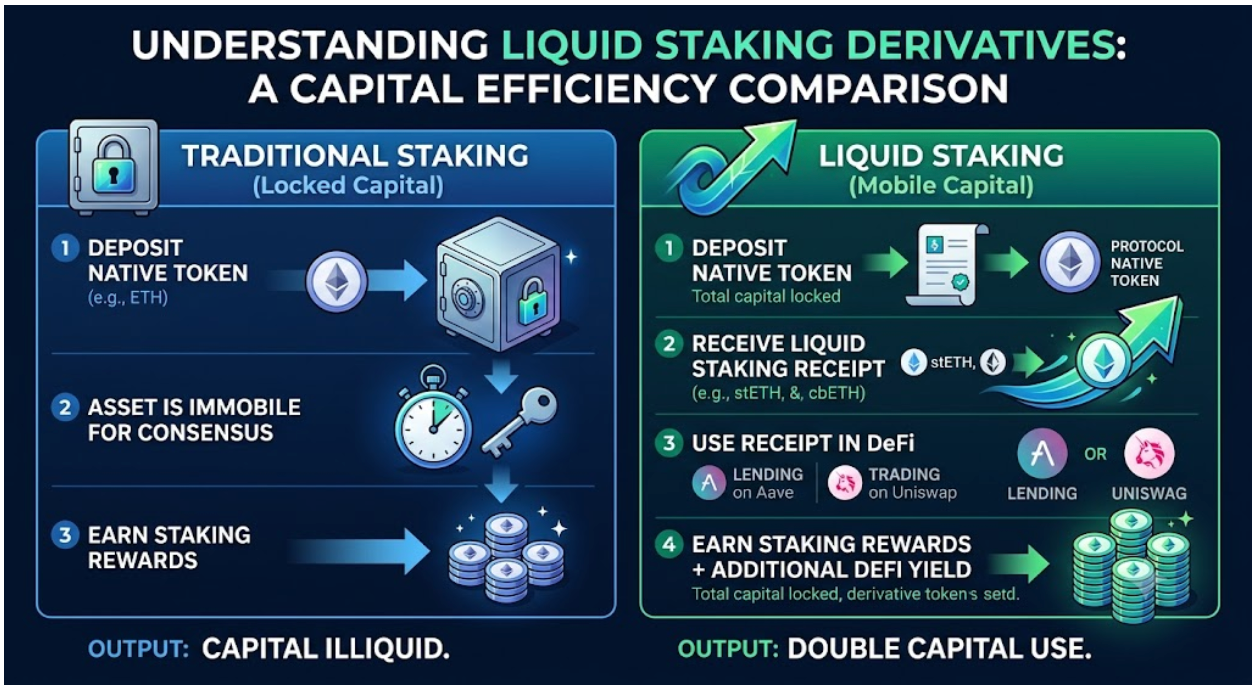 Traditional Staking vs. Liquid Staking Comparison
The Financial Ripple Effect: Why It Matters
Capital efficiency determines interest rates, market depth, and borrowing conditions across finance. Market participants observe how staking derivatives convert deposits into collateral for loans and swaps. This transformation multiplies liquidity throughout the economy without requiring emissions from base networks.
The rise in capital velocity concentrates risks into credit chains. Price divergences trigger waves of liquidations across money markets whenever derivative valuations separate from target assets. Borrowers forfeit collateral whenever volatility breaches liquidation margins on lending platforms.
Retail participants observe the effects of this speed through changes in bid-ask spreads on trading venues. Asset turnover reduces slippage during trades and lowers execution costs for market participants. Network stability now depends on the solvency of these staking mechanisms.
The Architects of Change: Key Players in Staking
A network of software developers, protocol foundations, and node operators orchestrates the staking derivative sector. These organisations manage smart contract logic and run the hardware that validates transactions on blockchain ledgers.
- Lido DAO oversees validator sets and controls twenty-three percent of ether on Ethereum.
- Rocket Pool decentralises node validation by allowing node operators to supply hardware and collateral.
- Binance and Coinbase offer custody staking products that package validation yields for clients across the market.
- EigenLayer expands capital velocity by routing deposited tokens into restaking contracts that protect data systems.
- Aave and Compound accept staking tokens as collateral to fuel borrowing activity across money markets.
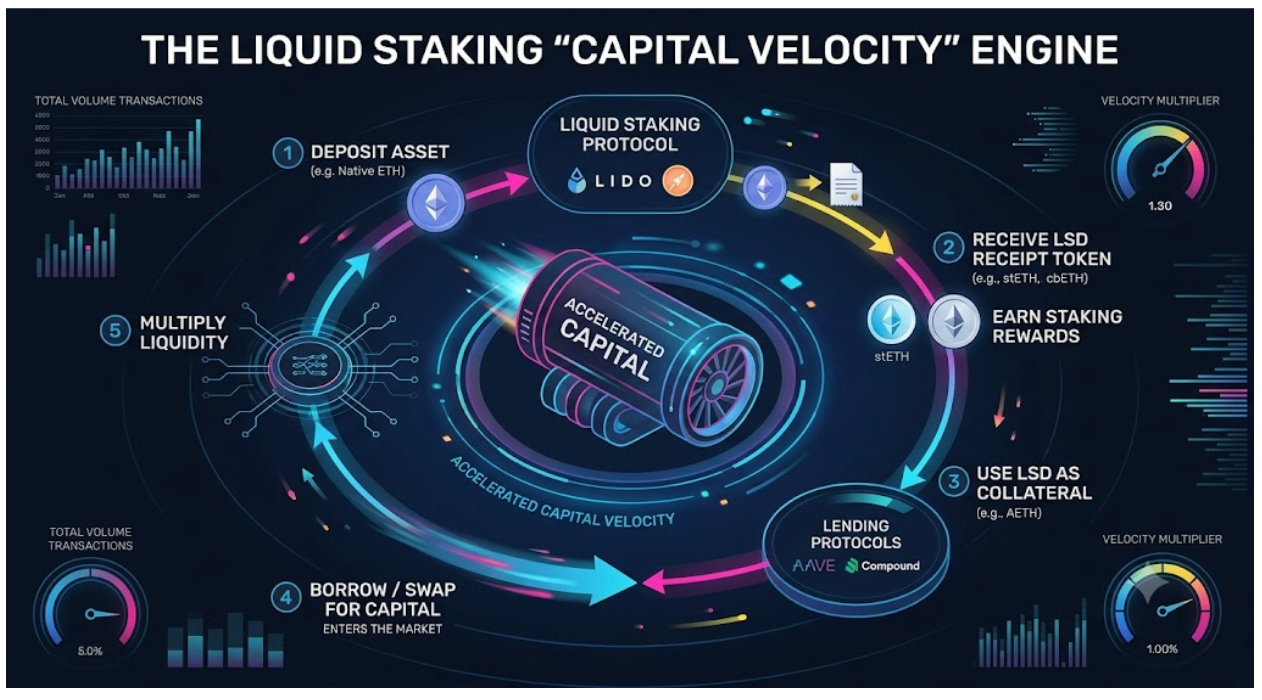 The Capital Velocity ‘Engine’
Capital allocators deploy funds into these protocols to optimise balance sheet performance. Asset managers such as Bitwise and VanEck study staking flows to prepare investment offerings for clients. Market-making firms deploy arbitrage algorithms to preserve price parity between derivative tokens and base currencies.
Industry researchers monitor staking centralisation and publish warning notes regarding cartel risks among node operators. Researcher Danny Ryan addressed this concentration of power across public forums during protocol discussions. Ryan stated: “Lido’s growth to extreme sizes presents systemic risks to Ethereum.”
Global Frontiers: Where the Innovation Happens
The expansion of staking derivatives centres on smart contract platforms across the world. Ethereum functions as the venue for these activities with thirty-four million ether inside consensus contracts. Solana and Avalanche also cultivate ecosystems that circulate staking tokens through network trading applications.
Cities across Australia, the United Kingdom, and the United States host firms that build staking infrastructure. Software engineers in Sydney and Melbourne design custody interfaces and risk analytics dashboards for trading desks. These teams collaborate with liquidity providers in London and New York to route capital across borders.
Regulation commissions in Canberra and Singapore evaluate the movement of these assets across borders. Regulators inspect how lending pools transmit shocks between counterparties across jurisdictions.
A Timeline of Transformation: How We Got Here
The timeline for liquid staking began with the launch of the Ethereum Beacon Chain in December 2020. Lido deployed its staking protocol during that month to pool assets ahead of network upgrades. Depositors accepted asset illiquidity until developers completed the Merge in September 2022 to transition the network away from proof of work.
The Shapella upgrade arrived in April 2023 and activated withdrawals for validator balances on Ethereum. This milestone eliminated redemption uncertainty and sparked capital inflows into staking protocols. Stakers deposited millions of tokens into staking pools within months of the upgrade.
The market reached velocity milestones throughout 2025 and 2026 as restaking protocols went live on mainnet. Staking derivatives now command forty percent of capital inside DeFi ecosystems.
The Road Ahead: How Liquid Staking Shapes the Future
Liquid staking achieves capital velocity through loops of collateralisation and borrowing. Users deposit tokens into smart contracts and receive derivative receipts that appreciate against the base asset or adjust token balances. Investors pledge these receipts on money market platforms to borrow currency, acquire assets, and repeat the staking cycle.
- Stakers submit ether or network tokens to smart contract pools.
- Node operators validate transactions and return consensus yields to protocol treasuries.
- Protocols issue derivative receipts that represent claims on deposited principal and protocol yield.
- Exchange venues facilitate the trading of receipts to ensure liquidity for token holders.
- Lending markets accept receipts as backing for stablecoin issuance and credit lines.
Restaking frameworks expand this process by exporting consensus security across networks. Operators stake derivative tokens on protocols such as EigenLayer to secure bridges, oracles, and data chains. This mechanism accelerates velocity by extracting revenue streams from one deposit.
Industry participants will introduce risk management frameworks and distributed validator technology to secure operations. Protocols will diversify validator distribution to prevent centralisation around node syndicates. Regulatory authorities will demand reserve audits to verify that derivative tokens maintain asset backing under stress.
Disclaimer: This article is for informational purposes only and does not constitute financial, investment, or legal advice. Cryptocurrency staking involves significant risk, including potential loss of principal, smart contract vulnerabilities, and market volatility. Always conduct your own research before deploying capital into decentralised finance protocols.