
Market data aggregators and blockchain analytics platforms published structural breakdowns categorising over 84 million digital assets into native coins and smart contract tokens. The technical classification distinguishes digital assets based on underlying infrastructure rather than market valuation or trading volume. Native coins power base layer blockchains, whereas tokens function on top of host protocols through smart contracts.
Data platforms recorded 17,000 active independent blockchain networks operating native protocol coins by early 2026. Conversely, smart contract deployment engines generated more than 50 million unique digital tokens across networks like Solana, Ethereum, and Base. Developers build tokens using standardized token templates, avoiding the requirement to establish custom consensus mechanisms.
Industry standards separate digital assets into distinct technical classes based on utility and architecture. Native coins provide underlying security, network validation rewards, and transaction fee settlement for primary ledgers. Tokens represent utility rights, governance power, asset-backed liabilities, or fractionalised holdings within specific decentralised applications.
Core architectural distinctions between digital asset classifications include:
- Native coins maintain independent ledger state, consensus mechanisms, and block production infrastructure.
- Digital tokens rely on host blockchain security, smart contract execution, and existing validator nodes.
- Users pay transaction settlement fees for token operations using the underlying native protocol coin.
- Smart contract standards govern token creation, supply minting, and balance transfers.
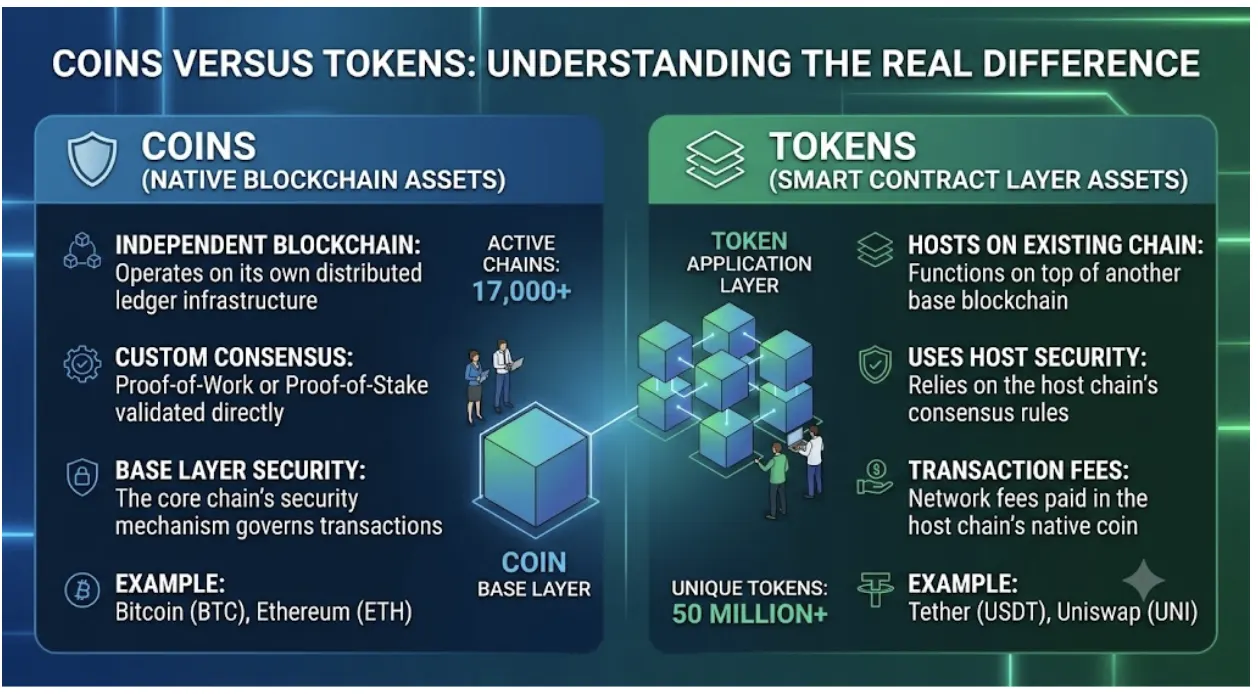 Figure 1: Coins vs Tokens
Why This Distinction Matters
Investors and platform users encounter distinct risk profiles and operational costs when handling coins versus tokens. Token transfers require users to hold balances of the native layer-one coin to settle transaction fees on the network. Network congestion on host blockchains raises execution costs for all hosted tokens simultaneously.
Security vulnerabilities affect coins and tokens in fundamentally different ways. Protocol flaws in a layer-one blockchain compromise every application and token operating on that infrastructure. Smart contract bugs in token contracts expose specific token pools to exploitation without damaging the host blockchain.
Regulatory bodies apply different compliance frameworks to digital asset categories based on issuer structure and control mechanics. Standardised tokens often trigger securities regulations due to centralised issuer groups and management expectations. Native coins frequently align with commodity classification structures when decentralised validation models govern network consensus.
Operational factors affecting market participants include:
- Network fee dependencies force token holders to acquire layer-one coins for asset movements.
- Smart contract code vulnerabilities expose token holders to exploit vectors independent of base layer security.
- Liquidity parameters vary between standalone network coins and smart contract token pools.
- Custody providers implement different technical integration standards for coins and token protocols.
Key Players Shaping the Ecosystem
Blockchain core engineering teams, software developers, institutional custodians, and financial regulators drive the ecosystem taxonomy. Foundations like the Ethereum Foundation, Bitcoin core contributors, and the Solana Foundation maintain base layer protocol code for native coins. Development firms deploy token frameworks across decentralised finance applications, stablecoin issuance mechanisms, and enterprise asset protocols.
Stablecoin issuers like Tether Limited and Circle Internet Financial issue digital tokens representing national currencies on existing blockchains. Tether manages over 180 billion US dollars in USDT tokens across multiple host protocols including Ethereum and Tron. Centralised exchange platforms like Coinbase and Binance list both coins and tokens while managing separate wallet infrastructures for each category.
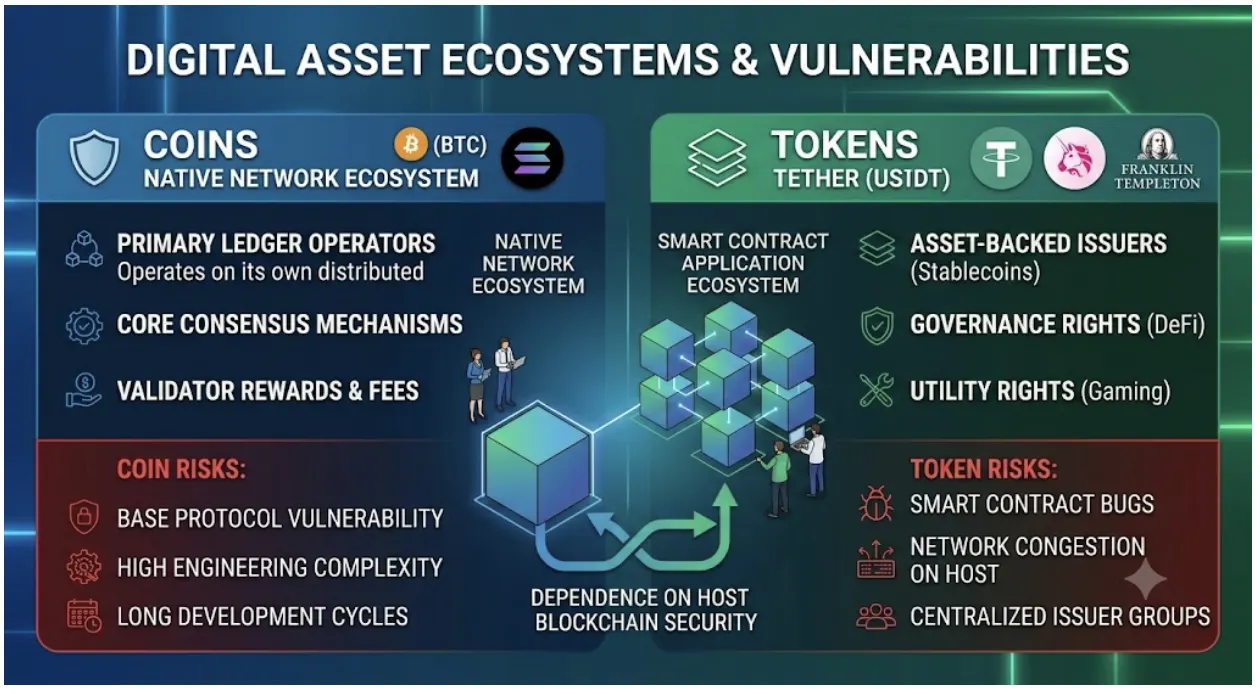 Figure 2: The Digital Asset Ecosystem
Decentralised finance protocols, gaming platforms, and corporate entities utilise tokens to grant access rights and transfer value. Decentralised exchanges like Uniswap issue governance tokens that allow holders to vote on protocol treasury allocations. Financial institutions like Franklin Templeton issue tokenised money market fund shares directly onto public blockchain rails. The European Securities and Markets Authority stated: “The financial classification of crypto-assets depends on their specific technical properties, rights, and underlying economic functions.”
A Global Digital Landscape
The structural separation occurs across globally distributed peer-to-peer computer networks and digital asset trading platforms. On-chain activity spans nodes situated in data centres across North America, Europe, Asia-Pacific, and Latin America. International financial centres establish distinct regulatory classifications for coins and tokens within local jurisdictional boundaries.
Jurisdictions like Australia, the European Union, Singapore, and Switzerland enforce specific digital asset taxonomy frameworks. The European Union Markets in Crypto-Assets regulation classifies digital assets into asset-referenced tokens, electronic money tokens, and utility tokens. Australian regulatory authorities evaluate asset structures to determine licensing requirements under existing financial services law.
Decentralised application deployment occurs primarily on smart contract platforms across public internet infrastructure. Developers initiate smart contract code deployments from software development environments worldwide. Trading venues execute transactions through global liquidity networks operating continuously across multiple time zones.
The Evolution of Digital Assets
The conceptual distinction originated in 2009 with the launch of the Bitcoin network as the first native coin. The introduction of the Ethereum network in 2015 established smart contract capabilities and enabled token creation standardisation. Ethereum developers introduced the ERC-20 token standard in November 2015, establishing uniform rules for fungible digital assets.
Token creation expanded during the initial coin offering expansion of 2017 and 2018. Decentralised finance platforms accelerated token issuance further between 2020 and 2022 through automated liquidity protocols. Automated token deployment tools on networks like Solana and Base drove total token generation past 84 million by 2026.
Global regulatory agencies began formalising definitions for digital coins and tokens between 2023 and 2026. Legislative bodies updated financial frameworks to account for differences between layer-one base protocols and smart contract tokens. Global institutional adoption shifted toward tokenised real-world assets during the same timeframe.
The Road Ahead: Building the Future
Developers create native coins by building standalone blockchain ledgers, setting genesis blocks, and establishing validator networks. The process demands custom network security architectures, consensus mechanisms, and peer-to-peer node infrastructure. Developers mint digital tokens by deploying written smart contract code onto an established blockchain network.
Future market development will focus on real-world asset tokenisation, cross-chain interoperability, and layer-two expansion. Financial institutions project the real-world asset tokenisation sector to reach 10 trillion US dollars in total value by 2030. Interoperability protocols will allow users to move tokens across separate blockchain networks without converting assets into native coins.
Regulatory enforcement will push token issuers toward higher compliance standards and mandatory reserve audits. Unregistered token projects will face tighter access controls from centralised exchanges and institutional liquidity venues. Base layer coins will continue serving as foundational monetary infrastructure, while tokens handle specialised financial applications.
Future developments across the digital asset structure include:
- Institutional asset managers will convert traditional financial products into smart contract tokens.
- Zero-knowledge verification systems will enhance privacy parameters for both coins and tokens.
- Regulatory authorities will mandate stricter reserve verification for asset-backed tokens.
- Blockchain networks will integrate automated bridges to simplify token transfers across ecosystems.
Disclaimer: The information provided in this article is for educational purposes only and does not constitute financial, investment, or legal advice. Digital assets, including coins and tokens, carry significant risk, including the potential loss of principal. Markets are volatile and subject to regulatory changes. Always conduct your own research and consult with a qualified professional before making any financial decisions.