
Senate Republicans released a substitute text for the CLARITY Act to establish statutory boundaries across the cryptocurrency sector. The document incorporates 126 modifications that Democratic senators submitted during cross-party negotiations. The draft balances authority between regulatory commissions and addresses competition between token issuers and banks.
The proposal establishes supervisory divisions between the Commodity Futures Trading Commission and the Securities and Exchange Commission. The text assigns authority over spot market commodity transactions directly to the Commodity Futures Trading Commission. Simultaneously, the draft reserves jurisdiction over investment contracts for the Securities and Exchange Commission.
The sponsors introduced provisions to curb deposit flight from retail institutions toward yield tokens. The text grants the Secretary of the Treasury power to activate a circuit breaker over stablecoin rewards when capital flows drain liquidity from community lenders. This mechanism provides banking executives with safeguards against liquidity runoffs during market expansions.
The text also integrates conflict-of-interest standards for government personnel and lawmakers. The provisions bar the President, Vice President, legislators, and judges from holding or trading specific blockchain assets. Senator Cynthia Lummis praised the cooperation of Donald Trump regarding these ethics sections.
 Senator Cynthia Lummis [Graeme Sloan]
She stated: “President Trump voluntarily agreed to unprecedented ethics restrictions, holding every federally elected official, judge, and their spouses to some of the toughest ethics restrictions in U.S. history”. Lummis added: “Democrats got what they wanted; now they need to take yes for an answer”.
Why It Matters to You
Consumers face legal exposure and security risks when exchanges operate without statutory guidelines. The CLARITY Act mandates the segregation of customer funds from company operating reserves to prevent balance-sheet co-mingling. This standard directly protects depositor capital if an exchange experiences solvency failures.
Investors also obtain disclosure documents before purchasing tokens from corporate sponsors. The legislation ends years of enforcement proceedings by regulatory agencies against token issuers. Market participants gain transparency regarding project governance, insider token distribution, and transaction histories.
The legislation influences household savings and credit access across communities. Lenders use retail deposits to underwrite home mortgages and business ventures. If cryptocurrency firms pull deposits toward stablecoin reserves, credit access contracts for local borrowers.
The bill provides stability by setting reserve requirements for stablecoin issuers. Consumers who transfer value across blockchain networks gain protections equivalent to payment systems.
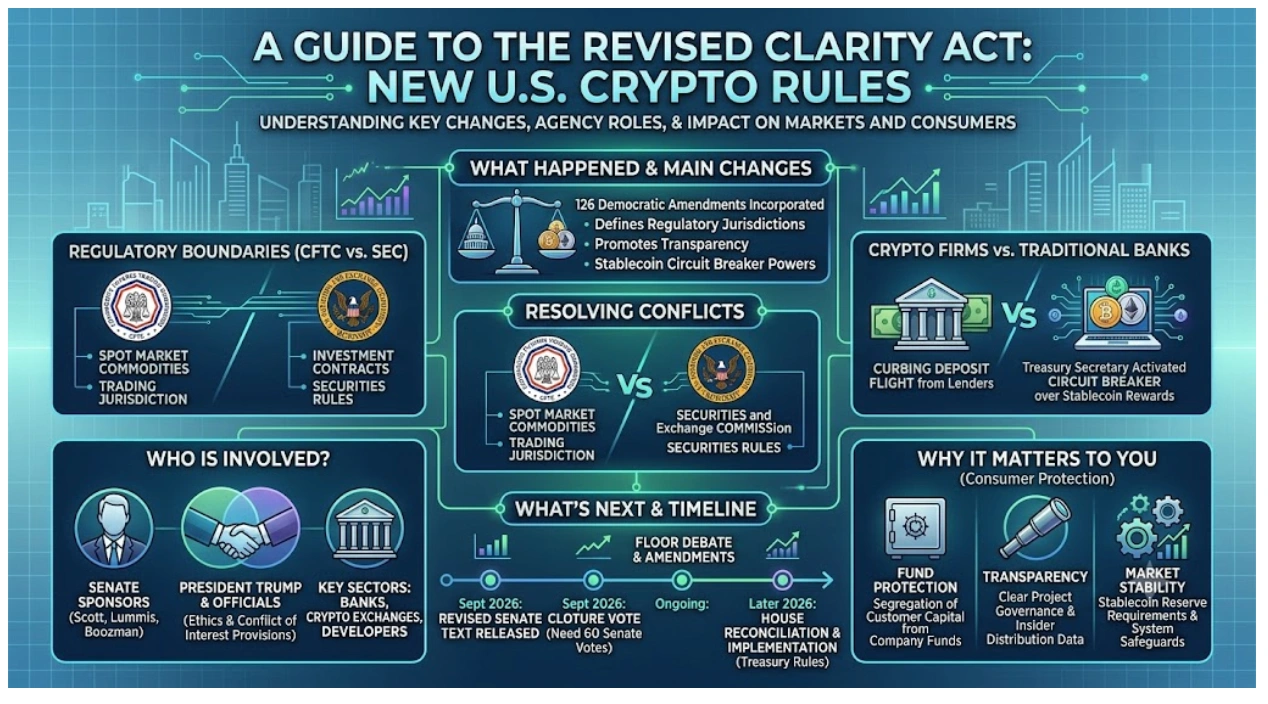 Guide to the revised CLARITY Act
Key Players & Sectors in the Spotlight
The text impacts several corporate sectors, regulatory bodies, and political figures. Senate Banking Committee Chairman Tim Scott, Senator Cynthia Lummis, and Senator John Boozman led the drafting efforts. Negotiators Thom Tillis and Ruben Gallego contributed ethics language to secure cross-party consensus.
The statute directly reshapes the regulatory scope of two financial supervisory institutions. The text redistributes oversight boundaries between the Securities and Exchange Commission and the Commodity Futures Trading Commission.
Multiple market sectors participate directly in the negotiations over digital asset legislation. Each commercial group maintains specific interests regarding market jurisdiction and compliance rules:
- Banking institutions: Banks and lending institutions lobby lawmakers to restrict stablecoin yield products. Bankers fear the loss of deposits to blockchain platforms that offer incentives on digital currency holdings.
- Cryptocurrency exchanges: Trading platforms seek regulatory legitimacy and access to central payment systems. Firms like Coinbase and Kraken want statutory definitions to avoid enforcement lawsuits from the Securities and Exchange Commission.
- Software developers: Programmers and protocol designers advocate for exclusions under the Blockchain Regulatory Certainty Act. The draft text protects non-custodial developers from money-transmitter registration requirements.
- Political officials: President Donald Trump and his family face scrutiny regarding private ventures such as World Liberty Financial and the USD1 token. The bill addresses these concerns by subjecting the executive branch and federal judges to conduct rules.
State attorneys general also assume enforcement jurisdiction under the modified compromise draft. These state legal officers will police conflict violations involving federal officials to guarantee compliance across jurisdictions.
Where the Action Is Happening
The policy debate centres on Capitol Hill in Washington, D.C., where legislators conduct committee negotiations. Senate hearing rooms and party leadership suites host daily discussions regarding financial technology oversight. State capitals across the United States also track the legislation due to provisions regarding money-transmission licences.
The conflict between Wall Street lenders and Silicon Valley venture firms spans financial centres. Lobbyists in New York, Charlotte, and San Francisco exert pressure on congressional delegations through industry trade associations.
The effects extend beyond American borders into global capital markets. Trading venues and regulatory agencies in London, Singapore, and Sydney monitor the drafting process closely. Global market operators align compliance programmes with American standards to preserve cross-border capital liquidity.
Timeline of Key Events
The House of Representatives initiated statutory action in July 2025 by passing its version of the bill with a 294-134 vote. Senate Republicans released their 126-amendment substitute text on Sunday night, 13 September 2026. The action followed weeks of engagement during the August congressional recess between bankers, crypto representatives, and lawmakers.
Senate leadership scheduled a procedural vote for Tuesday, 15 September 2026. This cloture ballot tests whether sponsors possess the required bipartisan support to begin chamber debate.
The congressional calendar imposes strict limits on the legislation. Lawmakers face an October recess ahead of the November midterm elections, leaving only a brief window for final passage. Failure to advance the text before the electoral recess delays market reforms until future legislative sessions.
How It Will Play Out
The drafting process evolved through months of negotiations between Senate committees and industry lobbyists. Republicans accommodated Democratic requests regarding ethics guardrails, developer safe harbours, and consumer disclosures to build consensus. This compromise generated momentum among moderate lawmakers who previously opposed crypto legislation.
The legislative trajectory now hinges on numerical tallies within the Senate chamber. Republicans control 53 seats, requiring at least seven Democrats or independents to cross party lines to reach the 60-vote cloture threshold. Prediction markets on Polymarket raised the probability of enactment from 22 percent to 32 percent following the release of the compromise text.
If the Senate invokes cloture, the chamber will execute a sequence of legislative actions. Lawmakers anticipate multiple procedural steps before sending a finalised statute to the White House:
- Formal floor debate: Senators will consider amendments over several days of chamber proceedings. Lawmakers from agricultural and banking committees will offer refinements to stablecoin provisions and agency boundaries.
- Reconciliation with the House: The House of Representatives must accept the Senate substitute or convene a conference committee. House leaders must coordinate floor votes around scheduled recess breaks in September and October.
- Treasury implementation: The Department of the Treasury will construct the 18-month emergency circuit-breaker framework for stablecoins. Regulators will monitor deposit movements between regional lenders and digital asset exchanges.
- Agency rule-writing: The Commodity Futures Trading Commission and Securities and Exchange Commission will write joint rules for asset registration and platform disclosure. Both agencies will phase in compliance requirements over a two-year transition timeline.
Banks will continue lobbying for tighter restrictions on stablecoin rewards during floor debates. Bank executives argue that non-bank yield accounts undermine community credit creation and economic stability. Digital asset advocates maintain that statutory rules keep technical innovation and capital investment inside the United States.
The forthcoming vote on Capitol Hill will determine the regulatory framework for American financial markets for decades. A successful vote establishes statutory certainty for digital assets, while legislative failure preserves regulatory enforcement actions.
Disclaimer:
This article is provided for informational and educational purposes only regarding the CLARITY Act substitute text and proposed cryptocurrency regulations. It does not constitute legal, financial, tax, or investment advice. The details regarding agency oversight, market impacts, stablecoin rules, and legislative timelines describe ongoing policy discussions and draft legislation subject to change. Readers should consult qualified legal or financial professionals for specific guidance related to digital assets or regulatory compliance.