
Ether climbed to 2,530 dollars during Sunday trading, while XRP reached 1.37 dollars across international order books. These price increases added 14 billion dollars to the market capitalisation of tokens outside Bitcoin. Spot trading volumes on global exchanges expanded by 18 percent compared to the prior weekend average.
Ether registered a gain of 2.4 percent across a forty-eight-hour period as buy orders absorbed available ask liquidity at key price intervals. XRP advanced 3.8 percent following consistent turnover on cross-border settlement corridors. The aggregate valuation of the digital asset market expanded to 2.18 trillion dollars over the same interval.
Decentralised finance protocols secured 48 billion dollars in total value as transaction activity increased on the Ethereum mainnet. Network monitors recorded median gas fees of 11 gwei throughout the Saturday and Sunday sessions.
- Ether gained 2.4 percent to trade at 2,530 dollars with 12.8 billion dollars in 24-hour volume.
- XRP advanced 3.8 percent to trade at 1.37 dollars with daily turnover of 3.1 billion dollars.
- Market capitalisation outside Bitcoin expanded by 14 billion dollars over forty-eight hours.
- Derivative trading platforms liquidated 420 million dollars in short contracts.
- Ethereum gas fees averaged 11 gwei across 1.1 million network transactions.
Derivatives platforms liquidated 420 million dollars in short contracts as prices moved above resistance markers. XRP ledger accounts processed 850,000 transactions while payments volume reached 1.2 billion dollars. Market participants transferred 18,000 Ether tokens from centralised exchange reserves into self-custody storage.
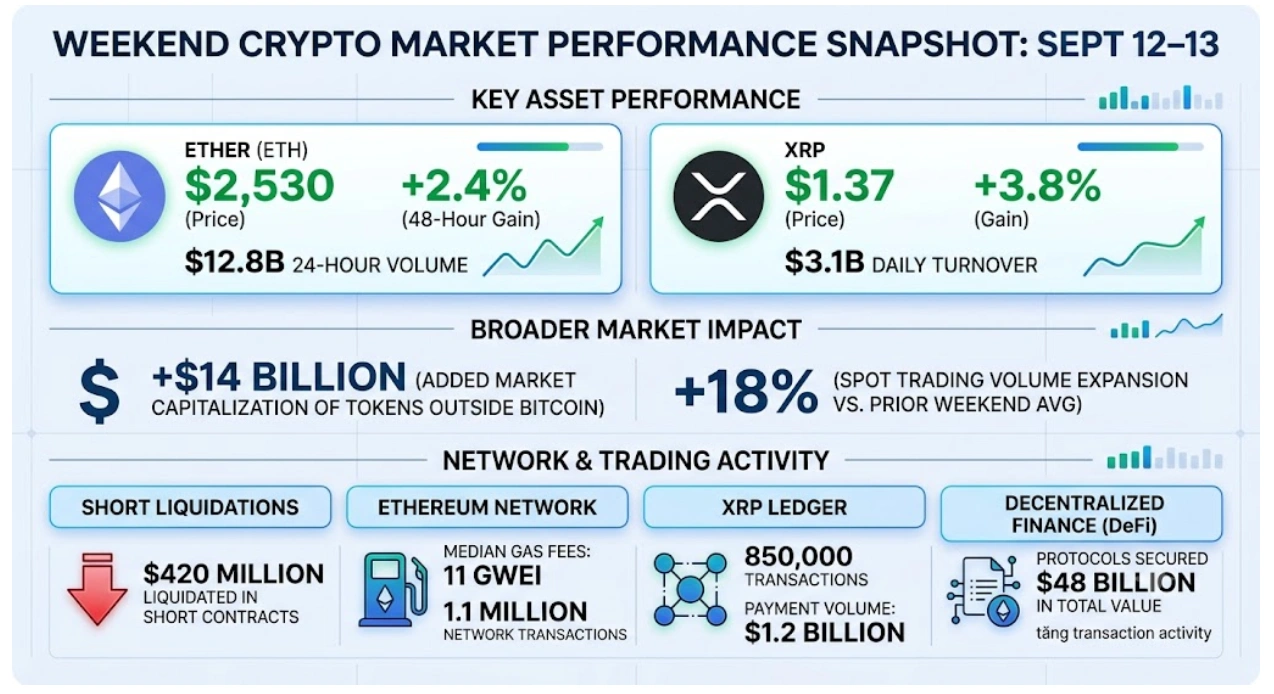 Weekend Crypto Market Performance
Market makers maintained pricing spreads across exchange pairs despite thin order book depth. Buyers matched sell volume without triggering downward cascades across decentralised lending pools.
Why This Matters to You
Weekend token performance indicates retail buyer sentiment because retail traders generate weekend volume while institutions pause operations. Market participants study these price trends to assess risk tolerance ahead of traditional stock exchange openings in Sydney, Tokyo, and London. Movements in Ether and XRP signal shifts in capital allocation from Bitcoin into alternative digital assets.
Individual investors face changing borrowing costs and collateral calculations when token values fluctuate. Higher token prices increase yield opportunities within staking programmes and automated liquidity pools for asset holders.
Remittance users rely on XRP price stability to calculate conversion rates and transfer fees for international money transfers. Enterprises building applications on the Ethereum network track Ether valuations to budget computation costs and smart contract deployment fees. Readers holding cryptocurrency assets gain data points to rebalance portfolios and evaluate margin limits across custodial platforms.
Order book liquidity conditions reveal how retail traders position capital when traditional banks remain closed. Individual traders utilise this information to update stop-loss limits and manage leverage ahead of Monday trading sessions. Price resilience during periods of macroeconomic uncertainty provides insight into structural adoption trends across global consumer markets.
- Retail trading patterns over weekends provide leading indicators for weekday institutional capital flows.
- Staking participants calculate rewards and yield percentages using current spot prices.
- Businesses track gas fees and settlement costs to project operational expenses for blockchain transactions.
- Margin traders adjust risk parameters to prevent automated liquidations during periods of price volatility.
Key Players & Market Drivers
Multiple commercial entities and market sectors influenced trading activity across the weekend. Ripple Labs continues work with international financial institutions to expand its on-demand liquidity infrastructure. The Ethereum Foundation coordinates technical improvements to support layer-two rollups and reduce settlement fees across the network ecosystem.
Digital asset exchanges Binance, Coinbase, OKX, and Kraken cleared the majority of retail spot volume. Market making desks, including Wintermute and Flow Traders, supplied bid-ask quotes to stabilise trading pairs across multiple order books.
Asset managers such as BlackRock and Fidelity track spot token movements to anticipate fund flows into their spot Ether exchange-traded products. While fund administrators trade ETF shares only during traditional exchange hours, portfolio managers monitor weekend price deviations to calculate prospective arbitrage spreads. Quantitative trading funds maintain automated systems that trade price variances between spot platforms and offshore derivatives exchanges.
- Ripple Labs: The fintech company provides settlement software to partner banks using XRP for liquidity.
- Ethereum Foundation: Developers implement technical consensus updates to optimise network throughput.
- Centralised exchanges: Operators maintain custody infrastructure, matching engines, and compliance frameworks.
- Market makers: Algorithmic trading firms provide continuous quotes to deepen order books.
- Decentralised finance protocols: Autonomous liquidity pools process token conversions without intermediaries.
The decentralised finance sector also played a central role in absorbing token transactions across decentralised networks. Protocols such as Uniswap, Aave, and Curve Finance executed 1.4 billion dollars in aggregate transaction volume over forty-eight hours. Node validators and staking pool operators processed 1.1 million blocks, securing transaction validation across distributed consensus networks.
Where the Action Unfolded
Trading activity took place across international digital exchanges and decentralised computer networks worldwide. Offshore platforms registered significant spot and derivatives volumes from market participants across South Korea, Japan, and Singapore. Australian licensed trading platforms in Sydney and Melbourne reported higher transaction counts during local daytime hours.
The physical network settlement occurred across thousands of computer servers hosting Ethereum and XRP Ledger nodes. These validator nodes operate across data centres in North America, Western Europe, Australia, and East Asia to confirm ledger balances.
Derivatives trading venues in Dubai and the Cayman Islands executed 65 percent of perpetual swap transactions. Licensed spot platforms in the European Union, the United Kingdom, and the United States handled institutional fiat gateway deposits. Remittance corridors connecting the United States, Mexico, and the Philippines recorded continuous XRP transaction volume through commercial settlement channels.
- Asia-Pacific markets: Trading desks in Seoul, Tokyo, and Sydney initiated early weekend buying volume.
- North American venues: Digital asset platforms processed retail spot orders and fiat transfers.
- European hubs: Frankfurt and London crypto desks managed liquidity corridors across Euro and Sterling trading pairs.
- Distributed node networks: Thousands of independent servers across five continents validated ledger transactions.
Timeline of the Surge
The price increase began at 02:00 UTC on Saturday, 12 September, and persisted through Sunday evening. Buyers entered order books immediately after equity markets in New York and Chicago completed Friday trading sessions. Upward momentum continued across thirty-six hours before European financial institutions opened pre-market trading windows.
The token movement occurred during a pause in economic data releases from government statistical agencies. Central banks in Washington, Frankfurt, London, and Canberra issued no policy statements over the weekend, creating a trading window free from interest rate announcements.
Trading volumes expanded throughout Sunday afternoon as retail participants in the Western Hemisphere increased order submissions. This price advance followed a week of interest rate discussions and inflation reporting across member nations of the Organisation for Economic Co-operation and Development. Ether and XRP consolidated their gains through Sunday midnight without triggering sudden market corrections.
- Saturday, 02:00 UTC: Spot order flow accelerated across Asian trading platforms.
- Saturday, 14:00 UTC: Ether cleared the 2,500 dollar resistance boundary on high volume.
- Sunday, 08:00 UTC: XRP reached 1.37 dollars following repeated buy executions on international exchanges.
- Sunday, 20:00 UTC: Both assets maintained consolidated trading ranges ahead of Asian market openings.
What’s Next: What to Watch
Traders absorbed sell orders on major exchanges by executing algorithmic purchase programmes during periods of reduced order book depth. As spot prices crossed key resistance markers, automated liquidation systems closed short futures contracts, accelerating upward price movement. This trading dynamic propelled Ether above 2,500 dollars and allowed XRP to surpass 1.35 dollars within hours.
Market analysts outline two primary paths forward as institutional market participants resume operations on Monday morning. Inflows into exchange-traded funds will determine whether institutional investors validate or reject the weekend retail price expansion.
Central bank interest rate decisions and sovereign bond yields will influence broader market liquidity throughout the coming trading week. If benchmark bond yields rise, capital allocators generally reduce exposure to non-yielding digital assets. Conversely, stable interest rate expectations will encourage traders to deploy capital into decentralised protocols and altcoin markets.
- Institutional ETF allocations: Monday inflow metrics will confirm whether institutions support current token valuations.
- Sovereign bond yield shifts: Changes in government debt yields will impact risk capital across global markets.
- Perpetual futures funding costs: Escalating funding rates will prompt corrective selloffs if leverage reaches excessive levels.
- Cross-border payment adoption: Expansion in corporate remittance partnerships will provide structural transaction demand for XRP.
- Network software upgrades: Upcoming testnet deployments on Ethereum will influence developer participation and transaction efficiency.
Technical milestones on respective networks will also affect future market performance for both tokens. Ethereum core developers plan client software updates to optimise data storage for layer-two networks. Ripple executives continue discussions with commercial banks to integrate automated market maker functionality into cross-border payment software.
Traders will monitor support thresholds at 2,480 dollars for Ether and 1.30 dollars for XRP to assess market durability over coming sessions. The interaction between retail momentum and institutional discipline will establish price trends across international digital asset markets.
Disclaimer: This article is provided for informational purposes only and does not constitute financial, investment, or legal advice. Cryptocurrency assets, including Ether and XRP, are highly volatile and carry significant market risks. Past performance is not indicative of future results. Readers should conduct their own research and consult with a qualified financial advisor before making any investment decisions.