
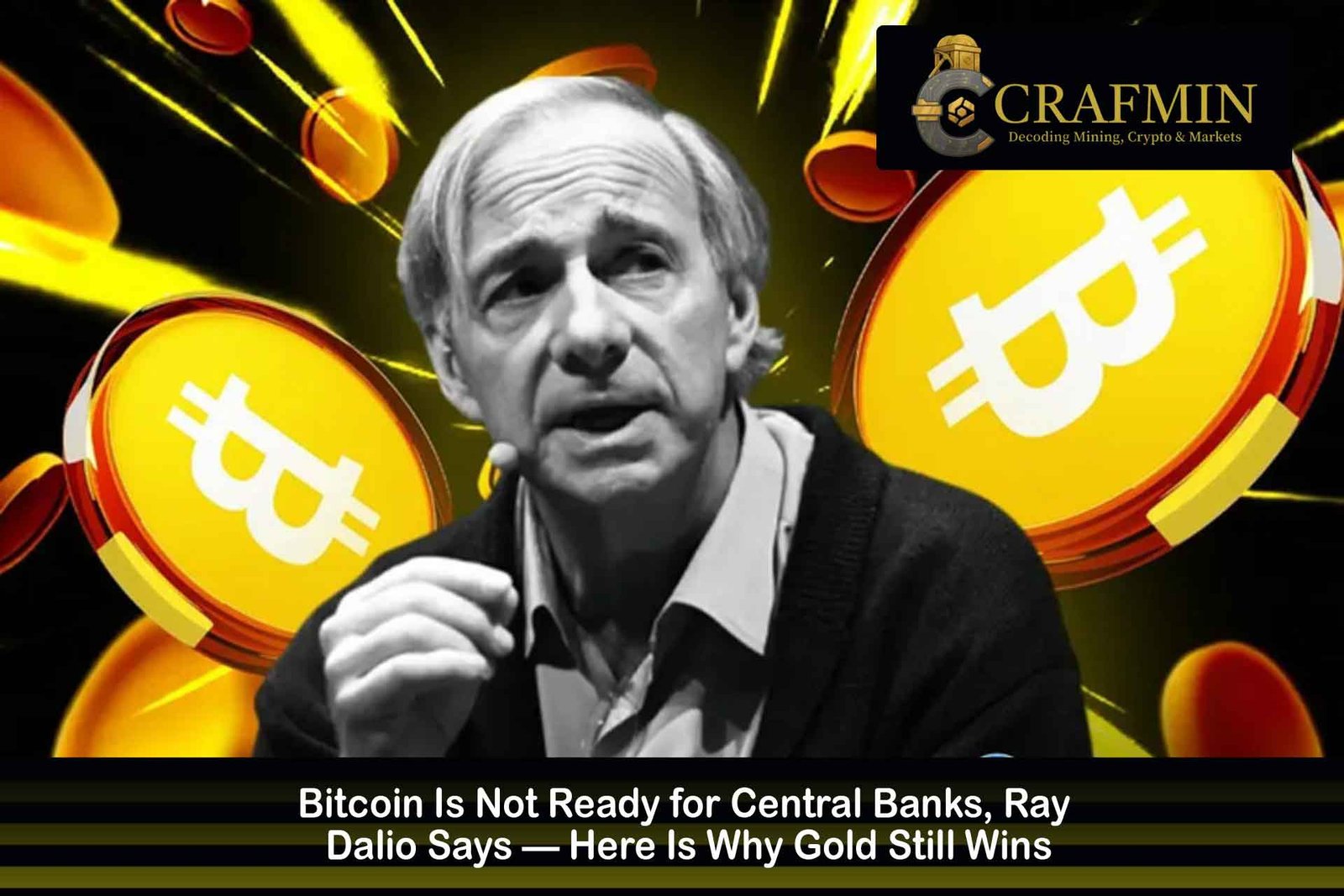
Ray Dalio, the man behind Bridgewater Associates, came out strongly against Bitcoin as a workable reserve asset for central banks. His remarks appeared in an X post dated May 11, 2026, and quickly drew attention across financial and crypto circles.
While Bitcoin gets a lot of attention, it hasn’t played the safe-haven role many expected. In my view, there are a few reasons why.
First, Bitcoin lacks privacy. Transactions can be monitored and potentially controlled, which is why central banks aren’t looking to hold it.… pic.twitter.com/j78NJdvrOw
— Ray Dalio (@RayDalio) May 11, 2026
Bridgewater sits among the largest hedge funds in the world, overseeing north of $120 billion in assets. That standing gives Dalio’s market commentary a reach that few investors can match. His latest Bitcoin criticism follows a pattern of skepticism he has voiced over recent years.
Dalio Points to Bitcoin’s Transparency as a Core Problem
At the heart of Dalio’s argument sits Bitcoin’s public ledger. Unlike traditional reserve assets, Bitcoin records each transaction openly, making the data accessible to virtually anyone. Sovereign institutions, he reasoned, cannot operate comfortably under that kind of exposure.
“Bitcoin lacks privacy. Transactions can be monitored and potentially controlled, which is why central banks aren’t looking to hold it,” Dalio wrote on X. Governments managing national reserves need a level of financial discretion that a fully open system simply cannot provide.
Anyone with internet access can plug a Bitcoin wallet address into a block explorer and pull up its complete transaction record. Wallet addresses do not carry names, but analytics firms have repeatedly shown they can link on-chain activity back to real-world entities. That capability alone, Dalio suggested, is enough to keep central banks at a distance.
Central Banks Already Have Gold, Dalio Says
Dalio pointed out that central banks already have access to a politically neutral, time-tested reserve asset. Gold has occupied that role for centuries, and Dalio questioned the practical reason for moving away from it. Bitcoin, in his view, has not offered a compelling enough alternative.
Gold sits on sovereign balance sheets across the globe and functions independently of any digital infrastructure. Its track record stretches back far longer than any modern financial instrument. Those qualities, Dalio argued, translate into a kind of institutional trust that Bitcoin has yet to build.
The Bitcoin-versus-gold conversation has grown louder throughout 2026. Bitcoin’s market cap has climbed past $1.6 trillion, a figure that sounds large until it sits next to gold’s roughly $33 trillion valuation. That gap tells much of the story on its own.
Bitcoin’s Correlation With Tech Stocks Draws Concern
Dalio widened his critique beyond privacy, turning to how Bitcoin actually behaves when markets come under pressure. His observation was straightforward: Bitcoin tends to track technology stocks rather than move independently. That behavior disqualifies it from safe-haven status in his framework.
Portfolios under stress tend to see Bitcoin liquidated early. Investors reach for it as a source of quick liquidity rather than treating it as a stable anchor. That response pattern is characteristic of risk assets, not the kind of instrument a central bank would lean on during a crisis.
TradingView data backed up the correlation argument. Over a 90-day window, Bitcoin and the Nasdaq carried a correlation coefficient of 0.89, producing an R² of 0.79. Put plainly, roughly 79 percent of Bitcoin’s price movement during that stretch mirrored what the Nasdaq was doing.
Bitcoin Reserve Asset Debate: Market Size Remains a Key Obstacle
Dalio rounded out his case by pointing to sheer scale. Bitcoin’s market remains relatively thin compared to gold, making it more susceptible to price swings and concentrated influence. For an asset meant to anchor national balance sheets, that kind of volatility is a serious drawback.
Gold has worked its way into the foundations of the global financial system over a very long time. Central banks treat it as a core strategic holding, not a speculative position. Bitcoin has attracted growing institutional money, but it has not broken into that foundational tier.
Bitwise CIO Matt Hougan took a measured position on Dalio’s size argument. He acknowledged the concern has merit, but noted it is already factored into why Bitcoin trades at a fraction of gold’s valuation. Institutional investors betting on Bitcoin’s future, Hougan said, are essentially pricing in the expectation that these gaps will close.
Michael Saylor Pushes Back on Dalio’s Position
Michael Saylor, co-founder of Strategy, wasted little time firing back at Dalio on X. Where Dalio sees transparency as a liability, Saylor frames it as Bitcoin’s greatest institutional selling point. The two landed on opposite ends of the same argument.
“Since we adopted the Bitcoin Standard on Aug. 10, 2020, Bitcoin has outperformed gold with a higher Sharpe ratio,” Saylor wrote.
He described gold as analog capital and Bitcoin as digital capital, arguing that the open ledger builds trust rather than undermining it. Global collateral, in his reading, benefits from verifiability.
MICHAEL SAYLOR PUSHES BACK ON RAY DALIO BITCOIN CRITICISM
Ray Dalio (@RayDalio) says Bitcoin $BTC has failed to behave like a true safe haven asset.
The Bridgewater founder pointed to Bitcoin’s correlation with tech stocks during market stress.
Dalio also raised concerns… pic.twitter.com/xxpeA4WvMl
— BSCN (@BSCNews) May 12, 2026
Strategy holds more Bitcoin than any other publicly listed company. Saylor’s pushback reflected a broader tension playing out between institutional crypto advocates and the old-guard macro investment community.
Industry Analysts Offer Measured Responses to the Bitcoin Reserve Debate
Matthew Sigel, who leads digital assets research at VanEck, framed the debate in generational terms. He acknowledged that both gold and Bitcoin have legitimate roles as hard assets, just from different financial eras. “Ultimately, this is a debate between the monetary architecture of the last century and the one emerging in this one,” Sigel said.
Hougan echoed a similar sentiment, stopping short of calling Dalio wrong. The risks are real, he argued, but they are also already embedded in how the market prices Bitcoin relative to gold. Structural concerns do not disappear, but markets tend to anticipate them.
Earlier this year at Consensus Hong Kong, analysts flagged the same privacy tension from a different angle. They suggested that meaningful institutional adoption of blockchain technology would likely require significant advances in transaction privacy, particularly for moves involving large sums.
Dalio Holds Bitcoin Despite His Skepticism
For all his public reservations, Dalio has not walked away from Bitcoin personally. He has disclosed a roughly one percent Bitcoin allocation within his own portfolio. He positions that holding as a macro hedge rather than a vote of confidence in Bitcoin’s reserve credentials.
That distinction matters. Ray Dalio is not arguing that Bitcoin has no value. His argument is more specific: the asset’s current design keeps it out of the central bank reserve conversation. Those are two very different claims.
As recently as August 2025, Dalio was still recommending modest crypto allocations to investors. That context makes his May 2026 remarks a targeted critique of Bitcoin’s institutional role, not a wholesale dismissal of digital assets.
What the Bitcoin Reserve Debate Means for Markets
Bitcoin was changing hands at around $80,614 when Ray Dalio published his post. The price had climbed steadily from a February low of $61,000, recovering ground lost after January’s peak of $126,000. Traders were watching closely to see whether bulls could push past the 200-day EMA resistance sitting near $82,000.
Ray Dalio’s statement did not trigger an immediate market reaction. It did, however, add fresh fuel to a debate that is only growing more consequential as governments around the world begin forming digital asset policies. The question of whether Bitcoin belongs on a central bank balance sheet is moving from theoretical to practical.
The broader argument now runs along a clear fault line: traditional macro thinking on one side, digital asset theory on the other. Neither camp shows signs of backing down. How this plays out will likely rest on a combination of regulation, technological development, and how institutional attitudes continue to shift in the coming years.
Also Read: Australia Plans to Scrap 50% Crypto Tax Discount in Major CGT Reform
FAQS
Q1. Why did Ray Dalio reject Bitcoin as a reserve asset?
A1. Dalio cited Bitcoin’s transparent blockchain, high correlation with tech stocks, and small market size compared to gold.
Q2. Does Ray Dalio own any Bitcoin?
A2. Yes. He holds roughly a one percent allocation as a macro hedge, not as an endorsement of Bitcoin’s reserve credentials.
Q3. What did Michael Saylor say in response?
A3. Saylor argued that Bitcoin’s transparency is a strength, not a flaw, and that Bitcoin has outperformed gold since 2020.
Q4. How does Bitcoin’s market size compare to gold?
A4. Bitcoin’s market cap sits at around $1.6 trillion. Gold’s stands at approximately $33 trillion.
Q5. What do analysts say about Bitcoin’s reserve potential?
A5. Analysts are mixed. Most agree stronger privacy features and broader institutional adoption will shape Bitcoin’s long-term reserve case.
Disclaimer
The content on Crafmin.com is for informational purposes only and does not constitute financial, investment, or legal advice. All views attributed to third parties are their own and do not represent Crafmin.com’s position. Cryptocurrency markets carry significant risk, and readers should conduct independent research and consult a qualified financial advisor before making any financial decisions. Crafmin.com bears no liability for any loss or damages arising from reliance on information published on this site.