On-chain investigator ZachXBT connected the RAVE token crash to a broader pattern of coordinated market manipulation across the 2026 crypto market.
RAVE Token Records a Near-Total Loss in Under 24 Hours
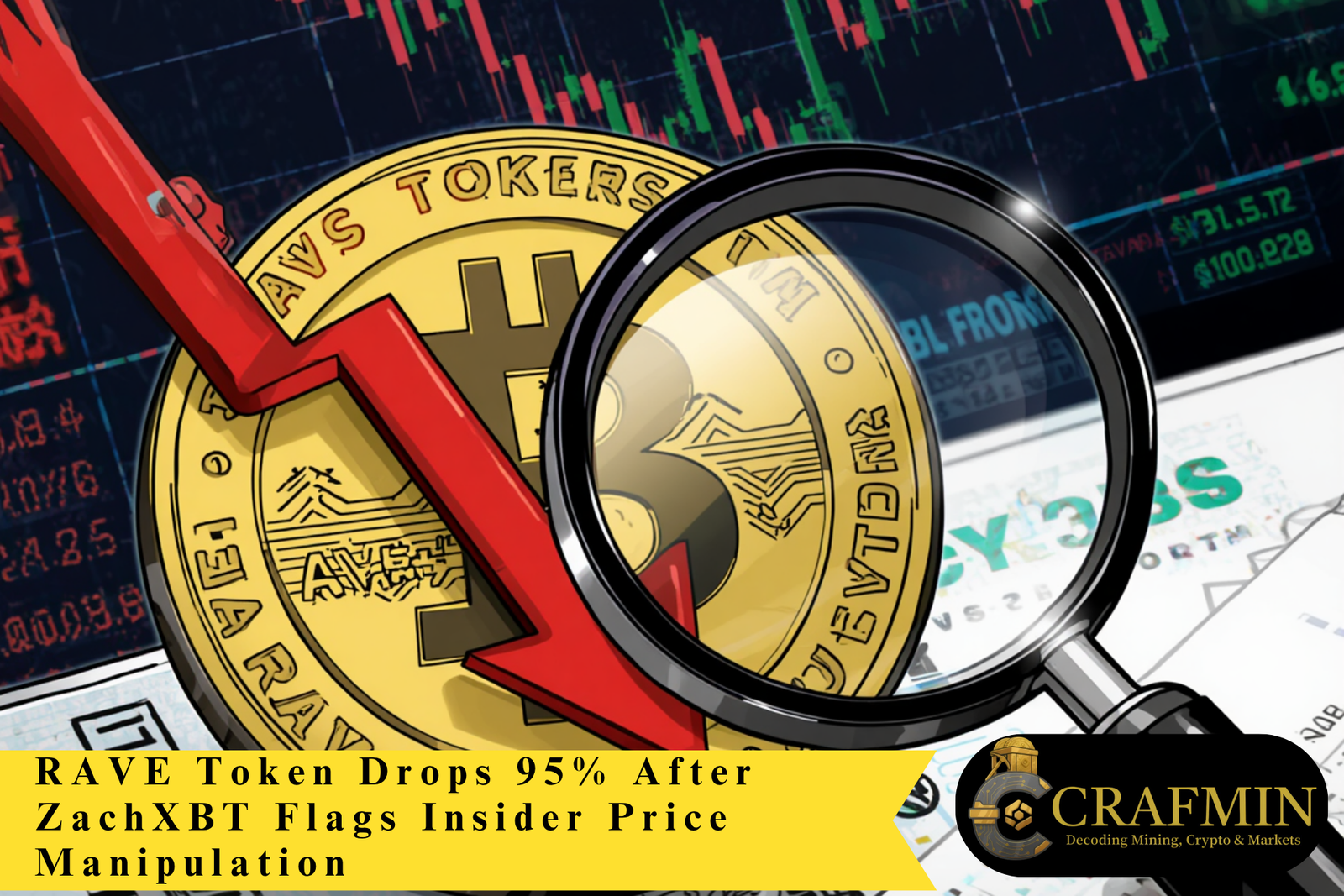
The RAVE token fell nearly 95% of its value within a single day. It dropped from an all-time high of $26 to below $1, wiping out billions in market capitalisation. The collapse came after on-chain investigator ZachXBT accused insiders of running a coordinated pump-and-dump scheme across three major exchanges.
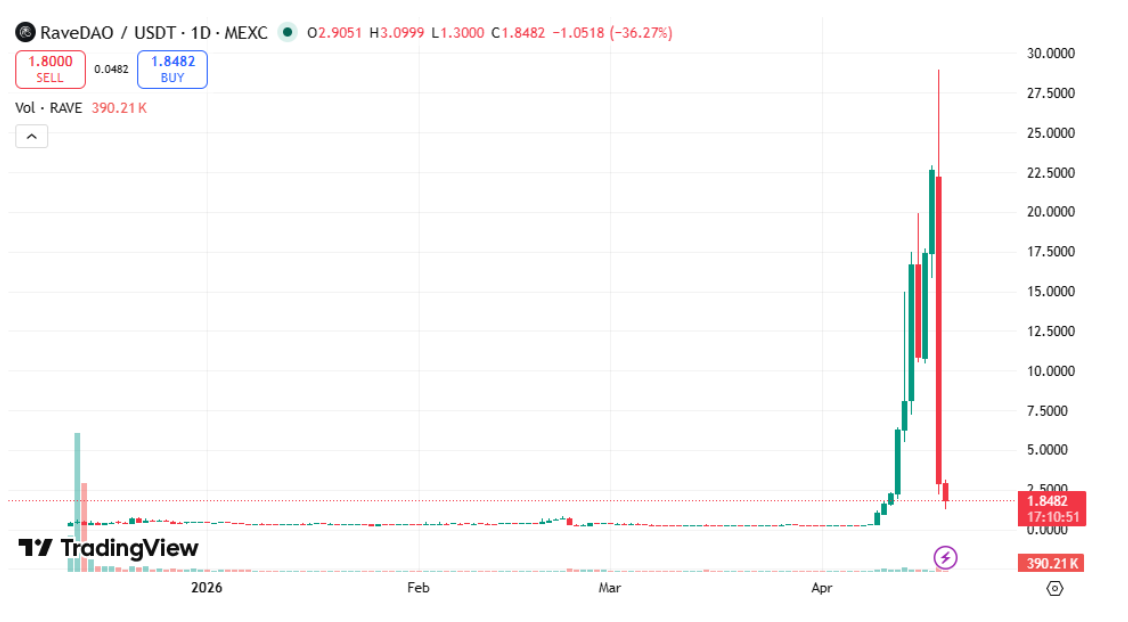 RAVE token price chart showing a steep decline of nearly 95% within 24 hours. [MEXC]
The reversal moved fast. Traders who entered during the rally faced near-total losses within hours. Binance and Bitget launched formal investigations shortly after ZachXBT’s post reached the public.
The incident quickly became one of the most discussed market events of April 2026. It raised questions about how oversight operates on centralised exchanges when token supply concentrations reach extreme levels.
RaveDAO Token Climbs Over 10,000% Before the Crash
RaveDAO is a decentralised autonomous organisation centred on music events. RAVE is its native token. It launched in December 2025 on Binance Alpha with a total supply of one billion tokens. For weeks, it traded near $0.25 with little attention.
That changed sharply in April 2026. The token climbed from $0.25 to $27.33 in nine days, a rise of roughly 10,800%. At its peak, RaveDAO’s market cap briefly touched $6.7 billion. It briefly ranked alongside established assets like Litecoin and Avalanche.
Heavy retail participation drove trading volumes higher across multiple platforms. Significant derivatives activity built up alongside the spot rally. That combination set the stage for large-scale liquidations once the price reversed.
On-Chain Data Reveals Unusual Wallet Movements Before the Rally
The token’s price surge did not occur in a vacuum. Wallets linked to the token’s deployer moved 18.58 million RAVE to Bitget before the price increase began. Those same wallets then withdrew 29.78 million RAVE during the rally itself. No public announcement accompanied either transaction.
At the time of the surge, only 24 to 25% of the one billion total RAVE tokens were in active circulation. The team held an estimated 75% in locked or team-controlled wallets. Roughly 90% of the total supply sat across just three multi-signature wallets tied to the RaveDAO team.
That level of concentration gives a small number of holders direct control over the available supply. It reduces the amount of external buying needed to move the price significantly in either direction.
ZachXBT Publishes Findings and Names Three Exchanges
On April 18, ZachXBT published his investigation on X. He named Binance, Bitget, and Gate directly. “Pump and dump activity for $RAVE originated on @bitget @binance @Gate,” he wrote. He called on Binance co-founder Yi He and Bitget CEO Gracy Chen to “do better and launch an internal investigation, offboarding the responsible actors.”
https://x.com/zachxbt/status/2045820638355693683
ZachXBT had contacted RaveDAO co-founder Yemu Xu on April 13 and 14 before going public. He received no reply. He identified nine wallet addresses connected to the initial token distribution. Together, those addresses controlled approximately 95% of RAVE’s total supply.
In his April 18 summary post, ZachXBT highlighted a telling figure. $6 billion in market cap had been erased on just $52 million in 24-hour liquidations. He described that ratio as pointing to “a manipulated and unsustainable valuation.” He offered $10,000 of his own funds as a whistleblower bounty, later raising it to $25,000 himself. The bounty remains open.
Binance, Bitget, and Gate Each Acknowledge the Allegations
All three exchanges responded publicly to ZachXBT’s call to action. Bitget CEO Gracy Chen replied first. She wrote: “Thanks for highlighting! We’ve started investigating RAVEUSD.” Binance confirmed it had launched an internal review. Gate issued its own public acknowledgement later that day.
ZachXBT welcomed the responses but raised a pointed concern. “While it’s good the exchanges responded, I find it unlikely this activity wasn’t spotted internally before I raised it publicly,” he stated. None of the three platforms has published formal findings as of the time of writing.
RaveDAO Denies Any Role in the Price Movement
RaveDAO responded publicly on April 18. The team stated: “RaveDAO team is not engaged in, nor responsible for, recent price action. We take transparency seriously and remain humbled by the attention, but our focus is on the mission: bringing mass adoption to Web3 through live events.”
The project outlined the steps it plans to take going forward. It confirmed plans to sell a portion of its unlocked tokens to fund operations, including hiring, marketing, and growth. The team also said it is reviewing performance-triggered and price-triggered lock mechanisms. Those tools would aim to better align team incentives with long-term ecosystem health.
Exchanges have not issued any formal response to RaveDAO’s statement. Investigations remain ongoing across all three platforms.
ZachXBT Flags Six Additional Tokens for Suspicious Price Action
ZachXBT stated clearly that RAVE is not a standalone case. In his summary post, he wrote that RAVE is “not the only token with manipulation we have seen on major centralised exchanges, it’s just the most blatant.” He named SIREN, MYX, COAI, M, PIPPIN, and RIVER as tokens showing highly questionable price action in 2026.
Each flagged token shares a similar profile. Low circulating supply, concentrated insider holdings, and undisclosed wallet activity ahead of price surges appear across all the cases ZachXBT identified. Retail participants tend to enter positions near the peak and absorb the steepest losses when selling begins.
The pattern points to a structural problem rather than a series of isolated incidents. ZachXBT confirmed he plans to continue investigating similar token movements and identifying the parties behind them.
Coordinated Social Media Activity Amplifies Token Manipulation
Token price manipulation has extended beyond on-chain activity. In March 2026, ZachXBT identified a coordinated network of X accounts that fabricated geopolitical breaking news stories. The accounts used that content to build large followings. They then directed those followers toward fraudulent tokens.
6/ Ten X accounts in the cluster all promoted the pump and dump crypto scam $ORAMAMA on February 22, 2026 before never posting about it again.
Onchain evidence suggests the scheme profited six figures.
I suspect they are farming engagement once again for another upcoming scam. pic.twitter.com/yTmDtIDvEd
— ZachXBT (@zachxbt) March 23, 2026
Ten accounts within that network promoted the pump-and-dump token $ORAMAMA on February 22, 2026. After promoting the token, all ten accounts went silent. On-chain evidence pointed to six-figure profits from the scheme. ZachXBT flagged the network publicly, after which X suspended all 16 accounts he had identified.
The combination of on-chain supply manipulation and coordinated social media promotion creates a two-layer approach to driving retail demand into low-liquidity tokens. ZachXBT said he intends to keep investigating these structures.
RAVE Collapse Puts Exchange Oversight Under Scrutiny
The RAVE case has drawn attention to how centralised exchanges monitor unusual token activity. ZachXBT noted that the volume-to-market-cap ratio and the wallet concentration data were visible on-chain throughout the rally. His central question was why no exchange acted before he raised the issue publicly.
ZachXBT confirmed he held no position in RAVE at any point. He also noted he could not predict how or when exchanges would respond to his post. With investigations at Binance, Bitget, and Gate still open, the crypto market will be watching how each platform handles its findings and what action, if any, follows.
FAQS
Q1. Why did the RAVE token drop 95%?
A1. The RAVE token crashed after on-chain investigator ZachXBT alleged that insiders controlled most of the token supply and may have orchestrated a pump-and-dump scheme across major exchanges.
Q2. What did ZachXBT find in the RAVE investigation?
A2. ZachXBT reported that wallets linked to the token’s deployer and team-controlled addresses held approximately 95% of the total supply, with suspicious transfers occurring before and during the price surge.
Q3. Which exchanges are investigating the RAVE token collapse?
A3. Binance, Bitget, and Gate publicly acknowledged the allegations and confirmed that internal investigations into the RAVE token’s trading activity are underway.
Q4. Did RaveDAO accept responsibility for the price crash?
A4. No. RaveDAO denied any involvement in the recent price action and stated that its focus remains on expanding Web3 adoption through live music events.
Q5. Is RAVE the only token flagged for suspicious activity?
A5. No. ZachXBT said RAVE is not an isolated case and also flagged other tokens, including SIREN, MYX, COAI, M, PIPPIN, and RIVER, for similar suspicious price patterns.
Disclaimer
This article is published by Crafmin for informational purposes only and does not constitute financial, investment, or legal advice. The content is based on publicly available information, including on-chain data and official statements, at the time of writing. Allegations referenced in this report remain under investigation, and no regulatory findings have been confirmed. Readers should conduct independent research and seek advice from a licensed professional before making any financial decisions. Crafmin and its authors disclaim any liability for losses incurred from reliance on this information.