

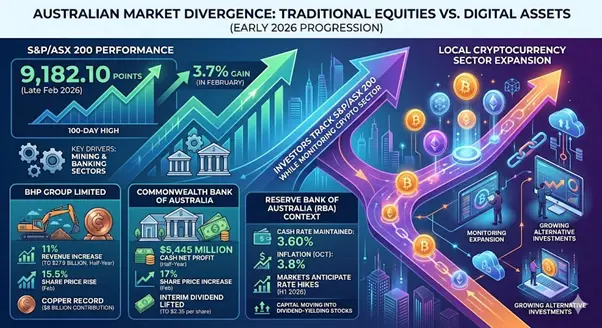
Markets in Australia display a divergence between traditional equities and digital assets as 2026 progresses. Investors track the S&P/ASX 200 Index while monitoring the expansion of the local cryptocurrency sector.
The S&P/ASX 200 Index reached 9,182.10 points in late February. This figure represents a 100-day high for the benchmark. The index gained 3.7% during the month of February. Mining and banking sectors drove these results.
BHP Group Limited reported a revenue increase of 11% to $27.9 billion in its half-year results. The share price for the company rose 15.5% in February. Copper operations contributed $8 billion to earnings. This amount marked a record for the segment.
Commonwealth Bank of Australia recorded a cash net profit of $5,445 million for the half-year period. The share price for the bank increased 17% during the month. The institution lifted its interim dividend to 2.35 dollars per share.
The Reserve Bank of Australia maintains the cash rate at 3.60%. Inflation reached 3.8% in October. Markets anticipate rate hikes in the first half of 2026. These conditions influence the movement of capital into dividend-yielding stocks.
Australian market divergence
Regulation and Market Values in the Digital Sector
The cryptocurrency market in Australia reached a valuation of $91.43 billion in 2025. Projections indicate a compound annual growth rate of 10.70% through 2035. The total value might reach $252.68 billion by that date.
Data shows that 32.5% of people in Australia own digital assets. Bitcoin maintains a price near $69,172. Ethereum and other tokens also attract attention from retail participants. Institutional engagement supports the demand for these assets.
The Australian Securities and Investments Commission (ASIC) set a deadline for June 30, 2026. Providers of digital assets must obtain an Australian Financial Services Licence by this date. This requirement aims to close gaps in the regulatory perimeter.
ASIC Chair Joe Longo stated, “ASIC has secured record penalties in response to serious misconduct, and is protecting Australians and safeguarding trust and confidence in Australia’s financial system.” The regulator secured $349.8 million in civil penalties during the second half of 2025.
Blockchain technology finds applications in banking and supply chain management. Large enterprises represent 60% of the blockchain market in Australia. Cloud deployment accounts for 48% of the infrastructure.
- Hardware leads the revenue segments for crypto technology.
- Software displays the fastest growth rate in the sector.
- Banking and financial services hold 15% of the blockchain vertical.
- New South Wales and the Australian Capital Territory account for 30% of market activity.

Australian cryptocurrency market
Comparison of Investment Risks and Asset Structures
Equities on the ASX represent ownership in businesses that generate earnings. Stocks like Wesfarmers and Woolworths provide dividends to shareholders. Woolworths shares rose 13% after an earnings report in February.
Cryptocurrencies do not produce earnings or cash flows. These assets rely on market sentiment and supply dynamics. Investors treat digital tokens as a hedge against inflation. Some participants view Bitcoin as a store of value similar to gold.
The Australian Taxation Office requires records of transaction dates and values. Data-matching programs identify non-compliance among investors. Tax applies to mining rewards and staking income as ordinary income.
Also Read: Why Licensed Financial Data on Blockchain Matters for Institutional Finance
Gold sectors in Australia saw prices reach $5,161.28. Mining companies like Lynas Rare Earths recorded share price increases of 27% in February. Commodities remain sensitive to interest rate expectations and geopolitical events.
Exchange Traded Funds (ETFs) now offer exposure to Bitcoin and Ethereum on the ASX. These products allow participation without the use of private keys. Investors use these tools to diversify portfolios.
Investment strategies in Australia continue to balance growth and stability. The stock market offers historical averages of 8% to 9% returns. Crypto assets provide potential for higher returns but include higher volatility.
