

Artificial intelligence is transforming the way we think, remember, and navigate our daily lives. While tools like ChatGPT and Claude Opus 4 boost productivity, they also affect mental sharpness. A recent study by the MIT Media Lab raises significant concerns about the impact of AI on brain activity.
Long Division and Lost Mental Skills
Once upon a time, long division was a mental milestone every student worked to conquer. Today, few of us could complete it unaided — the calculator has taken over that role. From maths to spelling, screen time and brain function are now closely linked in concerning ways. Outsourcing simple tasks has chipped away at our everyday cognitive capabilities. AI content consumption compounds the problem by dulling mental stimulation even further.
Also Read: Silver Price Forecast: XAG/USD Dips as Market Sentiment Shifts
What the MIT EEG Study Revealed
MIT strapped EEG caps on students and gave them essay-writing tasks using AI, Google, or nothing. Those who wrote without tools showed strong neural activity — their brains were working hard. Using Google led to reduced activation, but relying on ChatGPT caused the brain to dim drastically. The AI-assisted group produced the least memorable and most generic writing. Shockingly, 78 per cent couldn’t recall their AI-written content minutes later.
This highlights a worrying trend: artificial intelligence’s cognitive impact suppresses mental effort.
Cognitive Offloading and Brain Inertia
The study called it “cognitive offloading” — the tendency to let AI think so we don’t have to. When ChatGPT was taken away, participants’ brain activity remained low, showing lingering mental laziness. This means the more we use AI for basic tasks, the harder it becomes to think independently. Just like muscle atrophy from inactivity, our mental faculties weaken with underuse. AI addiction symptoms now include reduced memory, lack of focus, and difficulty problem-solving.
Universities and the Workforce at Risk
This mental decline is already visible in education and beyond. Universities report rising cases of AI-assisted cheating, with thousands of students relying entirely on generative tools for assignments. Professors struggle to detect AI use, making degrees less meaningful. In the workforce, the consequences could be worse—new graduates may appear qualified but lack the critical thinking skills their jobs demand. As digital overstimulation grows, both institutions and individuals face the risk of becoming cognitively unfit for a rapidly evolving world.
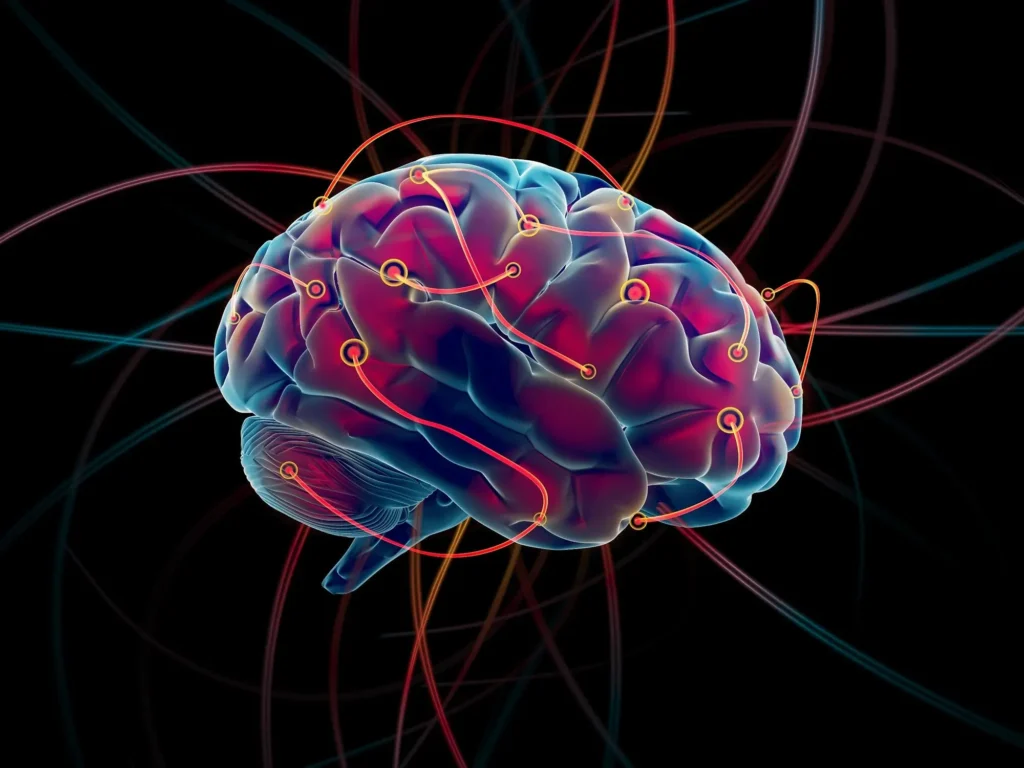
Visualising neural activity: a digital brain model shows AI interaction with cognitive functions.
Universities and the Vanishing Value of Learning
An increasing number of university students are relying on AI to assist with their coursework and dissertations. In 2023, UK universities recorded 7,000 confirmed cases of AI-assisted cheating, double the previous year. Some students even defended AI-generated theses in person without reading them. As detection tools fail, degrees are losing credibility, and real learning is diminishing. Graduates may enter the workforce underqualified, despite holding formal credentials. This crisis reveals how AI affects brain development and is already altering the value.
AI is Also Changing Work and Creativity
Writers, historians, and creatives are witnessing AI’s rising dominance in content generation.
In minutes, Claude Opus 4 can produce detailed, citation-rich essays indistinguishable from expert human writing. Why learn history if an AI can write it better and faster? This raises long-term questions about the need to learn and retain knowledge at all. Digital overstimulation from AI-generated content contributes to reduced motivation to think or explore deeply.
AI merges with human brainpower in a futuristic concept.
Society’s Sleepwalk Toward Mental Decay
We are not just using AI — we are adapting to it by mentally withdrawing from effort. AI content consumption encourages passive interaction, where facts are retrieved, not reasoned through. This quiet shift threatens long-term mental resilience, curiosity, and intellectual independence. Without attention, AI addiction symptoms may soon become societal norms, not isolated effects. AI tools can help — but relying on them fully risks losing our cognitive edge.
