A crypto trader executing what appeared to be a straightforward token purchase on the Aave protocol lost almost the entire value of a US$50 million transaction on 13 Mar 2026. The incident has drawn widespread attention to what is Aave slippage, how decentralised finance interfaces communicate risk, and why large orders executed without proper precautions can result in catastrophic outcomes.
 Figure 1: AAVE token price chart illustrating market volatility around the Aave decentralised finance protocol [Courtesy: CryptoNews]
The trader attempted to buy AAVE, the governance token of the Aave protocol, using US$50 million worth of USDT stablecoin through the Aave trading interface. Despite the platform issuing a clear warning about extraordinary slippage and requiring manual confirmation of the risk, the user proceeded with the swap on a mobile device.
A US$50 Million Trade That Returned Almost Nothing
One Confirmed Swap, 324 Tokens, and a Near-Total Loss
The transaction ultimately returned just 324 AAVE tokens. At a market price of US$111.52 per token at the time, those tokens were worth approximately US$36,100, implying an effective loss of approximately US$49.96 million relative to the original order size.
The result was not a hack, a protocol failure, or a technical glitch. The infrastructure functioned exactly as designed.
Aave founder Stani Kulechov confirmed via X that the trade was routed through CoW Swap, a decentralised trade-routing system integrated into the Aave interface.
He stated the transaction could not be moved forward without the user explicitly accepting the risk. Despite that, the final outcome was clearly far from optimal.
Aave Slippage and Price Impact Are Not the Same Thing
The Quote Already Showed a 99% Price Impact Before the Swap Began
Understanding what is Aave slippage is essential to understanding how this loss occurred. Slippage refers to the difference between the expected price of a trade and the price at which it is actually executed, typically caused by market movement between the time an order is placed and when it is filled.
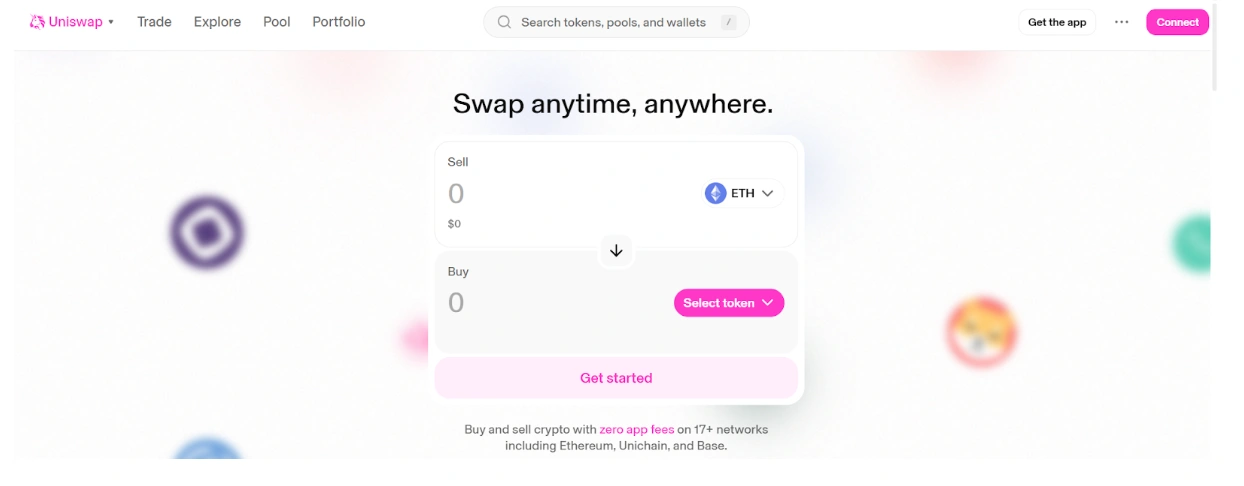 Figure 2: Uniswap decentralised exchange interface used for swapping crypto tokens across liquidity pools [Courtesy: Uniswap]
Aave engineer Martin Grabina clarified that the core issue in this case was not slippage at all. The real problem was price impact. The trade quote presented to the user before confirmation already showed that US$50 million in USDT would return fewer than 140 AAVE tokens before fees and slippage adjustments.
The order was so large relative to available liquidity in the pool that executing it in a single transaction consumed and moved the market against the buyer severely. The user accepted a quote with approximately 99% price impact before the swap even began.
A Platform Warning Ignored on a Mobile Device
The Aave interface issued an explicit warning flagging extraordinary slippage before the transaction was confirmed. The platform required the user to manually check a confirmation box acknowledging the risk.
The trader then proceeded on a mobile device, confirming the swap despite the warning. This sequence of events sits at the centre of the broader debate about how crypto traders lose money in decentralised finance environments.
Unlike centralised exchanges, decentralised protocols are permissionless by design, meaning they cannot block a user from executing a trade that the platform itself has flagged as carrying extreme risk.
Aave Commits to a US$600,000 Refund and Stronger Safeguards
Kulechov confirmed that the Aave team will attempt to contact the trader and return approximately US$600,000 in protocol fees generated by the transaction.
While the gesture acknowledges the severity of the outcome, it represents a small fraction of the total loss and does not address the underlying mechanics that allowed the trade to proceed.
Kulechov also stated the incident highlights how decentralised finance platforms may need stronger guardrails to help prevent extreme user errors while preserving permissionless access.
He confirmed the Aave team is investigating ways to improve these safeguards going forward, a commitment that reflects growing pressure on DeFi protocols to balance openness with user protection.
Large DeFi Swaps Carry Risks That Most Retail Traders Underestimate
The incident illustrates one of the clearest examples of how crypto traders lose money when executing large orders through decentralised exchanges without proper preparation. Professional traders routinely split large orders across multiple smaller transactions to reduce market impact.
Many also use execution algorithms specifically designed to minimise price impact and prevent US$50 million losses in crypto by distributing volume over time or across multiple liquidity sources.
 Figure 3: Investor reacting to sharp cryptocurrency market movements during a volatile trading session [Courtesy: Freepik]
Executing a single US$50 million market order through a single liquidity pool, particularly for a token with limited depth, is an approach that professional desks would not use, regardless of the warning systems in place.
The lesson from this event is not that Aave’s interface failed, but that the tools available to prevent losses of this scale are only effective when traders understand what they are confirming.
Industry Outlook
Decentralised finance continues to attract record user numbers in 2026, with Aave recently reporting all-time highs in active users as capital shifts toward DeFi lending platforms.
As the sector scales, incidents like this one are expected to accelerate debate about the appropriate level of friction that permissionless protocols should introduce for high-risk transactions.
Regulators in the United Kingdom, European Union, and Australia have each flagged DeFi user protection as an area of active policy development this year.
Future Direction and Impact
The US$50 million Aave slippage event is likely to become a reference case in DeFi interface design discussions. Kulechov’s acknowledgement that stronger guardrails are needed signals that even the most established protocols recognise the tension between permissionless access and user safety.
For retail and institutional participants alike, understanding what is Aave slippage and the distinction between slippage and price impact is now a baseline requirement before executing any large on-chain transaction.
The question of how crypto traders lose money in DeFi environments will remain relevant as the sector grows. Protocols that can implement meaningful safeguards without compromising decentralisation will be better positioned to attract institutional capital and retain retail trust over the long term.
ALSO READ: Millionaire Crypto Trader Profits Explained: Best Strategies in 2026
Frequently Asked Questions
Q1. What is Aave slippage, and how did it cause this loss?
Ans. Aave slippage refers to the difference between the expected and actual execution price of a trade. In this case, the core issue was price impact rather than slippage. The order was so large relative to available liquidity that the trade quote already showed a 99% price impact before execution, meaning US$50 million in USDT was always going to return very few AAVE tokens.
Q2. How did the trader lose nearly US$50 million on a single swap?
Ans. The trader executed a single US$50 million market order to buy AAVE tokens on the Aave interface. The order size far exceeded available liquidity, resulting in extreme price impact. Despite the platform issuing an explicit extraordinary slippage warning and requiring manual confirmation, the user proceeded with the swap.
Q3. How do you prevent losses of this scale in crypto from price impact?
Ans. Professional traders split large orders into smaller increments, use algorithmic execution tools, and assess pool liquidity before placing any single large transaction. Never executing a trade that shows a significant price impact in the pre-confirmation quote is the most direct way to avoid losses of this scale.
Q4. How do crypto traders lose money in DeFi environments?
Ans. The most common causes include misunderstanding price impact versus slippage, executing large orders in low-liquidity pools, ignoring platform warnings, and using mobile interfaces for high-value transactions without fully reviewing the quoted terms.
Q5. What is Aave doing after the US$50 million loss incident?
Ans. Aave founder Stani Kulechov confirmed the team will refund approximately US$600,000 in protocol fees to the affected trader and is investigating improved safeguards to reduce the risk of similar incidents while preserving permissionless access to the protocol.
Disclaimer This article is intended for informational purposes only and does not constitute financial or investment advice. All content is based on publicly available information sourced from Yahoo Finance, published 13 Mar 2026. Investing in cryptocurrencies and participating in decentralised finance protocols involves significant risk, including the possible loss of principal. Readers should conduct their own research and seek independent financial advice before making any investment decisions. Colitco does not hold any position in the assets or companies mentioned.
Sources
Yahoo Finance, 13 Mar 2026 — Crypto Trader Loses Nearly $50M in Aave Trade, Protocol Offers $600K Fee Refund
https://finance.yahoo.com/news/crypto-trader-loses-nearly-50m-224905098.html