

Bitcoin climbed past $81,000 on Friday morning before sellers pushed the valuation back toward $78,000. The United States Bureau of Labour Statistics released employment figures showing 162,000 payroll additions for August. This outcome tripled the consensus forecast of 53,000 positions and triggered liquidations across cryptocurrency brokerages.
Traders dumped digital assets within minutes of the publication, which erased gains from the previous day. Bitcoin lost $1,600 in three minutes as algorithms executed sell orders. The token traded at $78,649 by the afternoon as sell volume dominated order books.
Ether, Solana, and XRP mirrored the decline with price drops. Investors sold spot exchange-traded funds and shifted capital into cash equivalents. The retreat halted momentum that had carried the token above $82,000 twenty-four hours earlier.
Selling pressure intensified as derivatives markets experienced margin calls. Exchanges terminated contracts for traders holding leveraged long positions throughout the morning. The asset stabilised near $78,000 as buyers absorbed market orders.
Why the Market Moved
Price fluctuations at the $80,000 benchmark influence retirement balances, treasury holdings, and individual portfolios. Movements around this threshold signal shifts in investor confidence and liquidity across capital markets.
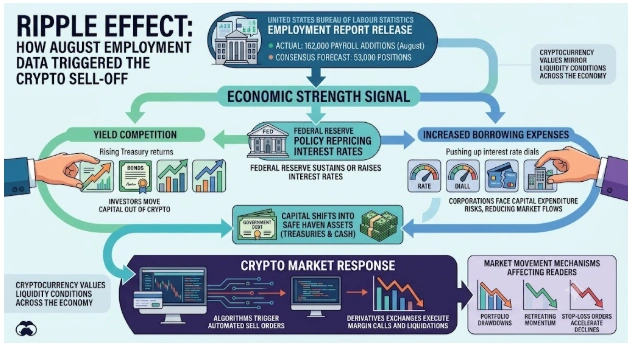 The Macroeconomic Mechanism
Market movements affect readers through specific mechanisms:
- Yield competition: Employment growth enables the Federal Reserve to sustain interest rate targets above 5 per cent. Rising Treasury returns prompt investors to move capital out of cryptocurrency and into government debt.
- Borrowing expenses: Sustained interest rates increase credit costs for consumers and corporations. Businesses face capital expenditures that reduce money flows into speculative markets.
- Portfolio drawdowns: Price breaks below support levels trigger stop-loss orders across exchanges. These sell programmes accelerate equity declines for retail market participants.
Cryptocurrency values mirror liquidity conditions across the economy. Readers holding exposure to technology equities and digital tokens face price stagnation when central banks delay rate reductions. Tracking employment releases provides readers with advance warning of volatility across asset classes.
Individual traders reassess risk parameters when macroeconomic indicators override technical chart patterns. Understanding the connection between labour statistics and token valuations protects capital during policy transitions.
Who Made Waves
Multiple institutions, regulators, and industry sectors shaped the market response on Friday. Federal Reserve officials shifted investor expectations during the days preceding the release. The subsequent labour data upended market positioning across Wall Street and cryptocurrency desks.
Key participants in this event include:
- Central bankers: Federal Reserve Governor Christopher Waller supported holding rates steady during a speech on Thursday. Governor Michael Barr emphasised labour market stability, which set the stage for Friday’s policy repricing.
- Asset management firms: Spot exchange-traded fund issuers, including BlackRock and Fidelity, attracted $730 million in inflows on 3 September. Fund managers witnessed buying activity diminish as bond yields climbed following the payroll print.
- Derivatives exchanges: Venues including Binance, OKX, and Bybit processed over $450 million in contract liquidations. Market makers removed liquidity from order books to mitigate execution risk during the price drop.
Corporate treasury holders also felt the consequences of the price drop. MicroStrategy holds over 226,000 Bitcoin on its balance sheet, linking company equity directly to spot valuations. Corporate executives track these price levels to maintain debt covenants and shareholder value.
Bitcoin mining firms, including Marathon Digital and CleanSpark, recorded equity losses during the session. These companies require token prices above production costs to fund operations following the April reward halving.
A Global Chain Reaction
The market reaction occurred across electronic trading venues in North America, Europe, and Asia. Spot exchanges in New York and London registered transaction spikes as traders exited positions. Decentralised finance protocols on the Ethereum network also recorded automated liquidations.
Physical trading desks inside banks observed capital transfers into United States debt markets. In Chicago, traders at the CME Group executed futures contracts tied to policy rates and digital assets. Settlement networks in Switzerland and Singapore processed fiat transfers as investors sought cash preservation.
The sell-off transcended geography because digital asset markets operate continuously worldwide. Global liquidity pools transmitted price drops from United States data releases into Asian trading hours.
The Friday Flash Crash
The price reversal occurred on Friday, 4 September 2026. The Bureau of Labour Statistics released the employment report at 8:30 Eastern Daylight Time. The descent below $80,000 commenced within sixty seconds of the data release.
The pullback reversed an upward trajectory that began on Thursday, 3 September. Buyers had accumulated tokens throughout Thursday afternoon following policy remarks from Christopher Waller. That momentum pushed Bitcoin to an intraday peak of $82,240 before Friday’s opening bell.
The drop to $78,649 concluded by 12:00 Eastern Time on Friday. Trading volume remained subdued as market participants closed positions until Monday. The market now awaits the Consumer Price Index announcement scheduled for 11 September.
The Federal Open Market Committee will convene its rate-setting meeting on 15 and 16 September. Market volatility will persist throughout this two-week window.
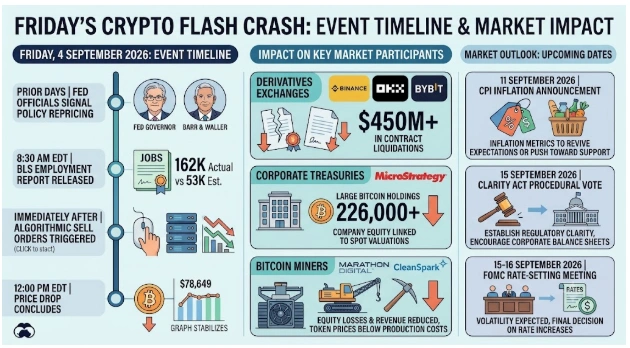 Event Timeline, Impacted Participants, and Key Dates
What Happens Next
The downturn began when the payroll addition of 162,000 jobs unsettled interest rate assumptions. CME FedWatch data showed the probability of a September interest rate increase jumping to 58 per cent from 49 per cent. Two-year Treasury yields rose to 4.40 per cent and ten-year yields reached 4.80 per cent, which drew capital away from risk assets.
Algorithmic trading engines detected the yield spike and initiated sell routines across Bitcoin spot and futures markets. Derivatives platforms liquidated $456 million in leveraged bets, which deepened the drop toward $78,000. Market makers widened spreads to manage inventory risk, accelerating the price descent.
The trajectory for the remainder of the year depends on inflation metrics and regulatory milestones. A moderation in inflation on 11 September could revive expectations for an interest rate pause and allow Bitcoin to retest $80,000. Higher inflation numbers would reinforce interest rate increases and push Bitcoin toward technical support at $74,000.
Political factors will also influence market performance during the fourth quarter. The United States Senate scheduled a procedural vote on the CLARITY Act for 15 September. Legislative passage would establish regulatory jurisdictions and encourage corporate balance sheets to accumulate digital assets.
Exchange-traded fund flows will serve as the indicator for a year-end recovery past $80,000. Asset managers must absorb miner selling and maintain daily inflows exceeding $300 million. Continued capital deployment from wealth funds and corporations will determine if Bitcoin reaches new valuations before January.
Macroeconomic policy and interest rate expectations retain control over digital asset prices in the current cycle. Bitcoin will breach $80,000 once macroeconomic indicators confirm interest rate pauses and liquidity expansion.
Disclaimer: This article is for informational purposes only and does not constitute financial, investment, legal, or professional advice. Cryptocurrency investments involve a high degree of risk, including the potential loss of principal. Market data, economic projections, and analysis mentioned herein are based on current information and may be subject to change. Always conduct your own research and consult with a qualified financial advisor before making any investment decisions.