

Every time a tanker goes dark in the Persian Gulf or OPEC announces a production cut, the damage spreads further than the petrol bowser. It moves through inflation forecasts, share markets, and now, with growing consistency, the Bitcoin price in Australia.
With roughly 20% of global oil supply passing through the Strait of Hormuz, a single military escalation can send Brent crude surging within hours. When that happens, fund managers do not sit around. They move money. Fast. And crypto is very much in the firing line.
Why Oil and Bitcoin Are More Connected Than You’d Think
They look like completely different beasts. One is a physical commodity pumped from the earth. The other runs on code. Yet Australian investors who dismiss any connection between oil and Bitcoin are missing something important.
Rising oil prices feed directly into inflation. Fuel costs push up the price of everything — freight, manufacturing, groceries. As that pressure builds, investors start hunting for places to park money that won’t get eaten alive by a depreciating dollar. Bitcoin gets drawn into that conversation more and more.
But here is where it gets complicated. Expensive oil also drags on economic growth. Businesses spend more just to keep the lights on and the trucks moving, leaving less cash available for investment. That tightens liquidity across markets, and tighter liquidity tends to punish assets that people consider speculative — Bitcoin included.
So the same oil shock can theoretically push Bitcoin in opposite directions depending on which economic force takes hold first.
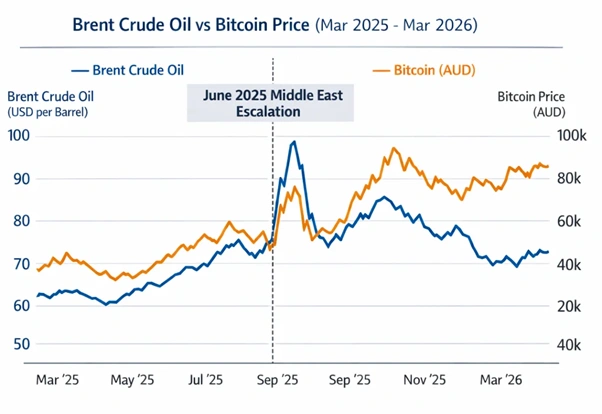
Brent Crude vs Bitcoin Price (AUD) – 12-month overlay showing how energy price shocks coincide with crypto market movements.
Bitcoin Sold Off Like a Tech Stock, Not a Safe Haven
When things go wrong in the world, Bitcoin does not behave the way its biggest believers say it should. Not immediately, anyway.
Take June 2025. The day Israel struck Iran, Bitcoin dropped to USD 103,639. Most major altcoins fell between 4 and 10%. Meanwhile, WTI crude jumped more than 13% to USD 77 per barrel and gold added USD 24 in the same session.
That tells you exactly what was happening. Big money was pulling out of anything considered risky, and Bitcoin sat firmly in that pile. Gold got the safe-haven flows. Bitcoin got sold.
During that period, Bitcoin was tracking the S&P 500 at an 82% correlation — both moving in the same direction for a full month. That kind of lockstep movement with US equities should make any Australian crypto holder think twice about treating Bitcoin as a hedge during geopolitical stress.
How an Oil Shock Actually Plays Out Across Markets
The first move is usually the same every time. Oil surges, panic sets in, investors dump anything volatile, and Bitcoin takes a hit along with growth stocks and high-yield bonds.
What happens next depends on how long the disruption lasts.
A short-lived spike, say a brief military incident that de-escalates within days, tends to see crypto recover fairly quickly once the dust settles and buyers come back in. Markets forget faster than people do.
A deeper, sustained energy crisis is a different story altogether. Prolonged high oil prices can tip developed economies into stagflation, weaken the currencies of energy-importing nations, and cause real stress in credit markets.
When fiat currency starts losing value, and central banks are stuck between raising rates and protecting growth, some investors do start looking harder at assets outside the banking system. That is when Bitcoin’s original pitch – a fixed-supply currency free from government control – gets a genuine hearing.
There Is a Mining Cost Problem Nobody Talks About Enough
When oil goes up, so does the electricity bill. And running Bitcoin mining hardware is not cheap under any circumstances.
As energy costs climb, mining becomes less profitable. Some operators shut down rigs or scale back. That drops the network’s total hash rate — the combined computing power securing the blockchain. Fewer miners mean slower transaction verification and, if the decline is severe enough, questions about network security.
It works in reverse too. When energy prices fall, mining becomes more attractive again. More operators come online, competition increases, and the network gets stronger. Energy pricing is not just an operating cost for miners. It is a barometer for Bitcoin’s underlying health.
What Australian Crypto Investors Should Actually Do With This Information
According to the Independent Reserve Cryptocurrency Index, 31% of Australian adults own or have previously owned crypto. Bitcoin is the most popular holding, sitting in the portfolio of 70% of local crypto investors. That is a large group of people with real exposure whenever oil markets start moving.
Here is what actually matters for cryptocurrency news Australia followers, keeping one eye on energy prices:
- Short-term: When oil spikes hard, Bitcoin will likely fall alongside tech stocks and risk assets. Institutions sell first and ask questions later
- Medium-term: If inflation sticks around and central banks struggle to contain it, the narrative around Bitcoin as a monetary hedge picks up steam again
- Long-term: A sustained energy crisis that weakens major currencies is exactly the scenario where holding something outside the traditional financial system starts making sense to a broader audience
None of this is a reason to buy or sell. But it is a reason to pay attention to oil markets, even if you have never spent a dollar on crude.

The energy-crypto connection – oil market volatility increasingly feeds into digital asset pricing through inflation, liquidity, and investor sentiment channels.
Frequently Asked Questions
Q: Does oil price directly affect Bitcoin?
A: Not through a direct mechanism, no. The link runs through inflation, investor confidence, mining costs, and how willing fund managers are to hold risky assets. When oil jumps sharply, the knock-on effect usually hits Bitcoin within hours.
Q: Is Bitcoin a reliable hedge during an oil price shock?
A: The short answer is no, not immediately. Bitcoin tends to get sold off during sudden market stress, much like a tech stock. If high inflation persists over months, the argument for Bitcoin as a hedge gets stronger – but that takes time to play out.
Q: How do rising oil prices affect crypto mining in Australia?
A: Electricity costs rise with energy prices, which squeezes mining margins. Some operators reduce activity or shut rigs down entirely. That weakens the network’s computing power and can slow transaction processing.
Q: What signals should Australian crypto investors watch when oil markets move? A: A: The most important question is whether the disruption looks temporary or long-lasting. A one-week oil spike is very different from a six-month energy crisis. The former might cause a short Bitcoin dip and recovery. The latter could reshape the macro argument for digital assets entirely.
