
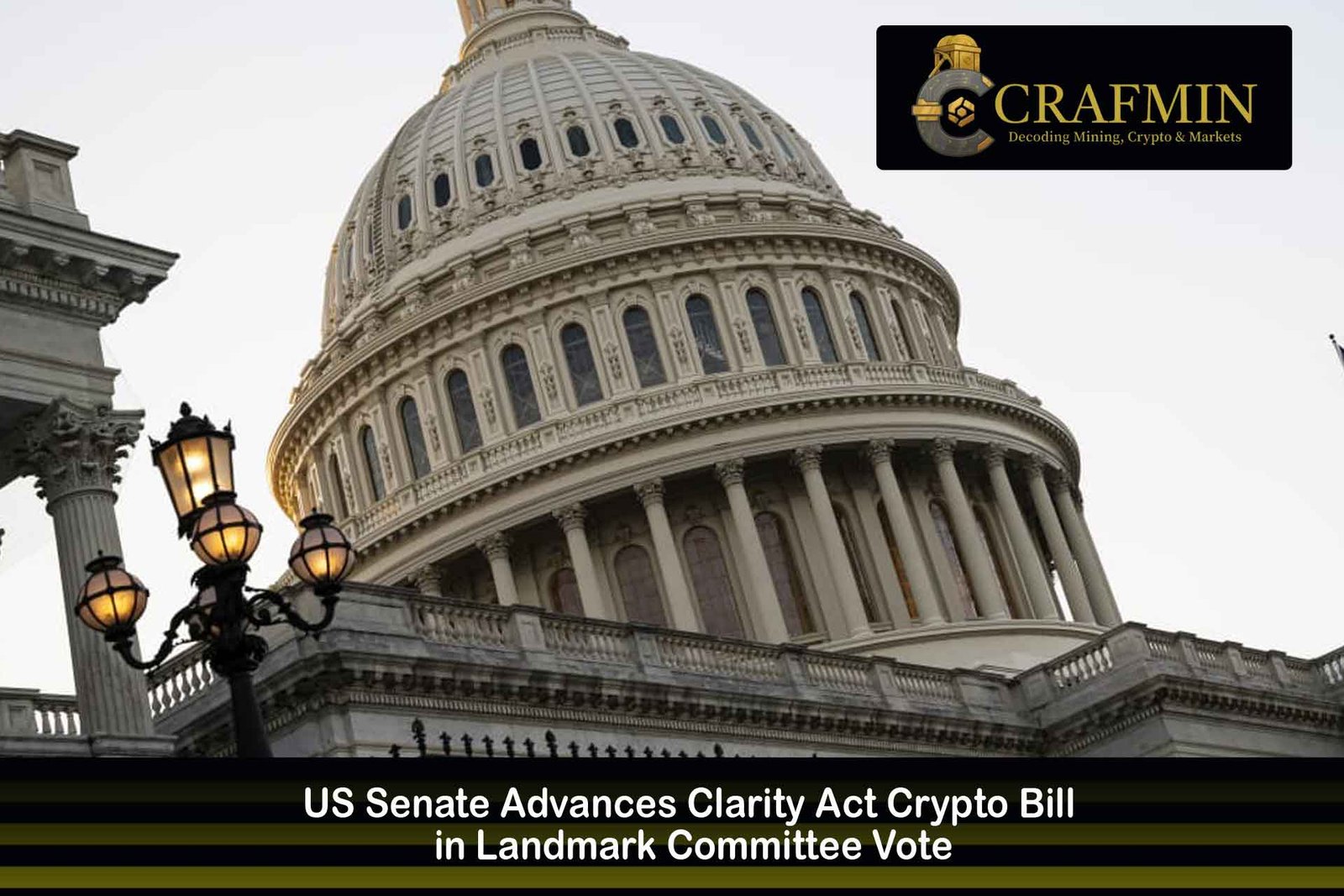
The United States Senate Banking Committee voted 15 to 9 on 14 May 2026, for the Clarity Act to move forward, and now ready for floor votes in the US Senate. That meant the result was bipartisan, with at least two Democrats voting with Republicans.

Figure 1: The US Senate advances the Clarity Act crypto bill aimed at defining digital asset regulation [Courtesy: Financial Express]
U.S. Bill The first bill whose introduction to the cryptocurrency industry is intended with regulation through them is called the Clarity Act. The vote is not the end. That said, this is a huge step in the progress of an industry that has sat in regulatory limbo for years.
What the Clarity Act Vote Means for the Crypto Market
The United States crypto laws update 2026 marks a turning point in how Washington views digital assets. Crypto companies in the US have walked a path of uncertainty for years, wondering whether their products were securities overseen by the Securities and Exchange Commission or commodities governed by the Commodity Futures Trading Commission or neither.
The legislation seeks to generate a broad-based regulatory environment regarding digital assets. This categorises assets into either securities or commodities, draws bright lines where the SEC and the CFTC can regulate digital assets. In simple words, it is that clarity that the industry has been looking for.
Why the Bipartisan Vote Matters
The crypto industry’s primary goal in Washington took a major step forward with the passage of the Digital Asset Market Clarity Act through a Senate committee process that had been held up for four months. The fact that two Democrats voted in favour is what makes this vote notable, not just the result itself.
Where all Republicans on the panel and Democratic Sens. Ruben Gallego of Arizona and Angela Alsobrooks of Maryland supported it. Many more Democrats had indicated beforehand that they might support the bill on the Senate floor if some concerns were addressed. The bill requires 60 votes for Senate floor passage. This bare minimum of 53 Republicans in the Senate only means seven or more Democrats must have support for a few votes.
What the Clarity Act Actually Does
The Clarity Act crypto explained goes beyond just labelling assets. The bill establishes protections for digital asset market participants and creates new pathways for companies to raise capital from retail investors.
Under a provision called Regulation Crypto, a company can raise the greater of US$50 million per calendar year for a period of four years, or 10% of the total dollar value of ancillary assets outstanding. An ancillary asset originator may not raise more than US$200 million in gross proceeds in reliance on Regulation Crypto.
The Stablecoin Yield Question
One of the most contested provisions in the bill involved how stablecoin yields are treated. The most contentious provision found a compromise between the banking and crypto industries on stablecoin yields. The banking sector had pushed hard on this point.

Figure 2: Stablecoins remain a central focus of debate in the Clarity Act discussions [Courtesy: Brookings Institution]
The vote was described in a joint statement from the American Bankers Association and several other large banking groups as the first key milestone in furthering an effective regulatory framework for digital assets. The groups pushed for more robust guardrails on yield-bearing stablecoins, saying this could suck deposits away from banks and harm local lending without them.
Who Supported It, Who Pushed Back, and Why
The bill was passed in a push from Tim Scott, Senate Banking Committee Chairman. During the hearing, Scott said that he hoped to retain innovation in the United states by streamlining outdated rules and adding that protecting national security is about closing doors exploited by criminals, terrorists and hostile regimes.
Not everyone agreed. Warren was the most outspoken critic of the bill at the hearing. The crypto bill she claimed is not cooked and predicted worries about national security, consumer protections and government officials reaping financial rewards from the crypto industry.
Law enforcement groups also pushed back. Law enforcement groups said the legislation does not do enough to prevent illicit financial transactions through digital assets, and argued it would make it harder to catch bad actors.
The Ethics Provision Debate
The biggest unresolved issue going into the Senate floor vote is the ethics provision. This would restrict senior government officials from profiting through business ties to the crypto industry. White House adviser Patrick Witt told an audience at Consensus Miami 2026 that an effort targeting the president specifically would not be tolerated, describing a negotiating posture of rules that apply across the board, from the president all the way down to a brand new intern on Capitol Hill.
Cody Carbone, who heads the Digital Chamber, told reporters that striking a deal on the ethics provision is likely necessary to reach the 60-vote threshold needed on the Senate floor. He said the vote likely needs to happen before August.
Why the Clarity Act Matters for the US Crypto Market
The why Clarity Act matters for crypto market USA question comes down to one word: certainty. Companies building in the digital asset space have struggled to make long-term capital allocation decisions without knowing which regulator will govern them or under what rules.
Blockchain Association CEO Summer Mersinger described the committee vote as a defining moment, saying durable and lasting digital asset policy must be built on a bipartisan foundation, and the vote reflects growing recognition across party lines that the United States needs clear rules of the road.

Figure 3: The Clarity Act could reshape how cryptocurrencies are regulated across US markets [Courtesy: CryptoSlate]
Jesse Knutson, head of operations at Bitfinex Securities, called the vote a real shift, saying that for years, tokenisation had been treated as a future promise when the market had already moved ahead of the policy framework.
The crypto industry’s political spending is also part of this story. Significant capital was directed into the 2024 US election cycle through political action committees supporting pro-crypto candidates. Those candidates are now in office and voting on this legislation.
What Happens Next With the US Crypto Laws Update 2026
The next step in this process is to reconcile two different versions of the legislation. Both the Senate Banking Committee and the Senate Agriculture Committee have put their own draft together. All have to be bundled and get a floor vote in the full Senate as one package.
The full Senate would have to pass the bill, which then requires passage by the House of Representatives that approved another version last year. And lawmakers in the House have also previously attempted to attach a ban on central bank digital currency (CBDC) to multiple pieces of unrelated legislation, which could open up room for another amendment regarding CBDCs against funding bills.
One of the Democrats who voted in favour, Senator Alsobrooks, expressed that her vote was a commitment to continued work rather than final approval.
Industry Outlook
The US crypto laws update 2026 arrives at a time when the global digital asset industry is pushing for regulatory legitimacy. Stablecoins, tokenised securities, and decentralised finance platforms are growing in adoption, and institutional participants have consistently cited regulatory uncertainty as the primary barrier to deeper involvement.
A federal framework in the United States, the world’s largest capital market, would set a precedent that other jurisdictions are likely to reference. The Clarity Act crypto explained at its simplest is a bet by Washington that regulated digital asset markets serve the national economic interest better than an unregulated or ambiguously regulated one.
Future Direction and Impact on the Crypto Industry
The why Clarity Act matters for crypto market USA becomes clearest when you look at what follows a potential passage. Companies that have delayed US market entry due to regulatory ambiguity would have a defined legal environment to operate in. SEC and CFTC jurisdictional disputes over specific assets would have a legislative resolution rather than a court-by-court answer.
The following three to four weeks are anticipated to be gruelling on both the Senate Banking Committee and Agriculture Committee fronts while negotiators try to clear away final differences.
The ethics provision, stablecoin yield guardrails and law enforcement gaps are three areas where negotiators could end up running into obstacles as they work to line up just enough voting support to allow a bipartisan bill on the Senate floor prior to the August recess.
ALSO READ: What Triggered SUI Token’s 13% Surge as Institutional Staking Reduced Supply?
Frequently Asked Questions
Q1. What is the Clarity Act?
Ans. The Digital Asset Market Clarity Act is a US federal legislation that creates rules around digital assets, determining which are subject to supervision by the SEC and if they belong in the hands of the CFTC.
Q2. What does the Clarity Act crypto explained mean for investors?
Ans. This means tighter regulations on buying, selling and holding digital assets in the U.S. over time, with existing disclosure requirements well defined and greater investor protection built into it.
Q3. What was the committee vote tally?
Ans. On May 14, 2026 the Senate Banking Committee voted 15-9 to advance the Clarity Act to the Senate floor, with all Republicans on the panel joined by two Democrats.
Q4. Why Clarity Act is important for Crypto Market USA?
Ans. The world Capital market is the biggest in the U.S. It will set the benchmark for international crypto enterprise and other jurisdictions to model a domestic regulatory regime here.
Disclaimer
This article does not cover financial or investment advice and is intended only for informational purposes. All content is based upon publicly available information. All legislative outcomes cited are subject to amendment. At the time of publication, Crafmin did not have any positions in the companies, organisations or assets referenced in this article.
Sources
https://www.cnbc.com/2026/05/14/clarity-act-congress-crypto-senate.html
https://www.banking.senate.gov/imo/media/doc/section-by-section.pdf
https://bpi.com/banking-trades-statement-on-senate-banking-committee-vote-to-advance-clarity-act
https://www.congress.gov/bill/119th-congress/house-bill/3633/text