
Morgan Stanley Enters Bitcoin ETF Race With Record-Low Fee
Morgan Stanley submitted its amended S-1 to the SEC on March 27, 2026. The document named the fund the Morgan Stanley Bitcoin Trust. It will trade under the ticker MSBT on NYSE Arca. The expense ratio is 0.14% per year.
JUST IN: Morgan Stanley files for the Morgan Stanley Bitcoin Trust, a spot Bitcoin ETF designed to track the CoinDesk Bitcoin Benchmark 4PM NY rate.
The fund would hold bitcoin directly with custody by BNY Mellon and Coinbase Custody and list on NYSE Arca. The ETF will not use… pic.twitter.com/eyaMdofnXi
— Bitcoin News (@BitcoinNewsCom) March 4, 2026
That is one basis point below the current market low. The fund will hold actual Bitcoin. It will not use futures contracts. A pricing benchmark from multiple major exchanges will be used to track Bitcoin’s value.
The New York Stock Exchange confirmed that NYSE Arca has issued a listing notice for MSBT. This step shows that structural and compliance requirements have been met. The bank has already put $1 million into the fund as seed capital.
Coinbase will act as custodian and prime broker. BNY Mellon will handle cash administration. Jane Street, Virtu, and Macquarie are listed as authorised participants.
| Fund | Expense Ratio | Annual Cost / $10K |
| Morgan Stanley MSBT (Lowest on market) | 0.14% | $14.00 |
| Grayscale Bitcoin Mini Trust (BTC) | 0.15% | $15.00 |
| BlackRock iShares Bitcoin Trust (IBIT) | 0.25% | $25.00 |
| Fidelity Wise Origin Bitcoin Fund (FBTC) | 0.25% | $25.00 |
The highlighted row shows the proposed MSBT fee. Annual cost is based on a $10,000 investment.
What Makes the MSBT Filing a Market-Shifting Moment
Morgan Stanley is not just a new face in the Bitcoin ETF space. It is a shift in strategy. The bank was previously a distributor. It sold other firms’ Bitcoin ETFs to its clients. Now it wants to be a manufacturer.
It will keep the fee revenue for itself. This puts pressure on every existing fund. Spot Bitcoin ETFs all hold the same asset. They all track the same price. The only real difference between them is cost. Morgan Stanley has used that gap to make a statement.
ETF analyst Nate Geraci summed it up on X: “Game on.” His point was simple. When the cheapest fund gets even cheaper, the whole market has to respond.
Advisors can move a client from one ETF to another with a single trade. They keep the same exposure but lower the annual fee. That ease of switching is what makes this filing so significant.
Looks like forthcoming Morgan Stanley Bitcoin ETF is undercutting competition on fees…
Will only charge 0.14%.
Current lowest cost spot btc ETF is Grayscale Bitcoin Mini Trust ETF at 0.15%.
Game on. pic.twitter.com/zJVK5k51ZD
— Nate Geraci (@NateGeraci) March 27, 2026
Key Institutions Powering the MSBT Bitcoin ETF Ecosystem
Primary Stakeholders
Morgan Stanley is one of the biggest investment banks in the United States. Its headquarters are at 1585 Broadway in New York City. The firm trades on the NYSE under the ticker MS. It manages around $9 trillion in client assets.
Those assets are spread across wealth management, institutional securities, and investment management. The bank reported full-year 2024 revenues of approximately $61.8 billion. Its wealth management division is one of the most powerful distribution networks in American finance.
Secondary Stakeholders
Several other institutions are key to this story. The SEC must approve the S-1 before any trading can begin. NYSE Arca has issued a listing notice, but cannot open the fund to traders without SEC clearance.
Coinbase will secure the Bitcoin holdings and act as a prime broker. It already serves the same role for BlackRock’s IBIT. BNY Mellon will manage the cash side of the fund. Authorised participants Jane Street, Virtu, and Macquarie will create and redeem fund shares to keep prices in line with Bitcoin’s actual value.
SEC Approval Timeline and What Happens Next
Geographic and Platform Context
The S-1 filing went to the SEC in Washington, D.C. on March 27, 2026. Morgan Stanley is based in New York City. The fund will list on NYSE Arca. That platform already hosts most U.S. Bitcoin ETFs. NYSE Arca handles around 20% of all U.S. equity ETF trading volume. It is the standard venue for this type of product. Once trading begins, MSBT shares will be available to any investor with a standard U.S. brokerage account.
Regional and Global Implications
The regulatory process is a U.S. matter. But the effects will reach well beyond American borders. Bitcoin trades around the clock on exchanges worldwide. Large inflows from a Morgan Stanley-backed fund will move the global BTC price.
Investors in Europe, Asia, and Australia who access U.S.-listed ETFs through international brokers will also benefit from the lower fee. Countries still developing their own Bitcoin ETP rules may look at this filing as a signal of what is coming.
When It Happened
Timeline of Key Dates
- 2018: Morgan Stanley calls Bitcoin ‘digital money’ in a published report. This was a bold stance at the time. Most major banks were still sceptical of crypto.
- January 2024: The SEC approves the first wave of U.S. spot Bitcoin ETFs. Morgan Stanley does not launch its own fund. It begins distributing BlackRock’s IBIT and Fidelity’s FBTC to clients.
- August 2024: Morgan Stanley gives its financial advisors clearance to proactively recommend spot Bitcoin ETFs. This moves the bank from passive access to active selling.
- March 27, 2026: Morgan Stanley files an amended S-1 with the SEC. The filing discloses the MSBT fund, a 0.14% fee, and a full operational setup. NYSE Arca issues a listing notice.
- March 30, 2026: Bitcoin trades at $67,552. That is up 2.42% on the day. The SEC review is ongoing. No approval date has been set.
- Expected Q2 2026: SEC is expected to reach a final decision on the S-1. If approved, shares could begin trading on NYSE Arca within days.
Historical Context
The first U.S. spot Bitcoin ETF approvals in January 2024 were a turning point. The SEC had rejected similar proposals for over a decade before clearing 11 funds at once. Those funds pulled in around $4.6 billion in net inflows during their first week of trading, according to Bloomberg Intelligence.
That made it one of the most successful ETF launches in market history. Grayscale’s GBTC started as the leader by assets. It lost ground quickly because of its 1.5% fee. Assets fell from $29 billion to roughly $10 billion as cheaper rivals took over. MSBT is entering in this second phase. Fee competition is already fierce. Distribution is now the main battleground.
How It Happened
Mechanism and Process
Morgan Stanley did not rush into this. The bank spent years building credibility in the crypto space. It started with research in 2018. It moved to distribution in 2024. Each step generated data on client demand and advisor willingness.
By the time it filed its own S-1, the operational playbook was already written by others. Custodians like Coinbase were established. Authorised participant relationships were standard. The SEC’s approval of previous Bitcoin ETFs gave the bank a clear regulatory roadmap. Filing its own product was the logical next step.
The mechanics of MSBT follow the same structure used by every other spot Bitcoin ETF in the U.S. Authorised participants deliver Bitcoin to Coinbase to create new fund shares. They send back shares to redeem them and receive Bitcoin in return.
This process keeps the ETF’s price close to Bitcoin’s actual market value. It avoids the premium and discount problems that hurt Grayscale’s original trust. BNY Mellon manages the cash flows on the other side. The $1 million seed investment from Morgan Stanley itself signals readiness to regulators and market participants alike.
Could Other Wall Street Giants Follow Morgan Stanley?
Forward-Looking Analysis
Most analysts expect the SEC to approve MSBT, given the precedent already set. If that happens, the real contest will play out inside Morgan Stanley’s own advisor network. Those 16,000 advisors previously steered clients into BlackRock and Fidelity products. Now they have a cheaper in-house option.
They also have a financial reason to prefer it. Bloomberg Intelligence analysts have pointed out that distribution relationships tend to decide ETF market share over time. Morgan Stanley’s captive advisor base is a competitive advantage that rivals cannot copy.
Bitcoin sits at $67,552 today. That is roughly 46% below its October 2025 all-time high of $126,186. That gap gives advisors a straightforward upside story to tell clients.
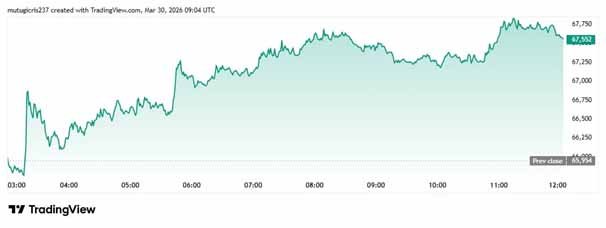
Bitcoin shows steady intraday upward momentum with higher highs and sustained buying pressure throughout the trading session. [TradingView]
The bigger question is whether other banks follow. JPMorgan Chase, Goldman Sachs, and Bank of America have all expanded their crypto services in recent years. None has filed for its own Bitcoin ETF yet.
If MSBT succeeds, that calculus changes fast. Bernstein Research analysts project that institutional Bitcoin ETF assets under management could top $200 billion by the end of 2026 if current inflow trends hold.
Risks and Counterarguments
There are real reasons to be cautious. SEC approval is not certain. The Commission has full discretion and no firm timeline. Even after launch, MSBT enters a market where BlackRock’s IBIT holds roughly $50 billion in assets and Fidelity’s FBTC has deep institutional ties. Advisors may stick with what they know.
Moving clients between funds triggers trades, potential tax events, and paperwork. That friction protects incumbents more than many analysts admit. And Bitcoin itself remains volatile.
On March 30, 2026, alone, the price ranged more than $1,795 in a single trading session. A prolonged bear market would pressure all Bitcoin ETF assets regardless of how low the fee is.
Also Read: Morgan Stanley Bitcoin ETF To Disrupt Market With Lowest Fees
Conclusion
Morgan Stanley’s MSBT filing is a clear line in the sand. The bank is moving from distributor to issuer. It is entering the market at the lowest fee available. It has the distribution network to back that up.
The SEC still needs to sign off. Bitcoin still carries its usual risks. But the direction of travel is clear. Wall Street is now competing directly over who controls Bitcoin exposure. Follow our coverage for updates on the MSBT approval process and Bitcoin ETF market developments.
FAQS
Q1. What is Morgan Stanley’s MSBT Bitcoin ETF?
A1. MSBT is a proposed spot Bitcoin ETF by Morgan Stanley that will hold actual Bitcoin and track its price using a major exchange benchmark.
Q2. What is the fee for the MSBT Bitcoin ETF?
A2. The proposed expense ratio is 0.14% per year, making it one of the lowest-fee Bitcoin ETFs in the market.
Q3. How is MSBT different from other Bitcoin ETFs?
A3. Unlike futures-based products, MSBT is a spot Bitcoin ETF and directly holds Bitcoin. It also undercuts major rivals on fees.
Q4. Who will custody the Bitcoin in MSBT?
A4. Coinbase is expected to act as the custodian and prime broker for the fund’s Bitcoin holdings.
Q5. When will MSBT start trading?
A5. MSBT still requires SEC approval. If approved, trading could begin shortly after the decision, likely in 2026.
Q6. Why is MSBT’s filing important?
A6. It signals that Morgan Stanley is moving from distributing Bitcoin ETFs to issuing its own, increasing competition in the sector.
Q7. Could MSBT affect Bitcoin’s price?
A7. Yes. If approved, inflows into the ETF could increase Bitcoin demand and influence global price movement.
Discliamer
This article is based on publicly available information regarding Morgan Stanley and the proposed MSBT Bitcoin ETF filing. It is intended for informational and news purposes only and does not represent financial, investment, or trading advice. While efforts have been made to ensure accuracy, details related to regulatory approvals, fees, and timelines may change without notice. Readers should conduct independent research or consult a qualified financial advisor before making any investment decisions. Neither Morgan Stanley nor Crafmin is responsible for any losses or damages arising from reliance on this content.