
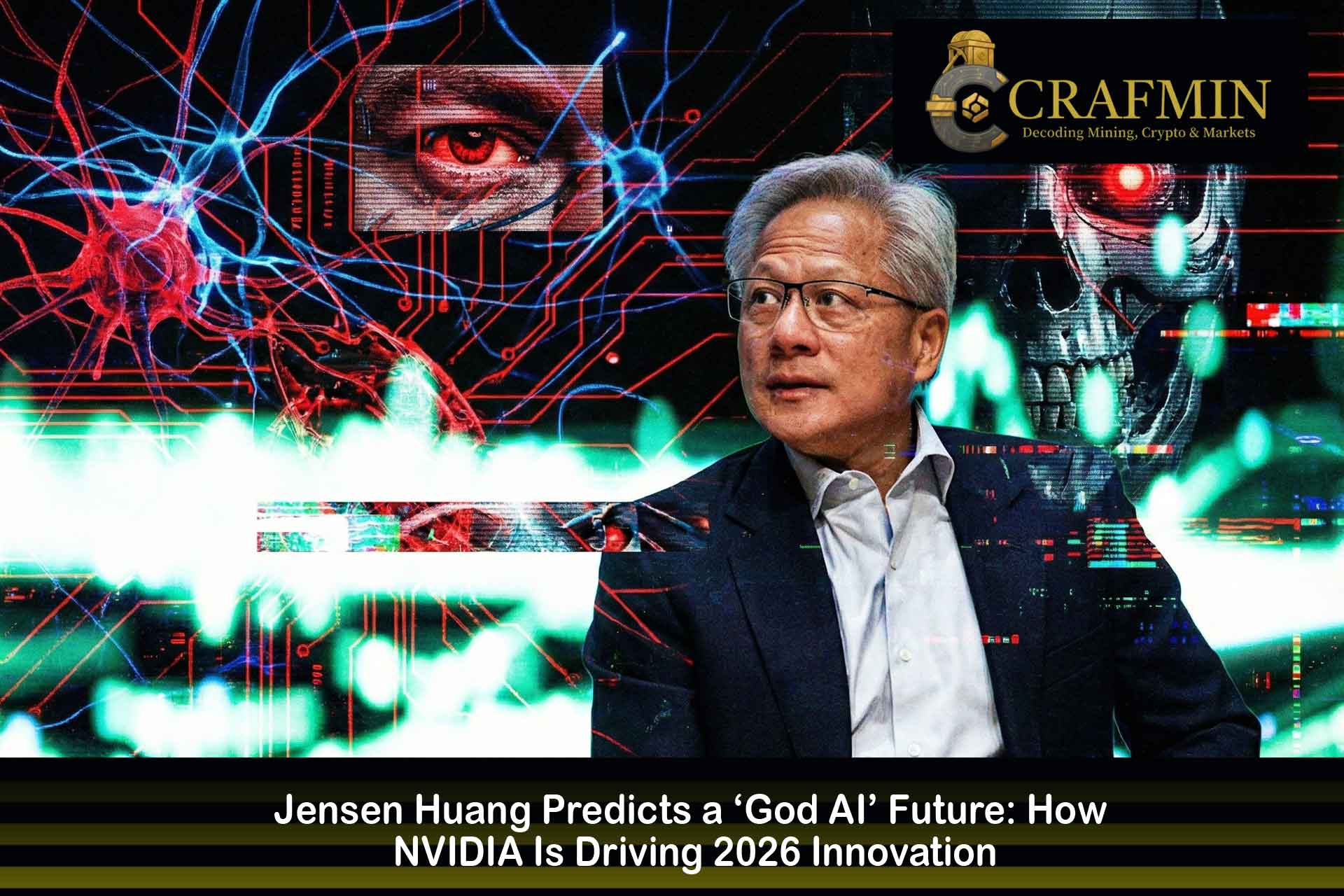
In a speech that has made news in the technology sector worldwide, the CEO of NVIDIA, Jensen Huang has caused a new debate into the future of computing by mentioning the concept of a God AI which is a computer that is so strong that it can learn language, biology, physics and other fields in a single manner. Although he emphasizes that this is a far-fetched dream, the discussion has brought closer issues of innovation, ethics, society and what is actually feasible in 2026.
This isn’t science fiction. It is an actual discussion of a real executive of one of the most powerful technology corporations in the globe, a corporation whose chip is installed in the systems which are being used by developers, scientists and businesses across the globe. And whether you are a tech expert, business executive or just somebody with an interest in reading, this story is already informing the general population on how to think in the next decade.
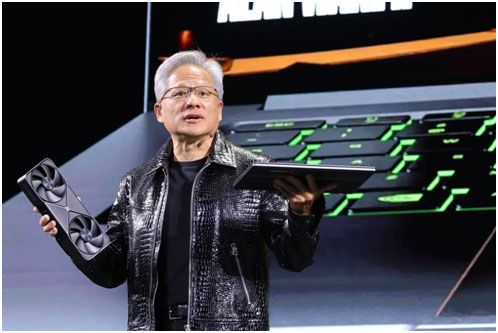
NVIDIA CEO Jensen Huang sparks debate with his vision of a ‘God AI’ shaping 2026’s tech future. (Image Source: CES)
A Controversial Headline Sparks an International Debate
In an interview that is going viral in the business, Huang cited the idea of a super-intelligent system, informally known as the so-called God AI, which would one day comprehend all language and all science. He has then added (with a caveat) at once that there is nothing of the kind to-day, and nothing of the kind that any research team is anywhere near inventing.
That two-sided attitude, of admitting possibility, but stressing the distance, is a part of what makes his remarks so interesting. On the one hand, all social platforms and technology domains are excited and, on the other hand, sceptical. The concept is inspirational to many people, a place to go. Others fear that the language is a source of hype and unrealistic expectations. It is not merely a battle of machines but of focus, values and what humanity holds dear to it in the new era of technological advancement.
Why This Matters Right Now in 2026
This argument is not going on in a vacuum. It is a time when it is fast growing the capabilities of powerful computational systems are rapidly growing. The hardware of NVIDIA is in the middle of this acceleration; their chips will be utilized in massive data processing and advanced model training. And the observations of Huang point out two things:
- Progress is advancing fast.
- The best universal intelligence is still a myth.
That is the tension of 2026, that is between breakneck development and possibility in the future. And to businesses, researchers, policymakers and daily users, this is a nuance. There is no such thing as a balanced opinion that is blindly optimistic or alarmist.
Theories of God AI: Myth or Vision?
When the majority of individuals mention God AI, they visualize a system that knows it all and has solutions to all the questions that humanity may pose. But the definition as given by Huang, which operates in terms of proficiency in complex scientific and linguistic fields, is more down-to-earth.
He says that it would be able to comprehend language all the way to the ground, solve genomes, think physics and combine information across fields. However, he also points out that this kind of power is well beyond the capabilities of modern systems. Simply put, the concept is not coming in a week, a year, or a decade down the line, at least in the present evidence of research laboratories and corporations.
Not only is the naming of God AI interesting, but also the concept of it, which is a long-term perspective of an integrated intelligence and computing.
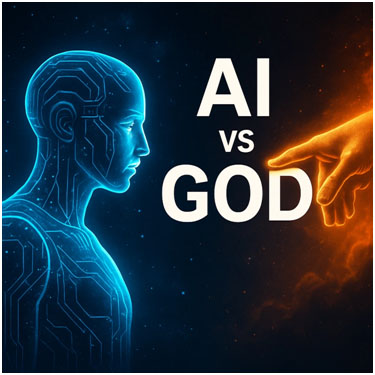
Huang envisions God AI as a system mastering language, science, and physics; far beyond today’s technology. (Image Source: Traqplan)
The Current Reality: Tools of Power, But Not All-Powerful Systems
The most developed systems of the day, which are trained on massive datasets and developed with the assistance of specialised chips, are already redefining industries. Diagnostics in healthcare are getting finer. The process of supply chains is more predictive. Multifaceted scientific models are being simulated in a more rapid manner than ever.
However, these are instruments, not philosophers. They are superior in some aspects, but not in their overall reasoning and comprehension as a human being can. It is also reminding the populace that the present is not about an imaginary future, but practical advantages when Huang discusses the possibilities of the future. This is why his opinion is particularly timely; it puts the discussion into the realm of practical realities and gives an opportunity to the imagination.
The Debate and Its Influence on Public Opinion
The manner in which the technology discourse helps to inform popular anticipations is one of the reasons why this discussion is effective. Huang himself has warned of what he terms doomer narratives, or pessimist narratives in which the future technology is depicted as dangerous or even apocalyptic. He has debunked that these will be detrimental to investment, innovation and sound policy formulation.
That’s a powerful idea. To most individuals, the trendy perception of future technology is not informed by research findings but by sensational headlines and gossip on social media. Framing is important in this respect. When leaders such as Huang discuss the visions of the future with care and aspiration, they will be able to turn the general discussion into concrete questions:
- What more should society invest in?
- What is the way we can control mighty instruments?
- What do we do to make workforces and economies ready to change fast?
In Addition to Headlines: What Experts Are Saying
Although the statements made by Huang are considered news, they are one of a series of discussions between researchers and executives in the industry. The majority of professionals concur on several important matters:
- Existing systems are narrow and limited systems.
- It is only a theoretical goal to have a really universal system, which can learn and reason in all tasks.
- The advancement of computational ability and data infrastructure is not going to happen overnight.
These statements put the comments of Huang into perspective: they are not hyperbole, just speculation based on grand-scale technological trends and actual hardware limitations.
Impacts of Business and Innovation in 2026
To innovators and companies, the message that Huang gives them is very apparent.
To start with, there is no slowdown in innovation. There is still high demand for state-of-the-art computing. Chips, which previously cost millions of dollars, have been made more available with time and this has extended the developer pool and project portfolio. This growing ecosystem generates sector opportunities.
Second, companies should not wait until some miraculous breakthroughs come. No matter what practical work can be used today, it can be integrated into workflows now. This brings physical value, whether it is smarter customer service or predictive analytics.
Third, sustainable development is important. The innovation and ethical practices and safety standards should not be seen as something good, but as something that would be good in the long term.

Huang urges innovators: keep pushing, use today’s tools, and prioritise ethical, sustainable growth. (Image Source: Medium)
The Current Winds of Change: Vision to Reality
It is not speculating about the future, but Jensen Huang, as he speaks of the future, is influential. Investors and developers, leaders and people pay attention and the rest of the population even tunes in because such companies as NVIDIA have a massive influence on the development of powerful computing. Huang does not comment about a system that can be deeply knowledgeable of language, science, physics and so on, what others refer to as a sort of God AI, although she does not refer to it as such, not because of tomorrow. It is about crafting the current roadmap for the coming years.
Although he rules out the possibility of any individual possessing any reasonable capacity to develop such a comprehensive system, he puts the discussion into perspective that will move the industry forward without instilling terror. That is the balance between the higher possibilities and the reality, which is the present technological moment.
The Response of Industry Leaders
The tech world isn’t silent. Huang has also been told on record by some of his contemporaries that his predictions are erroneous, most especially his idea that one day the software engineer will no longer need to write code whatsoever, instead relying entirely on generative systems. Among the voices that have been noted is that of former Tesla AI director and influential AI executive Andrej Karpathy, who holds the view that human coding will, in fact, not disappear in the near future.
This sort of discourse is indicative of an even larger theme: the rate and form of technology change is not pre-determined, but is in the real-time bargaining by constructors, philosophers and critics. Instead of accepting one account, these contradictions point to the fact that:
- The use of human skills has not gone away despite the multiplication of tools.
- Technology makes work and tasks faster and does not necessarily eliminate human creativity.
- Development is multidimensional; it is not linear or unique.
This subtle strategy is very important to both the readers and the industries. It promotes realistic hope; it is the belief in progress that is real, but needs to be utilized conscientiously.

Critics like Andrej Karpathy stress that human coding isn’t going away, showing that real technological progress still relies on human skills and creativity. (Metaverse Post)
The Innovation Landscape: It is Not Only Speculation
The comments made by Huang are important in more than the headlines, as they are an indication of the fact that the computing infrastructure that modern systems are built on does not cease to evolve.
As an example, NVIDIA has a new generation chip platform called Vera Rubin, which is allegedly under full production and will cost much less and be far more efficient than its predecessors. The early availability to leading cloud vendors indicates the true paradigm shift of how powerful computing will be scaled in 2026 and beyond. These chip innovations are not marketing hype; they translate directly into the real-world effect:
- Advanced systems are affordable to more developers since it is cheap to compute.
- Quicker, less expensive hardware enhances creativity in all sectors, such as medicine to logistics.
- More advanced data management enables the complicated issues to be addressed earlier instead of later.
A hardware jump is felt throughout the entire technological system. When a hardware jump occurs, as in the case of Vera Rubin.
Economic and Market Implications
The race to the next frontier is not just vision talk by Huang, but was supported by market forces that are currently at work. Investors and analysts are keeping a keen eye, with some of them having bet against the present euphoria about growth in computing. Well-known investor Michael Burry has been sceptical and has characterised Nvidia as being in a tentative position, should the market correct the forecasts regarding future demand.
This is a good tension, much like optimism and caution. It challenges both the markets and the readers to ask more questions, such as:
- Is this growth sustainable?
- Do companies have over-speculated futures?
- What would occur in the case of reversed demand?
Economic questions do not have less significance than technical ones. They affect the job markets, investment flows, and national economic policy. And they remind us: technology talk is not only academic, but it is making or breaking livelihoods and careers.
A Change in Industrial Practices and Workforces
Though God AI is still in the area of speculation, Huang and others are very evident that the current systems are changing the nature of work. Huang has also speculated that robots may become the so-called AI immigrants, replacing the jobs that are difficult to fill due to labour shortages in the global labour market. Such positioning makes future automation an augmentation and not a substitute for workers.
But the world of work is already changing. Recent polls indicate that the future of the workforce is expected to be heavily disrupted and professionals project a sharp change in employment setups in the coming few years. It’s a nuanced reality:
- Certain positions can develop or be automated.
- The emergence of new positions that did not exist ten years ago is taking place.
- Creativity and strategic thinking of people are also needed.
It is no longer a technology versus workers, but technology forming the future of work.
Ethical and Social Aspects
The central question of this continuing debate in the public is the issue of the moral aspect of advanced computing. Huang himself has warned not to be an alarmist, claiming that doomer narratives may depress rational investment and innovation. He says that cautious optimism and practical supervision will give superior results to fear-based practices.
However, optimism does not imply that one should not ask tough questions. Scholars and moral philosophers worldwide are pressuring stakeholders to develop structures that will guarantee safety, fairness, transparency, and accountability as it applies to both strong systems and new technologies. It is a wider discussion which involves:
- What is the process of auditing decisions of complex systems?
- Are we defending employment in the process of innovation?
- What is the fairness and access on a global basis?
- Who controls the technology for millions?
These are not easy questions; these are the ones that are fundamental to any responsible account of the technological futures.

The ethical debate heats up: Huang urges caution, while experts push for fairness, accountability, and safe technology use. (Image Source: CSR Reporters)
Industry Transformation: Tech to Tangible Impact
The most interesting things in 2026 will not be theorising, but applications. During world shows and expos, businesses are demonstrating how physically intelligent systems and robotics are becoming a reality instead of a dream. For example:
- Intense machinery and robotics are being incorporated to supplement industrial practices.
- Independent logistics, transport and safety systems are being developed, but not just offered.
These advancements make us look towards the future, whereby the power of computers is advanced to a point that can be measured in terms of productivity, safety and efficiency, and not merely in terms of dream-like scenarios.
Human Angle: Why This Tech Talk Moves Past Tech
All significant developments in the history of humanity have generated both enthusiasm and apprehension. Railways changed the topography. Affected industries changed with electricity. Communication was revolutionised by the use of computers. The current era of computing leadership, incorporating such firms as NVIDIA at the lead, becomes a new chapter of this story.
When a leader makes a speech regarding a distant future that has potential, it does not create just headlines. It challenges society’s creators, politicians, teachers and citizens to consider how we can responsibly construct that future. That combination of unrealized imagination and realistic action is what the world must talk about in 2026.

Huang’s vision urges society to pair imagination with responsibility as computing shapes 2026. (Image Source: Tech Leadership Lab)
What It Means in 2026 with Regards to Readers and Society
To ordinary readers, business executives, and experts in general, it does not necessarily mean that they should pursue the concept of a powerful system. It involves knowing where change is headed. Here’s what is happening now:
Innovation Goes On in Practice
Powerful computing is opening the door to finding solutions to real problems; in manufacturing, in health sciences.8 Patients are receiving more rapid diagnostics; supply chains are being smarter; sustainability modelling is becoming stronger.
There Are Economic Shifts That Are in Progress
The strategies by investors and companies are being refocused on the practical need, and not hype. Drivers are hardware investment cycles, software ecosystems and cloud infrastructure spending.
The Evolution in the Workforce Is Occurring
As skills are changing away from repetitive duties, they are becoming strategic oversight and innovation. Ongoing education is essential to various types of industries, not a luxury.
Ethical Conversations Are Entering the Mainstream
It is no longer a niche debate that takes place in the specialist forums. Governments, civil society groups and corporations, universities are all considering the issue of governance and allocation of benefits.
Also Read: Why the Chatbot Ban by WhatsApp is a Game-Changer in Messaging Platforms
The Future: Grounded, Human-Centered
It will be possible to talk about the discussion which the commentary of Huang titled God AI caused in the year 2026, but this time the topic of discussion will be not about the hypothetical power but about the tangible progress which can be measured and which impacts industries, economies and societies. The way is not pre-written. It’s shaped by:
- Practical innovation.
- Economic forces and investment decisions.
- Workforce adaptation.
- Ethical principles and management.
- Engagement with the community and the general conversation.
The world is no longer afraid of the possibilities that lie far away, but is instead concentrating on the way that truly advanced computing can help to make significant differences, whether in health, environment, industry, or in everyday life. This is what is happening in the real world now and it is a story worth reading, discussing and writing about.
Frequently Asked Questions (FAQs)
- Will high-tech computing replace humans?
Ans: Not necessarily. Although automation will alter many jobs, new categories of work are emerging, and human judgment remains essential in numerous areas. - Does it merit fear of an all-powerful system?
Ans: Industry leaders believe current technology is far from creating such a system, and fear can hinder sensible development and innovation. - When will physical robotics become the norm?
Ans: Some industry estimates suggest we will see robotics increasingly deployed in controlled environments, such as factories, over the next few years. - What is important to governments regarding this technology?
Ans: Governments focus on balancing regulation with innovation to ensure safety, economic growth, and cooperation rather than conflict. - Where can ordinary people start engaging with this topic?
Ans: Follow practical technological progress in your industry, participate in policy debates, and commit to lifelong learning to stay aligned with a rapidly changing environment. - What does Jensen Huang mean by “God AI”?
Ans: Huang describes a speculative future system with profound knowledge across multiple domains but emphasises that it is not a near-term technology. - Is anyone close to creating a God AI?
Ans: Current evidence and expert evaluations indicate that no company or research group is near building a system with universal intelligence. - Should people be afraid of this vision?
Ans: Analysts stress that fear can distort public perception. Most recommend responsible, grounded innovation rather than sensationalism. - What is the impact of this discussion on daily technology use?
Ans: It highlights that powerful computing tools are already available for practical use in business, science, and everyday applications. Speculations about distant future systems should not distract from present-day opportunities.