

Franklin Templeton’s crypto insight predicts that the days of stablecoins as the primary conduits for daily digital payments are not too far off. The Head of Digital Assets at the firm, Roger Bayston, asserted that the current situation is such that what matters is the usage of the virtual currencies and not their price growth.
Bitcoin was initially proposed for payments; however, the situation has changed over time. Investors now prefer to hold on to Bitcoin rather than liquidate their position. This trend mirrors the larger cryptocurrency movements in the global markets and investment portfolios.
Bayston mentioned that the increasing price of Bitcoin has changed the way people deal with the asset. People prefer to store the asset and not use it daily since there will be a long-term appreciation. This trend has, in turn, made Bitcoin less attractive for small purchases or regular transactions.
However, usage of stablecoins for trading, transfers, and merchant payments is on the rise. Their stable value lends support to faster settlement, without price risk being involved. This characteristic is an ideal one for the modern digital finance systems.
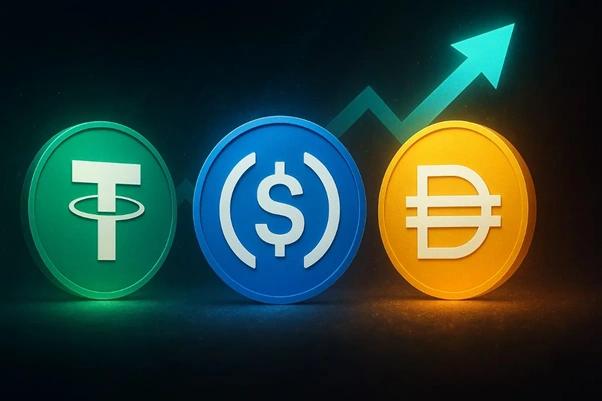 Stablecoins Expand In Everyday Digital Payments. [TransFi]
What Changed Bitcoin’s Original Payment Role?
Bitcoin was initially designed as a peer-to-peer network for payments. In those days, the users regarded it as if it were digital cash that could be used for normal purchases and services. But as the price increased, so did the reluctance to spend the asset that was expected to become more valuable.
Bayston has pointed out that the users have now started treating Bitcoin as a digital commodity. It is often placed alongside gold or other long-term stores of value. This gradual change has restricted the use of Bitcoin to just investment portfolios and not down the checkout counters anymore. Moreover, volatility is another factor that limits the role of Bitcoin in payments.
Price fluctuations can create uncertainty in the settlement process for both businesses and consumers. Hence, the current state of Bitcoin adoption is more about wealth preservation and less about commercial exchange. Such a transition further asserts the notion that Bitcoin has indeed grown into a long-term holding instrument.
How Do Stablecoins Fit Modern Payment Systems?
Stablecoins are intended to maintain their value over time by attaching themselves to the US dollar or government bonds, for example. Such a system leads to the reduction of price fluctuations as well as the increase of trust in the prices.
Stablecoins, in contrast to Bitcoin, are not created for capital appreciation. Their advantage is in allowing smooth operations and predictable settlements. The use of stablecoins is in remittances, cross-border payments, and on-chain commerce. Companies are able to transact faster and incur lower conversion costs.
Customers have easier access to digital payments and are not at risk of the dramatic price swings associated with the market. That balancing act is the reason why stablecoins have come to account for such large portions of the cryptocurrency transaction volume. Their structure accommodates real-life trade rather than speculative possession.

Price Stability Drives Commercial Adoption. [Paddle]
Can Bitcoin Still Gain Transaction Utility?
Meanwhile, some developers are on the lookout for new solutions to make Bitcoin more usable for transactions. Layer-two networks and decentralised finance instruments are being tested for their potential to make the processing faster and cheaper.
These modifications might result in a situation where Bitcoin would only be able to carry out limited payment functions in the future. Nevertheless, the majority of major players still assign to Bitcoin the role of a hedge.
Retail investors continue to view Bitcoin as a safeguard against monetary disorder. Such an attitude further strengthens the long-term holding strategy. When confidence in the conventional systems wanes, diversification of portfolios becomes more common. Bitcoin is the one to benefit from that situation, even though stablecoins are leading in the field of practical payment use cases.
Will Regulation Boost Stablecoin Expansion?
Regulatory clarity could be a great help to the usage of stablecoins in banks and financial platforms. The authorities in different countries are laying down the rules to manage the reserves and the transparency of the whole process.
The legislation is meant to guard the consumers on one hand and, on the other, to promote innovation. The faith of the institutions may increase as the compliance criteria become more transparent. Another possibility is that banks would issue their own digital tokens within a regulated framework.
Such a trend might directly connect stablecoins to mainstream finance. The usage of tokenised currencies in payment systems, settlement operations, and treasury management might become more widespread. This transformation could change the flow of liquidity and settlement of trade across borders globally.

Policy Could Accelerate Institutional Participation. [Brookings Institution]
What Does This Mean For Global Crypto Adoption?
Stablecoins have the potential to invite more people into the world of digital finance. The very reason for their stability is that they can be used daily without the risk of losing money. Also, businesses will be able to offer their products at a fixed price through the use of blockchain technology.
On the other hand, consumers will be provided with digital payment means that are not affected by the volatility of the market. Bitcoin is definitely going to continue being the most important long-term value investment asset. There is a good chance that it will keep luring investors who are looking for a haven from inflation and economic uncertainty.
At the same time, stablecoins are likely to take over the operational aspect of digital commerce. The two are going to be the interdependent parts of the maturing cryptocurrency ecosystem. All these changes are indicators of the moving cryptocurrency trends that are determining the global usage of digital assets.
FAQs
Q1: What is Franklin Templeton crypto insight about stablecoins?
A1: The firm believes stablecoins will dominate payments while Bitcoin remains a store of value asset.
Q2: Why is stablecoins utility compared to Bitcoin higher for payments?
A2: Stablecoins maintain stable prices, making them suitable for commerce and settlements.
Q3: Is Bitcoin still useful beyond investing?
A3: Some technology upgrades may improve transactions, but most use remains investment-focused.
Q4: Can regulation increase stablecoin adoption?
A4: Clear rules may boost institutional trust and integrate stablecoins into financial systems.
