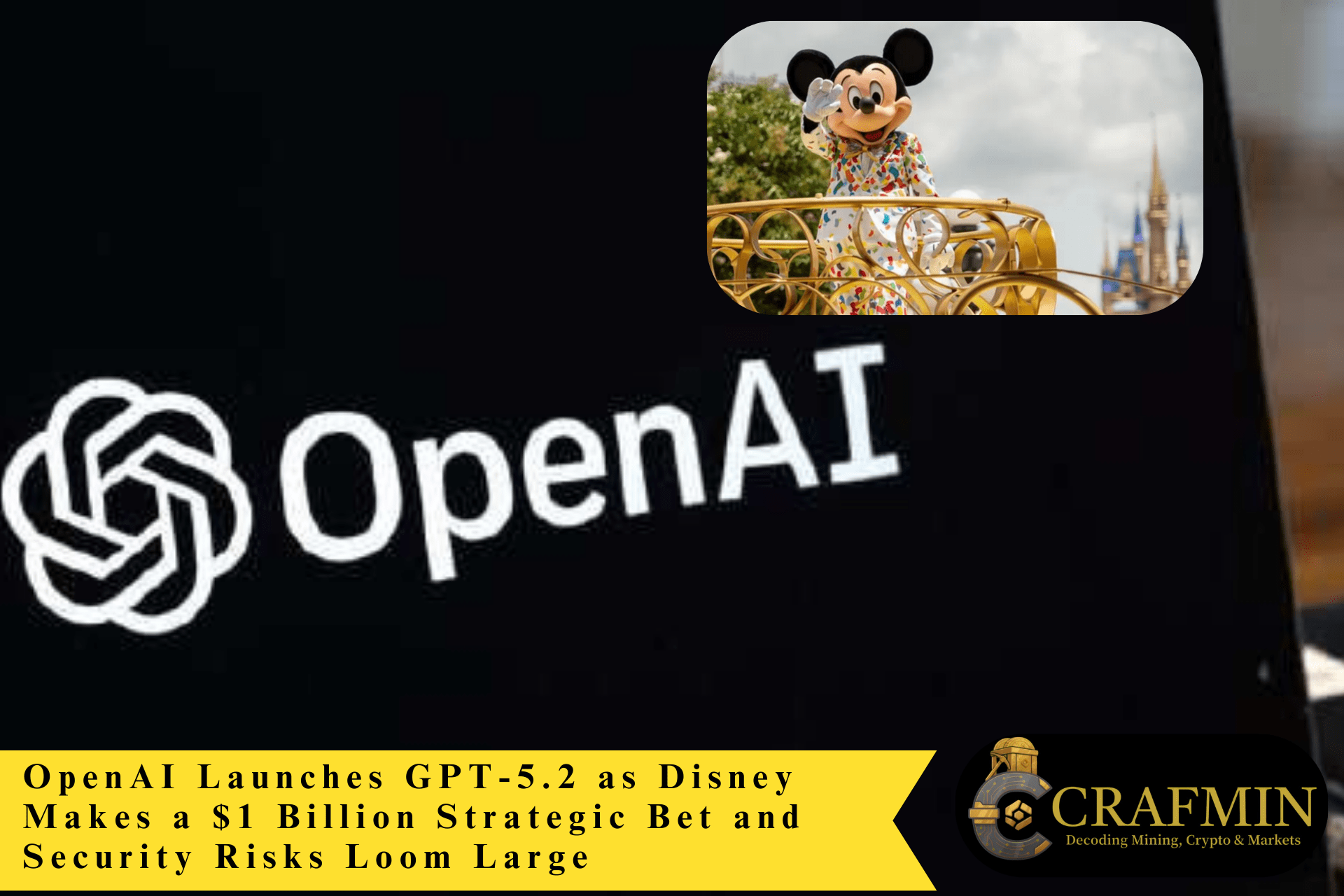
In a sudden turn of events that brings together innovation, business strategy, and the looming challenge of tech threats, OpenAI has rolled out its newest model, GPT-5.2, as entertainment behemoth Disney invests a historic $1 billion. Meanwhile, experts point out that advanced technology poses increasing threats that cannot be overlooked.
This narrative is emerging as a model for how technology, creativity, and security intersect, and it has relevance for both professionals and laypersons. (reuters)
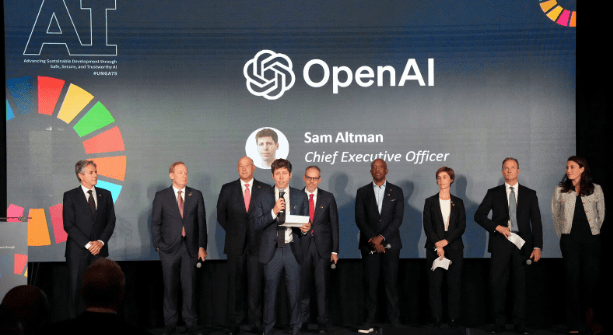
OpenAI debuts GPT-5.2 as Disney invests $1B amid security concerns. (Image Source: ny times)
What’s Hot Now: GPT-5.2 Emerges in the Market
On December 11, 2025, OpenAI launched its highly anticipated version, GPT-5.2, a significant enhancement for professional knowledge work and problem-solving.
Contrary to other models, GPT-5.2 offers major advantages in:
- Advanced Reasoning Capabilities and Understanding in Long Contexts: Useful for multi-stage tasks.
- Advanced Coding Features: Enabling deep engineer-level coding tasks and code review.
- Improved Productivity Software: From spreadsheets to presentations.
GPT-5.2 is not a mere upgrade. This technology brings a line of models, Instant, Thinking, and Pro, which are designed for various professional tasks.
Analysts already suggest this can possibly be the most powerful version yet, especially when it comes to tasks requiring precise reasoning.
Strategic Play By Disney: A $1 Billion Stake and Creative Synergy
Simultaneously with the launch of GPT-5.2, Disney also announced that it would invest a total of $1 billion in OpenAI, a move that signalled Hollywood’s faith in technology.
Under this three-year agreement, OpenAI’s Sora video-making tool will be able to use more than 200 classic Disney, Pixar, Marvel, and Star Wars characters.
This means that fans worldwide would soon be able to create their own videos using characters like:
- Mickey Mouse
- Iron Man
- Yoda
- Cinderella
Disney will also make use of OpenAI technology. This involves integrating various tools for their teams and developing other products for the Disney+ platform services.
Why this Matters?
Disney has protected its intellectual properties for many years. This partnership not only opens revenue channels for Disney but also provides a platform for users to contribute to content inspired by popular franchises.
A part of this user-generated content may also find a place on Disney+, which would be a completely new area for fan engagement.
In addition, Disney has received warrants, which are options for purchasing additional equity in the company in the future.
Behind the Scenes
Competition And Corporate Strategy
- These actions are not timed coincidentally. There has been a growing rivalry between OpenAI and Google in the world of generative tech.
- There was a stir in recent technology tests with Google’s Gemini 3, which pushed OpenAI to give priority to releasing their own next-gen models.
- The launch of GPT-5.2 illustrates how serious the battle for technological supremacy has become. There is also a message that in traditional media, leaders know where the future lies in merging technology with storytelling.
- This meeting of creativity and computation could affect the world of entertainment, academia, and business for years to come. (webpronews)
Increasing Cybersecurity Risks: The Unseen Element Of This Story
However, amidst all the fanfare and news of finances, there is a darker side, and this involves models such as GPT-5.2, which pose severe cybersecurity threats.
OpenAI has itself pointed out that “rapidly improving models that can write code, produce complex output, and analyse systems” could be used for developing:
- Zero-day exploits,
- Complex network attacks,
- Harmful automation tools.
These issues were brought to light in a recent report from OpenAI on cybersecurity, which highlighted how these kinds of tools were likely to be used in a damaging way.
GPT-5.2’s power raises new cybersecurity threats. (Image Source: BusinessDay)
What Authorities Tell Us
According to security experts, even as these models benefit developers as well as organizations, dangerous individuals can also make use of models with inadequate security.
Academic research on large language systems reveals that many personalised model application systems are vulnerable to instruction leakage and privacy concerns.
These days, governments and corporate security teams are racing to adjust their defences with the increasing capabilities.
What It Means For Businesses And Users
For Tech Professionals
GPT-5.2: Productivity Shift
GPT-5.2 symbolizes a productivity revolution – it provides capabilities that can transform how engineering, research, and business operate.
For Media And Entertainment
This move by Disney has set a precedent for licensing that has the potential to transform how intellectual property is licensed in the digital age.
For Security Teams
More complex models require robust defences, which involve capabilities for monitoring as well as access management.
For Everyday Users
The customer will benefit from enhanced functionality and content – but will also live in a world where trust in technology has never been more important.
The Tech Lift: What Matters About GPT-5.2 and What it Can Do
GPT-5.2 does not merely provide quicker text. There are marked improvements in terms of the system card and notes from the company for enhanced support in scientific and mathematical rigour, as well as coding. This translates to it being far more practical for knowledge workers.
Essentially, this implies that developers would work with technologies that can:
- Follow the thread of a strategy document from a board-level meeting through numerous other interactions.
- Generate code skeletons with multiple files, then inspect for programming bugs.
- Prepare a draft of research summaries that are linked to scientific results and undergo numerical validations.
For organisations, this means a potential increase in productivity, but also a corresponding increase in dependency. The trick is to provide robust boundaries for delivery to maintain integrity, as well as compliance with corporate values.
ChatGPT 5.2 is another reminder of how fast the AI stack is maturing.
The most interesting part isn’t just the accuracy jump, it’s the way OpenAI has split the model into Instant, Thinking, and Pro modes.
This finally fixes one of the biggest pain points: you don’t need one… pic.twitter.com/3K46ALOeXx
— House of AI (@houseofai_swan) December 11, 2025
Creative Economies: Disney’s Wager Sets A New Playbook For I.P. And Creativity Among Fans
This step taken by Disney marks a turning point. Licensing characters to a video generator tool means that Disney adopts an approach where fans are also co-creators, as per policies and platform guidelines. This agreement brings valuable IP to OpenAI, as well as new ways for Disney to reach their fans.
This transformation alters incentives for content producers and platforms:
- Independent creatives are able to use classic characters for their creations, providing a new revenue stream.
- Groups of talents, trade unions, as well as child welfare groups, would continue to maintain pressure on platforms to stop any abuse, deepfakes of likeness, or exploitative content. Disney’s agreement has a specific no-likeness/no voices of actors line.
Overall, licensing adds authenticity, but it has to be done carefully, including content filters, age restrictions, and monetised policies.
The Security Paradox: Better Defenders, Stronger Attackers
Here’s the bitter truth. The very same technologies that make GPT-5.2 such an exceptional research assistant are also used to make powerful cyber tools. This can lead to sophisticated exploits, malware, and social engineering scripts if malicious users gain access to models such as GPT-5.2.
This creates a paradox:
- Defensive Use: Organisations can leverage models for automated code scanning, vulnerability triage, and attack simulation to secure their systems. OpenAI has also planned initiatives that focus on defensive use cases with limited access to high-risk capabilities.
- Offensive Risk: These capabilities can also be used for malicious purposes by those who seek to create effective phishing messages, deepfake dialogues, or exploit code that human attackers can use.
The result: security teams are now faced with a new set of technologies and a new attack vector.
Policy And Governance: Hard Questions Of Law Fall to Soft Law
The commercial and risk considerations that arise lead to challenging regulatory issues. A trade-off between innovation and protection now faces governments and trade associations:
- Intellectual property law issues need to be resolved with regard to licensing, specifically where derivative works exist and when. Disney licensing illustrates this, where licensing plus certain exceptions are involved.
- Safety regulations must set rules for access levels and audit trails to allow a platform to trace how a model arrived at a harmful output. While OpenAI commits to access control and monitoring, this does not substitute the need for robust policies.
- The protection of children and consumer rights will take centre stage as user-generated content intersects with IP from established family-friendly brands. Advocacy groups have pointed out threats to children.
The challenge for policymakers is to move quickly and effectively: too much regulation stifles creativity, while too little invites trouble. The middle course involves direct policy interventions in transparency, grievance, and safety.

AI raises tough policy questions on IP, safety, and child protection. (Image Source: Business Cardinal)
Jobs, Skills, and the Labour Market: Augmentation, Not Replacement
Extrapolating mass layoff predictions from GPT-5.2 would be tempting but naive. The model accentuates certain human capabilities and shifts the demand curve:
- Routine writing, first drafts, and basic coding are set to be disrupted.
- Higher-value tasks, such as strategy, ethical review, interdisciplinary integration, and edge-case engineering, become more important.
There will be an increasing need for hybrid professionals with knowledge in a domain, along with model management capabilities.
Essentially, businesses can realise productivity benefits by re-skilling employees in model management, reviewing model output, and using their own judgment – rather than replacing employees.
Practical Security Guide for Organisations: Checklist
- Think of models as infrastructure. Update models in the same way you are already doing for key services.
- Use tiered access. Limit powerful functionality to trusted teams, and keep logs of use and prompts.
- Host regular Red Teams. Uncover potential behaviour using model simulation ahead of adversaries.
- Protect IP and privacy. Employ watermarking, provenance metadata, and content filtering in licensing and generating derivative works.
- Invest in people. Hire or develop a team with experience in cybersecurity, data science, and policy.
These measures mitigate risks without undermining the productivity potential.
Also Read: Why the Rise of Open-Weight AI Models Could Reshape the Global AI Landscape in 2026
Ethics and Culture: Who Has a Story to Tell?
The Disney agreement brings into focus a societal question: when businesses are licensing icons for mass-producing technology, who gets to tell the story?
While fans are able to make interesting, subversive, and/or satirical works from copyrighted characters, a line has to be struck between freedom of expression, reputation, copyright, and performer rights. This is especially important where concerns of freedom of expression are raised.
Expert voices:
- Security experts remind that enhanced automation raises the odds of emerging cyber threats, and improved access monitoring and management are now needed.
- Media analysts say that this move by Disney underscores a certain acceptance of these tools, as long as IP and monetization protections are in place.
- Summaries paraphrase news from Reuters, AP, and other trade sources to provide a practical understanding.
Disney deal sparks debate over storytelling, copyright, and ethics. (Image Source: Arise News)
What Consumers and Producers are Waiting to See Next
- Rollout specifics, including those with early access to functionality in GPT-5.2, as well as mitigations that come with access.
- The content policy of Disney: how Sora enforces age restrictions, protects against abuse, and processes removal of inappropriate user-generated content.
- Regulatory signals from states and supranational organisations, which develop new requirements in response to incidents of breaches or misuse of technology.
Closing: A Practical, Modest Claim
- Technologies are changing quickly. Companies create press releases and white papers, and we ponder their effects for years to come. A sensible course of action is not to panic, nor celebrate without discernment.
- Leverage powerful tools that can enhance human judgment.
- Create governance with responsibility and traceability.
- Assist in acquiring new skills for using the tools more safely and effectively.
OpenAI’s GPT-5.2, as well as Disney’s $1 billion investment, pushes forward a narrative that has already begun to emerge – that of computation meeting culture. This raises enormous potential for both positive and negative consequences. The more prepared organisations are, the stronger their chances of influencing that narrative.
Frequently Asked Questions
- Q: Will Sora use Disney characters that are deepfakes of actors?
A: No. The licensing does not cover actor likenesses and voices; this agreement is solely for characters and other creative purposes with policy limitations. - Q: Can GPT-5.2 be misused to develop harmful code?
A: Yes. Technologically, sophisticated models could develop codes that may be used adversely. OpenAI will limit access and develop defensive software. Organisations should consider models as both potential attack enablers and defenders. - Q: Should companies ban model use in-house?
A: Not necessarily. Organisational bans are a blunt instrument. A better approach is structured and authorised access, monitoring, and staff training to make this tool an audited helper, not a wild card. - Q: How does GPT-5.2 differ from other Companion models?
A: GPT-5.2 offers improved reasoning, coding assistance, and long-context capabilities, catering to practical, multi-step tasks. - Q: In what ways would Disney’s $1 billion investment affect content development?
A: The investment provides opportunities for fan-made videos using over 200 Disney properties, possibly seen on Disney+. - Q: What cybersecurity risks do these models pose?
A: Powerful models may pose threats of sophisticated cyber attacks if not closely monitored and protected. - Q: When will users get access to GPT-5.2?
A: Rollouts are first started with paying users and then extended to other groups. - Q: Are actor voices and likeness rights part of the Disney agreement?
A: No. This licensing agreement does not cover direct actor voices and likeness, but rather their use in content creation.
