

Bitcoin is not the topic of debate in Washington.
It is arguing about money, the type that travels at light speed.
An invitation-only White House gathering on 2 February 2026, puts crypto executives and banking leaders in the same room to resolve a stalemate on US digital-asset bills. The barb sounds uncomplicated: would people get rewards to have dollar-pegged stablecoins?
That feature, stablecoin rewards, is now at the centre of a far larger battle over who holds the future of digital dollars.
Bankers refer to it as a deposit flight disguised.
Cryptos refer to it as consumer choice.
And the White House seems to think that it is some sort of an emergency to take the refereeing into their own hands.
Why it matters and what happens today to the market.
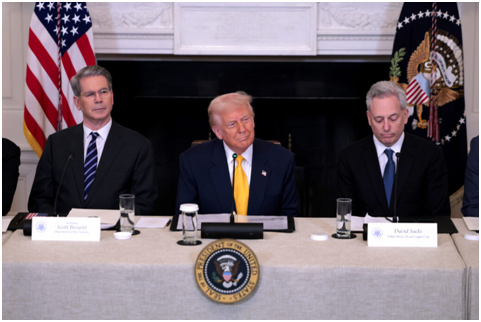
White House talks on 2 February 2026 pit banks against crypto over stablecoin rewards, deposit flight vs consumer choice, with big implications for digital dollars and markets. (Image Source: Institute for China-America Studies)
Why it Matters and What Happens Today to the Market
The White House crypto council hosts the meeting in a bid to reach a compromise on the Clarity Act (a market-structure bill aimed at establishing federal regulations of digital assets). According to Reuters, the negotiated subjects are centred on the interest and other rewards on the dollar-pegged stablecoin holdings.
This is important in that stablecoins no longer exist on the fringe.
They already act as the plumbing of crypto markets – and more and more, as an alternative rail of real-world payments.
The US government has just developed a formal stablecoin structure as well in the form of the GENIUS Act, where reserves are 100 percent and frequent disclosures are required, and the structure encourages issuers to have the backing of liquid forms such as US dollars and short-term Treasuries.
So the system now has rules.
But still, there is a loophole in the argument over yield.
What is being discussed today is how to make it closed, how to protect it or how to transform it into something that both parties can live with.
The “Yield War” in One Line
Stablecoins are profitable due to the ability of the reserves they are backed by to generate yield (think Treasury bills).
It is a struggle over who receives that yield.
It can be retained as revenue by the issuers and platforms.
Or they could distribute it to users in the form of rewards.
As soon as you share it, a stablecoin will no longer be a digital cash sensation but a sense of an interesting product, and at this point, the politics of banking come into play.
The Law Initiating the Argument: GENIUS Act
In 2025, the GENIUS Act was signed, creating a federal system of stablecoins.
It focuses on consumer protection, quality of reserves, and disclosure and compliance requirements.
It also creates a boundary: issuers of stablecoins are not able to pay interest to holders (the policy objective is to make the stablecoins resemble more payments than savings).
However, regulators and lobbyists are soon focused on an alarming fact: that the issuer might not be paying interest, but an exchange or custodian might be paying rewards to users – on fees, spreads, or reserve-linked economics.
That is what the meeting of today attempts to close or open.
Stablecoin regulation just picked winners—and created tension.
The GENIUS Act hard-codes issuer controls—1:1 reserves, audits, disclosures, freezes, eligibility—mirroring the architectures long built by crypto-native firms like Gemini, Coinbase, and Kraken (some of which have… https://t.co/RVhiTQqDnK pic.twitter.com/2DOFeiPQs5
— Reggie Middleton, Disruptor-in-Chief (@ReggieMiddleton) February 1, 2026
Why This Isn’t a Feature of Banks But a Treatise
The existence of stablecoins does not give banks sleepless nights.
They lose sleep at the thought that stablecoins are more attractive than deposits.
Deposits fund lending.
When deposits run out, credit tightness occurs.
The essence of the narratives banks have been selling to policymakers is that stablecoin rewards may lead to a mass flight of deposits, which they present as a risk to financial stability.
This is no longer mere rhetoric.
A Standard Chartered analysis projects that by the end of 2028, the stablecoins might draw out of US banks as much as US$500 billion in deposits, and regional banks in particular are vulnerable.
The banking groups contend further that the consumers can transfer money in FDIC-insured accounts to non-FDIC-insured stablecoins, particularly when the platforms promote the benefits in deposit-like lingos.
That is, rewards are a marketing tool for banks.
Not a minor product tweak.
The Reason Why Crypto Companies Are Not Ready to Surrender
Cryptocurrency sites claim that rewards are not a sham.
They’re the on-ramp.
A flat rate stablecoin that does not pay money to its users seems like a regression in the world where money markets, high-yield savings accounts, and fintech applications yield returns, particularly when the reserves are yielding at all.
Leaders in the crypto industry also believe that the banks desire the rules to be written in a way that would maintain incumbency.
The Big Banks have waged a pressure campaign, according to Summer Mersinger, the CEO of Blockchain Association, and removing stablecoin rewards would kill consumer choice.
There is a reason why language is sharp.
The reason is that in 2026, stablecoins will not only be crypto instruments.
They are pushing into mainstream positions in payments, payroll, remittances and business settlements, the areas where banks have dominated in the past.
Stablecoin rewards are a growth strategy anda survival strategy for crypto firms.
The Back Room to “Rewards”: Treasuries
And this is the embarrassing bit to all.
Stablecoin reserves are usually held in US Treasuries and Treasuries yield.
That yield becomes revenue.
And it is big enough to battle about.
According to Reuters, the deposit-flight risk is determined by whether issuers have reserves in the banks; the largest issuers have the highest reserves in Treasuries, and so there is very little re-depositing that is being done.
That detail matters.
Since a user transfers money between a bank deposit and a stablecoin, the banks are not always refunded the money through reserve deposits.
The funds may get into government debt rather than bank lending.
That is why the banking lobby does not regard stablecoins as a trend, but rather a structural competitor.
This Political is Enough to Market in the Market
Like a macro indicator, the stablecoin market size is now being monitored.
According to the data presented by DeFiLlama, the stablecoin market cap has reached a new high of over US$311 billion in January 2026 and is near the US309 billion range as reported by Yahoo Finance.
Tether alone remains a giant.
Reuters documents that USDT has approximately US186-187 billion in circulation.
Once it is that big, the topic of stablecoin rewards is no longer a fringe crypto discussion.
The question arises as to how the US dollar circulates – and who makes the spread.
What is the Reason the White House Interferes at This Point?
The Senate Banking Committee was to debate and vote on the Clarity Act, but it put it on hold due to disagreements, particularly on the rules on stablecoin interest.
According to Coinbase CEO Brian Armstrong, the bill in its current form would halt stablecoin rewards. He protested in the open, and the bill was once more adjourned by the committee.
The white house now desires all to sit at the same table.
This is clear.
It indicates that the administration does not view stablecoin rules as a policy that they are going to address in the future.
The Actual Battle of the Clarity Act
It is a bill regarding market structure: it determines ownership of who owns what, which tokens are categorised, and how platforms are registered.
It is a struggle to dominate the next generation of money-like products.
The interest of stablecoin rewards is that they confuse categories:
- Banks desire bank-like constraints in the event that stablecoins are deposits.
- Crypto firms desire payment-like freedom in case they behave as payments.
- When they behave like investment products, then regulators desire investor-grade protection.
Compromise is not that easy, as each one is defending a category that suits them.

Stablecoin rewards blur whether they’re deposits, payments, or investments, so everyone fights to label them their way, and compromise gets messy. (Image Source: Crypto News Australia)
The Policy Problem: Should We Prohibit Interest and Permit Rewards on an Activity Basis?
Lawmakers believe that the distinction should be made between:
- Passive holding rewards (you earn yield by holding the stablecoins).
- Activity-based rewards (you get rewards by using stablecoins in a payment, settlement or loyalty scheme).
The Senate bill fundamentally prohibits the interest in just having the stablecoins, yet can preserve the reward of the action, such as payment or enrolling in loyalty programs.
That sounds good.
But the market is clever.
Moreover, the concept of activity can be designed.
Should a platform involve making a very small step, say clicking a button, going through a wallet, conducting a small transfer, is that still a passive action?
This is the reason why state supervisors and banking regulators are concerned with evasion via affiliates or business partners.
The Loophole Issue That Everybody Keeps Going Around
Rewards can be made by intermediaries even when there is an issuer interest ban.
Wired pointed out this contradiction: issuers are unable to make interest, yet exchanges can reward holders, a move that critics believe reinvents interest-like products through a side door.
Banking representatives demand that the regulations should end this type of workaround.
CSBS would endorse a prohibition on paying interest on service providers on the basis of merely holding stablecoins, but cautions that exceptions will defeat the purpose should they permit reward arrangements that resemble revenue sharing.
Crypto companies claim they are wrong: the prohibition of incentives prevents innovation in general and confines consumers to the lower-yield products dominated by banks.
And there is the point of departure.

Even with an issuer interest ban, exchanges can still pay “rewards” as back-door yield; banks want it shut, crypto says banning incentives kills innovation. (Image Source: CryptoSlate)
How a Compromise Might Appear at the End of the Present Meeting
There is no magic wand you use after leaving a meeting with the White House.
Washington Compromises are likely to have predictable patterns.
The most realistic landing zones that the industry is currently observing are as follows:
- A strict prohibition on passive stablecoin yield (the optimal choice of the banks).
This would prevent platforms from assuming yield-like payments on stablecoins because they have them.
This is something that banks consider essential to avoid insured account competition, like the one caused by deposits.
Cries to tokens would probably change the incentive to other fronts: fee refunds, card benefits, or bundles.
- A use it to earn it model (policy-friendly middle ground policy).
Rewards are not illegal merely because they are conditioned to be used measurably:
- payments volume
- merchant spend
- settlement activity
- loyalty programs containing definite non-deposit marketing regulations.
This holds stablecoins in the payments lane.
But it must be defined hard, or it will be passive, give up with a false identity.
- Controlled rewards system (the fintech-type solution).
Rather than prohibiting rewards, legislators may:
- Need more transparent risk disclosures.
- Limit the marketing language (no claims of deposit-like)
- Limit or impose suitability requirements.
Regulators are already concerned with the manner in which yield is sold, since consumers read rewards and imagine safe interest.
- The solution of the banks enters the game.
With a regulated framework, banks may be able to issue their own stablecoins or tokenised deposits, and they will be able to compete without prohibition.
This doesn’t end the yield war.
It moves it elsewhere.
The Reason Why This Controversy Determines The Future Of Digital Dollars
An already existing example is a digital dollar that is a stablecoin in the private sector.
The U.S. government considers them to be strategically useful; even the GENIUS Act describes the role of the stablecoins as a contributor to the dollar reserve position and the demand for U.S. debt.
The U.S. also desires stability, compliance, and a real economic funding banking system.
The policymakers have a balancing act:
- In case stablecoins excessively appreciate and yield, deposits can be lost.
- In case they are too hard constrained, the innovation might shift offshore.
- As long as stablecoins remain more cash-like, consumers may wonder why they should keep them as opposed to other places that will pay them interest.
This is why the current meeting is not a show; it is a point of decision.

Stablecoins already act like digital dollars, so the U.S. must choose: allow yield and risk deposit flight, or restrict it and push growth offshore. (Image Source: Forkast News)
The Practical Perspective: What it Entails for the Common Consumer
Unless you are a policy nerd, the simple version is this.
The stablecoins feel like depending on stablecoin rewards:
- a spending wallet (like cash)
- savings product (such as an account)
When the legislators tighten their ties, we may have fewer such earn programs on the exchanges of the mainstream.
When they are permitted to reward, stablecoins can be found in more apps, cards, payroll, remittances, since users will have what is worthwhile to them.
In any case, the rules will have the following impact:
- What platforms are capable of providing in the U.S?
- How they describe it.
- What products do they give precedence to worldwide?
The Business Perspective: Why Fintech, Payroll and Merchants Are Paying Attention
Stablecoins are becoming more useful to businesses:
- Faster settlement
- Lower cross-border friction
- Treasury and payout programmable flows.
Trust is needed in business adoption.
Certain regulations enable businesses to operate without the threat of uncertainty in regulations.
The GENIUS Act advances stablecoins to ensure transparency and uniformity.
The market-structure bill now determines the way platforms are run around them.
That is why, nowadays, the meeting can change the course of action not only regarding exchanges, but also payment providers, card programs, and other global vending machines in need of U.S. compliance credibility.
The Bank Angle: Why the Headline is the Case of Deposit Flight
According to Standard Chartered, up to US$500 billion of deposits would be threatened by 2028. That presents banks with a catchy title and a frightening figure.
The mechanics are quite straightforward: Consumers transfer money to stablecoins. Issuers purchase Treasuries that are under reserve. Banks lose low-cost funding. The lending tightens particularly in the regional banks.
According to the banks, it is not just a competition but a big shift.
Cryptocurrency companies claim that this is what innovation is all about: making better rails, better products, better results for users.
The stories contradict each other today in the same room.
Follow-up on the Meeting
The market will seek indicators rather than discourse. Key indicators are:
Does the bill language restrict the meaning of prohibited earnings?
Will the exemptions be retained on payment-related or loyalty-related rewards?
Will regulators have better power to crack down on marketing language and risk claims?
Does the white house have a schedule to return to Senate action?
When the sides become closer, you may probably notice an increase in Senate activity. Otherwise, the industry will be frozen and platforms will continue to be developed on guesses.
Frequently Asked Questions (FAQs)
- What Are Stablecoin Rewards?
Ans: Stablecoin rewards are incentives (usually such as interest), given to users to hold or use stablecoins on a platform. They can take the form of interest, although named rewards. - Why Does The Meeting At The White House Revolve Around Rewards?
Ans: The reason the meeting is dedicated to rewards is that it is the primary impediment to advancing the U.S. crypto market-structure legislation, as banks and crypto firms are divided on whether rewards ought to be permitted. - Isn’t The U.S. Law Already Prohibiting Stablecoin Interest?
Ans: The GENIUS Act prohibits the issuance of interest by the issuers, although policy discussions continue whether or not the intermediaries (exchanges, custodians) can remain rewarded. - Why Can Banks Be Against The Stablecoin Rewards?
Ans: Bankers are anxious that incentives will make people take money out of insured deposits and put it into stablecoins, leading to deposit runs and decreased credit supply. - What Is The Motivation Behind Crypto Platforms To Defend Stablecoin Rewards?
Ans: They claim that rewards are essential in competition and adoption and their prohibition will favour incumbents as opposed to consumers. - What Is The Current Size Of The Stablecoin Market?
Ans: According to recent Yahoo Finance information (through DeFiLlama), the market is currently estimated to be about US309billion following its highest ranking of over US311billion in January 2026. - How Large Is Tether’s USDT?
Ans: According to Reuters, the circulation of USDT is approximately US$186 -187 billion. - What Would Be The Case If Rewards Are Limited?
Ans: Places may move the incentives to payment-based reward, card programmes, rebates on fees or non-U.S. products. The stablecoin products in the U.S. might not be as appealing as the yielding products. - What Will Be The Situation In Case Of Reward Allowance?
Ans: Stablecoins may enter the mainstream fintech feature (wallets, cards, business settlement), increasing the competitive pressure on deposits and payments.