
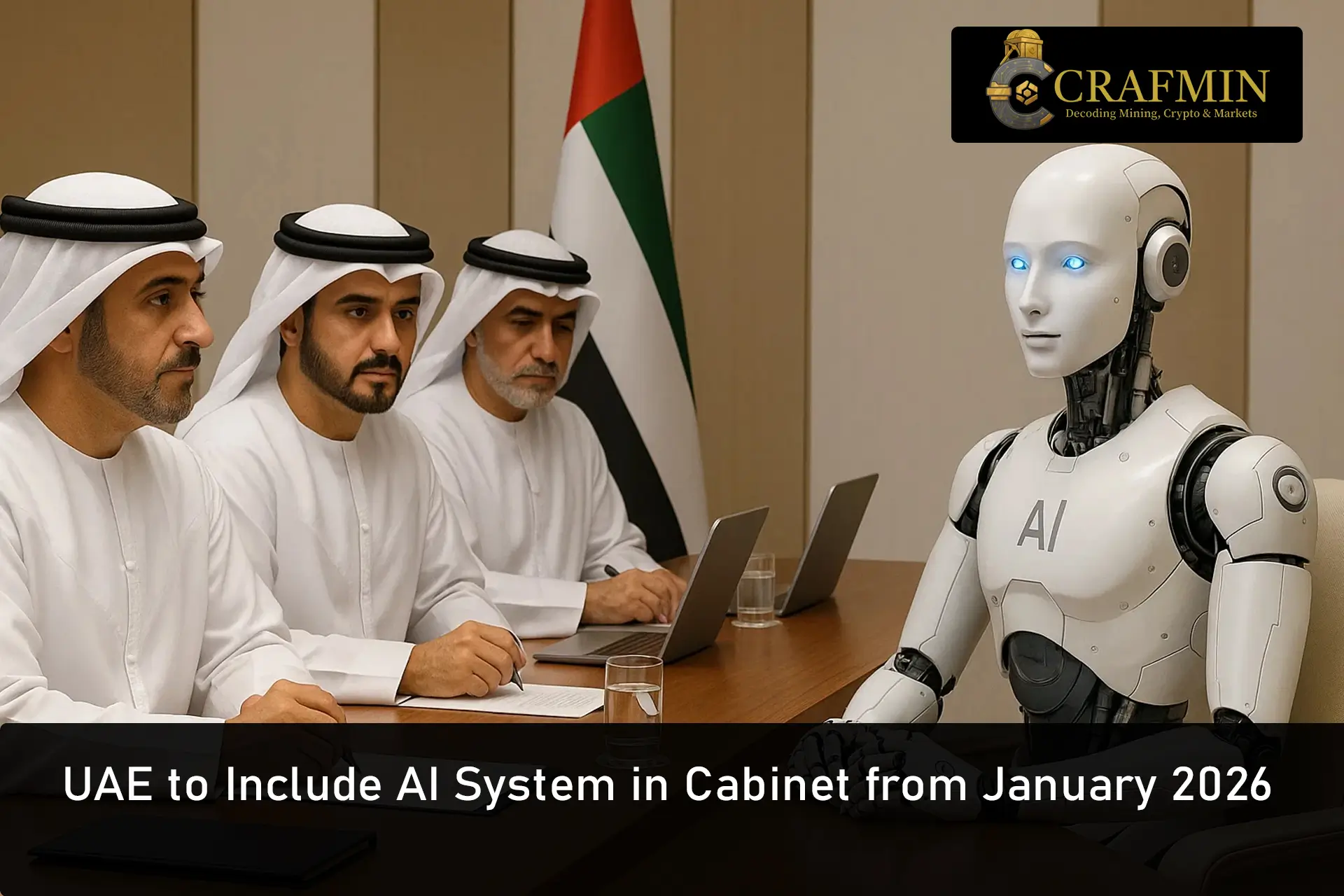
In a bold move that’s setting a new benchmark for digital governance, the United Arab Emirates has announced that its National Artificial Intelligence System will join Cabinet-level meetings starting January 2026.
The statement, issued by Sheikh Mohammed bin Rashid Al Maktoum on 20 June 2025, outlines a future where real-time data and intelligent systems will guide national decision-making. This initiative positions the UAE as the first country to formally assign AI a consistent advisory presence in its highest government circles.

UAE Plans to Embed AI System in Cabinet by Early 2026 ( Image Source: Economy Middle East )
A Tech-Driven Seat at the Table
From next year, this AI system will work alongside human ministers, offering insights, feedback, and strategic analysis across key government platforms. These include the federal Cabinet, the Ministerial Development Council, and boards of state-owned enterprises.
The AI will not serve as a symbolic gesture—it will actively assess ongoing discussions, flag risks, highlight opportunities, and improve efficiency by removing guesswork from government processes.
Sheikh Mohammed announces UAE’s National AI System will become an advisory member of the Cabinet in 2026 https://t.co/oqu81y9UXW
— The National (@TheNationalNews) June 20, 2025
Rooted in the UAE’s Vision 2031
This major development is part of the UAE’s broader ambition under the National AI Strategy 2031. The strategy seeks to position the country as a global front-runner in digital innovation, with smart technology embedded at every level of society and governance.
Giving AI an official voice in government signals a shift from piloting tech behind the scenes to making it a core pillar of national leadership.
What the AI Will Actually Do
The system’s functions will go beyond passive observation. Once integrated, it will:
- Evaluate policy proposals on the spot
- Assist in long-term planning using predictive modelling
- Advise government-owned enterprises on strategic issues
- Detect inefficiencies in current policy or implementation
By bringing a data-first lens to governance, the system aims to help reduce delays, increase accuracy, and maintain continuity across administrations.
Why It’s a Global First
Most countries are still debating how to regulate advanced technology. The UAE is going a step further by weaving it into the executive branch.
This signals the start of a new governance model—where tech doesn’t just support public services, it shapes the way they’re conceived and delivered.
The UAE’s approach may well spark a shift in how other governments view digital infrastructure and AI’s potential in public administration.
For the People: Real Benefits
The everyday impact of this innovation could be profound. Faster service delivery, reduced administrative overhead, and personalised public experiences are just the beginning.
AI-supported governance could mean better responses to urban planning needs, healthcare trends, and education gaps—because the government will be working from real-time insights rather than static reports.
Proactive governance becomes possible when problems are flagged before they reach crisis point.
Why Crypto and Web3 Should Care
Although this development isn’t directly linked to blockchain, it lays the groundwork for more open collaboration between decentralised technologies and central institutions.
Here’s how the ripple effect could benefit emerging tech sectors:
- Blockchain can assist with digital identity, licensing, and government contracts
- Smart contracts may power welfare or subsidy distribution
- Token-based systems could streamline logistics and procurement
- Decentralised applications may gain government-backed infrastructure
It suggests that future governments could be more open to hybrid systems that combine traditional leadership with decentralised architecture.
Hurdles That Still Exist
No transformative initiative comes without its own risks. Some of the key challenges facing this rollout include:
- Ensuring full transparency in how the AI system forms its recommendations
- Securing data privacy across sensitive national topics
- Avoiding dependency on systems that may lack nuanced judgment
- Balancing machine input with human intuition and ethical oversight
Officials maintain that the system is advisory, not authoritative—final decisions will always rest with human ministers.
A Regional and Global Wake-Up Call
With this move, the UAE sends a message not just to its citizens but to the world. It sees digital systems not as future options, but as present necessities. And it’s acting accordingly.
Whether other nations follow this lead remains to be seen, but it’s likely many will take notes. The outcome of this integration could help define global policy debates on how to responsibly use intelligent systems within state governance.
Also Read: SoftBank Eyes Arizona for Massive $1 Trillion Robotics Hub
What’s Next Before January 2026
As the start date approaches, the country is expected to carry out a series of preparatory steps:
- Establishing frameworks for the system’s role and limits
- Conducting cybersecurity assessments
- Training government staff to work with the AI’s insights
- Educating the public on what this system means for everyday life
- Fine-tuning system algorithms to align with national values
If implemented smoothly, this could become one of the most successful examples of digital transformation in the public sector.
Closing Thoughts
The UAE’s decision to formally include an AI system in its Cabinet processes isn’t just innovative—it’s transformative. It challenges the world to reimagine how leadership and technology can coexist in real time.
Rather than replacing humans, this AI aims to empower them. It offers governments a faster, more responsive, and better-informed way to serve their people. The digital state is no longer a concept—it’s becoming a lived reality.
For policy makers, tech founders, and everyday citizens alike, this initiative signals the next wave in how societies are governed. The UAE is no longer simply adapting to the future—it’s designing it.
