
Washington is preparing cryptocurrency regulations. It is struggling with a fundamental query: Does a digital dollar put money in your pocket on its own? A recent secret meeting at the White House failed to reach a compromise, although both sides describe it as constructive. What is significant about this stalemate is that it stands in the way of a broader agenda: a plan for market structure that will determine who regulates what in the crypto industry, how exchanges get registered, and how the sector can sell its products to regular consumers.
The phrase that has been the center of the dispute is; stablecoin yield.

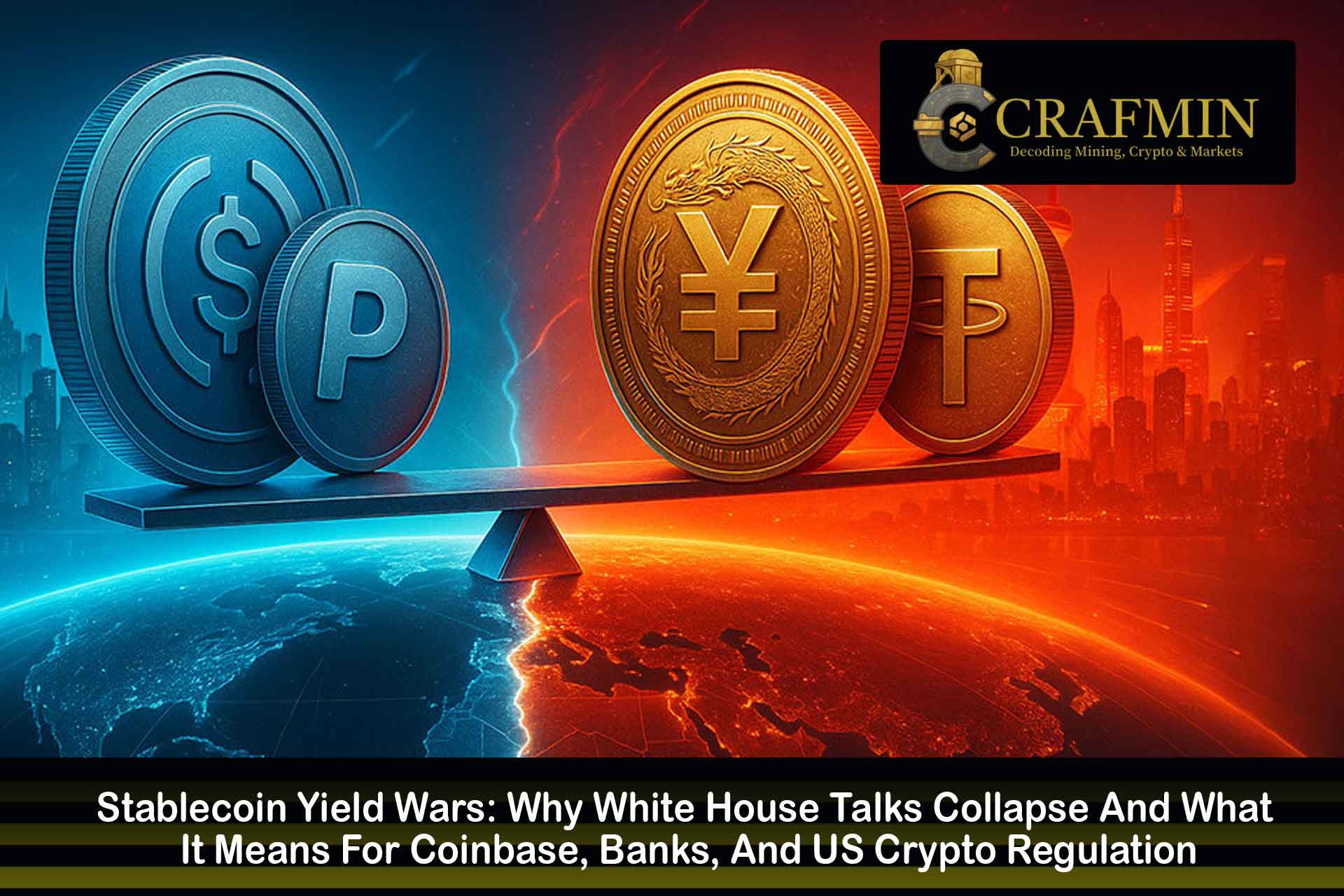
US crypto rules are stuck on one question: should digital dollars pay yield? A White House meeting ends without a deal, delaying broader market structure reforms. (Image Source: Payment Expert)
The Washington Facts That Should Have Taken Place
The White House hosted a meeting with banking and crypto organizations in an attempt to stop several months of inertia regarding U.S. laws on digital assets. The biggest point of contention is the way the interest or rewards that are paid on stablecoins will be treated in the bill. Banking groups desire language that essentially prohibits the practice. According to crypto companies, rewards will be important in attracting customers and the ban will put an undue amount of power in the hands of the banks through the law. The representatives of the American Bankers Association, Independent Community Bankers of America, Blockchain Association, and The Digital Chamber participated in the meeting. In the long run, an agreement was not achieved and a new talk on the subject will be held.
The Word Yield Might Be Boring to Hear; However, It Leads to Transformation
The word yield might be boring to hear; however, it leads to transformation. When you have not used stablecoins, consider the following: a stablecoin is meant to work like cash; one coin has the value of one dollar. Suppose there is an app that claims to hold 1000 in stablecoins and get 4%. It is not a technology trick; it is the one competing directly with bank deposits. Banks are concerned with the risk of funding. Cryptos consider it a method of attracting consumers. Regulators are asking themselves whether we are building a savings account devoid of the customary bank regulations. This is why the argument is rather emotive and hot-tempered.
The Reason The Negotiations Are Failing: The Problem Of Rewards Versus Interest
The debate is not only on the existence or non-existence of yield, but also on the definition of yield. The banks would like the bill to treat most yield-like payments as interest, the type of payment that is associated with deposits, prudential regulations and financial stability. Crypto lobbyists retaliate by referring to the term ” rewards. They mention that some payouts are customer incentives, loyalty benefits, or activity-related benefits. Such distinction is important since one draft permits some of the activity-related incentives but aims at passive just holding it yields. As a matter of fact, the demarcation soon blurred. In case an exchange rewards you daily by having a balance, then the majority of users would interpret it as interest. Lawmakers are aware of this.
The discussion is turned into a word play. Whoever prevails in the definition prevails in the market.
The Reason Banks Are So Desperately Fighting
Banks are not dependent on sentiments, but on deposits. Deposits fund loans. Loans bring profit. Profit supports stability. According to banks, yielding stablecoins has the potential to relocate deposits in insured banks to platforms that lack the same level of responsibility, posing a potential threat to the financial system. To put it plainly, when a lot of money leaves, the banks become more restrictive, loans become more costly and the problems spread faster. Although you dislike banks, this systemic risk argument is rational to policymakers. It does not just concern bank profit. It concerns the ability or otherwise of a cash-like token to turn into a speedy savings product online.

Banks warn yield-paying stablecoins could drain insured deposits, tighten lending, and spread financial shocks faster. (Image Source: Bittime)
The Reason Crypto Companies Are Not Willing to Sacrifice Rewards
Cryptocurrency businesses desire what banks already offer: an easy and secure method to get money. The banks have customers as they deposit their wages, pay bills and have debit cards in their wallets. Crypto platforms have to strive harder. They are user-friendly, 24/7 running markets, worldwide payment avenues, and additional incentives in some cases. That is why the industry defines rewards as a user-friendly feature and a competitive need. Coinbase is another subject of the debate. As stablecoin rewards are risky in the law of the land, the initial targets are the large compliant platforms that run online. The industry is worried that bans would best damage regulated players the most, with less-transparent or offshore still possible to provide rewards.
The Bill to the Drama: CLARITY and the Market-Structure Push at Large
The Stablecoin yield crisis thwarts broader efforts of market structure dubbed CLARITY. The goal is to establish federal regulations of digital assets and determine which agencies deal with what portions of the market. It attempts to address the questions that bother U.S. crypto: What is a commodity versus a security? Who registers where? What are the rules relating to exchanges, brokers, dealers and custodians? What is the effect of consumer protections in an ever-open market? The House passes its version early, but the Senate development halts on the stablecoin rewards clause. Therefore, yield has been turned into a one-point that can derail the whole effort.
The Warning Signal Shot in January: Coinbase Retreats
This is not a short‑term mix‑up. The Senate Banking Committee, in mid-January, made the process of its advancement due to objections, and the discussion of stablecoin interest or rewards is one of the most contentious aspects. The then Senate scheme stated that crypto businesses would not be able to pay interest on the possession of stablecoins, although they could provide rewards in response to certain activities, such as the transmission of money or the participation in a reward system. That plan was an attempt to reach an intermediate goal. However, this division is precisely what everybody is not fighting about. The reason is that the market will adjust to whatever the law may say.

January warning: Coinbase pushes back as the Senate targets “hold-to-earn” stablecoin interest but allows activity-based rewards. (Image Source: CryptoSlate)
The Appearance of a Stablecoin Yield
To individuals who are not users of crypto, it may appear abstract. Here is a simple example. An app on a renter in Brisbane will display: savings account: 1.5 percent; digital dollars: on an exchange: 4 percent. No jests, no leverage, no other coins. Only a greater price of something that is being sold as stable. The renter does not consider losing business on the banks. Their only thought is: rent continues to increase, I will take the additional return. Multiply this situation and you can understand why the banks would like to stop the habit before it becomes the norm.
The Political Fact: Everybody Claims to Defend the People
Banks refer to stablecoins that earn yield as a stability and consumer safety threat. Crypto businesses claim that the restrictions are unjust and maintain low rates. Both arguments could be valid in their own regard. This is why this subject is of great concern. It is not about the good and the bad guys. It is two systems colliding with each other: The system of regulated deposits in banking and the programmable money in crypto. Washington needs to determine the boundary.
The Dynamics of the Meeting Room, the Reason Why Compromising is Difficult
Compromise is normally effective when it is possible to exchange something. Stablecoin yield is not a minor thing. It is a core feature. In the case of banks, yielding is as close to letting a deposit challenger in the door as a ruleless deposit challenger. In the case of crypto, banning yield is like compelling the product design to shield the incumbents. That is why the meetings ended using polite words and no fix. Their motives do not coincide. And nobody wishes to appear like the party that, in one paragraph of the law, ceded to view the future of money.
The Reason Why This Story is Trending Today
Because the issue of market structure is not an abstract one. It is being passed across committees. It is attracting the attention of upper-level politicians. And it makes large institutions speak the silent truth aloud: stablecoins can be a competitor to deposits. It is more of a financial power change than a crypto headline. It also enters the everyday life of people now: the price of living, rates and seeking yield. This is the reason as to why those who do not have any concern about Bitcoin do care about this.
The Next Step That Follows is Three Realistic Scenarios
1) A hard ban on passive yield. Regulators create a strict principle: not holding because you have. Rewards may still be rewarded to active use on platforms, but the value that is of the savings-type vanishes. Other benefits will be provided by crypto companies, such as fee rebates, subscriptions, or bundles.
2) A slender path that has shields Congress would permit certain yielding but demand disclosure, bounds, or special regulations. Consider: you may do so, but you ought to tell where it comes from. This is a disheveled route that is sellable politically.
3) The stalemate drags on. Uncertainty remains in case there is no deal. Companies keep guessing. Lawyers keep billing. And the market refers to a business where rules are more definite. Reuters anticipates numerous more meetings to attempt to clear up the stalemate.
The Actual Stakes of the Coinbase and Large Exchanges
In the case of major U.S. platforms, stablecoin rewards are not an additional activity. They are at the core of what the customers appreciate: hold money, move money, and get something. In case the legislators intimidate that paradigm, negotiations will be deprived of one of the primary channels through which individuals enter them. It is not only about the money made. It’s about keeping customers. One that substitutes a savings habit is a product that will be stuck. This is why it feels like survival in regard to stablecoin yield.
The Real Stakes For Banks
Banks do not only engage in a struggle to make money. They protect a position that they have been holding for a century. In case stablecoins start being used as daily money, it will no longer be the bank that you will turn to as a natural place of keeping your cash. And when a stablecoin balance is more remunerating than a bank deposit, then the migration accelerates. Banks do not want the lawmakers to make their decisions after a backlash.

Banks fear stablecoins could become everyday money, pull deposits faster, and force rules only after a shock. (Image Source: American Banker)
The Consumer and The Bait: The Promise and the Catch
Stablecoin yield offers an easy offer: earn better, transfer money quicker, access 24/7, avoid ancient spleen. But the catch comes back: who takes the risk? What backs the payment? What can go wrong in case something breaks? Even such a word as stable can mislead a person to believe that it is bank-like safe. Regulators notice that. Since the headlines on consumer-harm may be on a weekend.
The Muted Technical Aspect of It That Counts: Whence The Yield?
Here you can shine with your lengthy piece. Fun does not come out of thin air. It normally originates in the following sources:
- Issuer revenue on reserve (Treasuries, cash equivalents)
- Platform revenue-sharing agreements.
- Lending/borrowing business (more risky)
- Marketing spend to get users
Policymakers are fearful that individuals will not discern the distinction between safe-appearing yield and risk-financed yield. Banks use that fear. Cryptocurrency companies believe the answer to it is transparency. This forms the primary policy issue.
The Reason Why the GENIUS Act Continues to Resurface
According to reports, there is a discrepancy between the previous rules of stablecoins: an issuer can be prohibited from paying interest directly, but can still organize rewards such as interest. It is the reason banks refer to it as a loophole. And it is the reason why the current bill attempts to shut it down. The issue: its closure would also put an end to mainstream exchange rewards that are already utilized by people. So lawmakers face a trade‑off: end product innovation or close loopholes.
The Reason Why Experts and Non-Experts Should Be Concerned
The reason why experts are concerned is that it provides precedent: how the U.S. defines deposit-like products in tokenized form. They are concerned because this is how world regulation is set by example. The reason why they care is that it alters the market structure and distribution of the stablecoins.
The non-experts are concerned since it is a matter of everyday life: saving, spending, sending money, and getting a percentage. Once a policy struggle is directly overlaid on household action, it ceases to be crypto news and turns into economic news.
Stablecoins are the most dangerous thing in finance right now. That’s why banks hate them.
Not because they’re risky.
Because they work.A stablecoin is a digital dollar that:
• moves 24/7
• settles instantly
• pays yield
• doesn’t need a bank in the middleThat breaks the… pic.twitter.com/YoJQiN8shL
— Jessica Gonzales (@lil_disruptor) January 30, 2026
And What This Entails Outside the U.S. (Including Australia)
U.S. rules influence: Even though you never handle a U.S. bill, U.S. rules influence:
- Which are the products of key exchanges throughout the world?
- How compliance teams shape characteristics,
- Response of banks and fintechs to other countries.
When the U.S. makes it hard to draw in, more reward-lite models will proliferate everywhere. Other regulators can use the U.S. as a template in case it permits it with guardrails. In any case, leakage in Washington gets into your apps.
The Bottom Line
Here is one of the hooks that you may employ. Begin with a scene. One has digital dollars in his/her hands. They do not want a massive breakthrough. All they desire is their money to make more. And then go to the policy sector: It is a debate by a room of business people on whether this is a new and good return or a danger. That will make your hybrid structure: Institutional concerns, Portes of law, Human reasons.
The problem of stablecoin yield is the key to the questions that people have to answer: Is a stablecoin pure digital cash, or is it equivalent to a new savings account? In case it is cash, then the earning is suspicious. In case it is a savings option, the prohibition of the earnings assumes the appearance of local business protection. It is the collision of those that renders the talks fruitless. This is why this narrative is more than crypto; a real discussion of who will be holding money online.
Frequently Asked Questions (FAQs)
-
- What is stablecoin yield?
Ans: Stablecoin yield is a return paid to people who hold stablecoins, often called rewards or interest. - Why do banks oppose it?
Ans: Banks argue it could pull money out of insured deposits and create financial stability - Why do crypto firms support it?
Ans: Crypto firms say rewards help attract users and keep the market competitive. - Did the White House meeting solve the issue?
Ans: The talks end without an agreement, and negotiations continue. - What happens if the US bans stablecoin yield?
Ans: Exchanges may remove passive rewards, switch to activity-based rewards, or redesign products to meet the rules.
Disclaimer
- What is stablecoin yield?