

The browser ceases to be a window and becomes a worker.
Chrome is now capable of doing that which browsers never did very well.
It does not merely present you with the web. It goes around the web on your behalf.
The new Gemini feature features the auto browse in Chrome, transforming it into an AI agent capable of doing the rest of the multi-tasking-shopping comparison, travel planning, form-filling, and booking, and more without you clicking one tab after another to get the search done.
And when you wondered, “I do not want to do research; I just need it done,” this is the concept, coated with a thin layer of shipping mud and installed into the browser most often used, and a hundred times on earth.
And yes, it’s a big deal.
Since the information is no longer the most valuable part of the internet. You spend it burning up getting it.
 Chrome is shifting from a window to a worker. Gemini Auto Browse can research, compare, and fill forms across sites, so you stop tab-hopping and save time. (Image Source: Digital Trends)
What is Now Being Launched, in Simple Terms
Auto browse is an extension of Chrome that is installed in Gemini in the form of a side panel. You say it what you wish, and it begins clicking around in your place.
It does web-admin work that normally feels small enough, until you discover that it is consuming your entire evening:
- Comparison and deal-hunts.
- Mostly adding items to carts and working within a budget.
- Booking inter-flight and inter-hotel.
- Completing the forms (including the information in documents)
- Reserving and booking
Google sets it as agentic browsing: you specify the result, and the browser does the work.
Who Gets it (And Who Doesn’t)
At this point, the supply is limited.
Auto browse is currently being introduced in the US, but to people aged 18 +, on the latest version of Chrome, who are enrolled in Gemini in Chrome, and who have subscribed to Google AI Pro or Google AI Ultra on their own account.
There are a couple of important boundaries (when writing to an Australian audience):
- It does not have the Incognito mode.
- It will not be there as long as you are on Chrome with a work or school account.
- It is rolled out gradually, hence it might not be immediately visible to even qualified users
Therefore, to the Australian reader of this day: the trend does still count, though not yet on your toolbar. That is the trend of browsers, and Chrome is taking the first plunge into the mainstream.
The Fact That Alters All Things: It Can Sign in (With Permission)
This is where your brain changes to a cool helper, too; this is different.
It can be used to browse automatically and manage tasks that need a login with the permission of Google Password Manager.
Google also explains that Password Manager does not transfer your passwords to Gemini – it only gives it the power to log into your accounts, not your passwords on a sticky note.
That is the gap between the AIs which are advised and the AIs which act.
The internet has been awash with talking assistants. This is a helper who does so.
The End of Clicking No Longer is a Metaphor
The majority of browsing has become muscle memory.
Search. Open. Skim. Back. Open. Compare. Forget what tab had the price. Repeat.
Auto browse is focused on looping back. It makes the browser a runner and can run fast through the dull procedures and you will remain at the finish line.
The easiest explanation to imagine: You are not requesting Chrome to provide you with answers. You are requesting Chrome to complete the assignment.
Such a change seems insignificant, yet it alters the competition of websites in their struggle to attract people.
Since it is no longer about what users see only. It is a matter of choice on the part of the agent.
Scenario: An Ordinary Life Situation, Which is Travelling Without Becoming a Travel Agent
Imagine the procedure of trip planning.
You start excited. Two tabs down, you are comparing baggage rules. At table five, you are counting. Nine tabs in, you’re irritated.
Auto browse is designed with precisely such an issue in mind.
It is explained by Google by suggesting the most appropriate weekend to stay in the hotel, depending on your hotel and flight parameters–and it can even do the cross-checking of the sites.
That is not AI that writes a travel itinerary. That is, AI does the tedious hunting, comparing and narrowing down.
And when the painful part is eliminated, more people do attend, in fact. That is what behavioural change at scale is.
 Trip planning turns into tab chaos fast. Gemini Auto Browse cross-checks flights and hotels to find the best dates, so you skip the tedious comparing and just book.
Shopping is No Longer a Process But is a Conversation
The most effective early examples are not on writing or summarising. They’re about shopping.
The example of Google is strangely apt: you get a vibe in a photo (a Y2K theme party), and auto browse recognises what is in the picture, and it finds something similar, adds it to your cart, does not exceed your budget, and a discount is even applied.
This is why it is like the internet will not be the same.
Since shopping ceases to be a search process. It turns into explaining the appearance, the funds, the time limit, and then overseeing.
It is more like having a sharp-edged friend with endless patience than having a conventional browser.
The Mute Business Tale Lurking Within This Feature
This is your bread and butter in case you are writing a long-form SEO article:
Chrome is becoming a transactional layer.
Nothing that looks like a payment system, but like a decision system, an interface which selects paths, not merely shows pages.
Also, Google claims Chrome will implement the Universal Commerce Protocol (UCP), an open agentic commerce standard that it developed with partners (Shopify, Etsy, Wayfair and Target) as well.
Speaking in regular language: the business is gearing up toward AI agents being able to shop between sites without difficulty.
That’s not a gadget feature. That’s a new economic pipe.
The Control Question: Do You Still Need You?
Yes, and here the product design is intelligent.
Auto browse stops and requests confirmation of sensitive actions such as making a purchase or sharing on social media.
Google also adds in a takeover task, where the agent transfers control to you to make some steps you have to complete yourself (transactions, terms acceptance, account creation and other sensitive operations).
So the primitive version does not succeed as an escape bot.
It is more of: I will bring the boxes, but you are going to be the one to sign the delivery slip.
That equilibrium is not accidental, since trust is what it is all about.
The Speed Limit: Daily Limits (And The Reason Behind It)
In case you are attempting to comprehend the paths where Google believes this path takes you, refer to the usage limits.
The Google help documentation has daily limits on tasks requested:
- AI Pro: 20 requests (maximum) of multi-step tasks in a day.
- AI Ultra: 200 or less per day
Not a frivolous feature of that. That is, we expect people to make a lot of use of this.
It also foreshadows a future in which agent minutes will be a commodity–such as data, or cloud compute, but sold as convenient.
 Google’s limits tell the story: AI Pro caps at 20 Auto Browse tasks a day, AI Ultra at 200. That screams daily, heavy use and hints that “agent time” could become a paid commodity, as data or cloud compute.
The Danger That No One Wants to Discuss: Immediate Inoculation
Now to the point in which your article must be handled, not with fearmongering.
The agents are also known to have a vulnerability in web-browsing AI agents, which can be controlled by malicious commands embedded in information.
Google specifically cautions on timely injection, where a site, email, or document has hidden instructions which the agent can view and follow unintentionally.
Google indicates that it is introducing new defences and emphasises user surveillance, confirmation messages, and limiting actions to pertinent websites and actions.
The moral of the story to the common user is straightforward:
Do not give an agent a sensitive job and forget to pay attention, if you would not leave your unlocked phone with a stranger.
Not since the agent is bad, because the web is a tangle.
Why This is Important Both to Professionals and Laymen
Somehow, non-experts experience relief. At last, somebody does the aggravating part.
Professionals are experiencing another thing: a paradigm shift.
In case browsers are made to be action-takers, then:
- SEO does not just concern human ranking.
- The UX is not merely about making humans delighted.
- Conversion does not just mean leading human beings.
It is also about making sense and being reliable to skimming, decision-making, and acting agents.
And the oldest winners will probably be the sites which are:
- Transparent on the price and supply.
- Consistent in structure
- Fast and mobile-friendly
- Open on charges and policies.
In other words, the dull sites which are already running clean operations.
Using Gemini Auto Browse in Chrome Currently
When you are eligible, auto browse is embedded in Gemini within Chrome, as a right-hand side panel which you can leave open as you can navigate the tabs.
The flow is simple:
- Open Chrome on a desktop and log in using a personal Google account.
- Open the Gemini side panel.
- Type a job as you would brief an able assistant.
- See how it can be used by following the steps (clicking, filtering, comparing).
- Provide authentication when Chrome requests it on sensitive operations (payments, social posts).
Critical weaknesses are included in the reality of today:
- It doesn’t work in Incognito.
- It does not work with the work/school Chrome accounts.
- Google AI Pro / AI Ultra subscribers are now US-only.
Even though you are not yet able to do so in Australia this very second, the trend is apparent: network is no longer read, but rather done.
Big updates on Gemini in Chrome today:
+ New side panel access (Control+G)
+ Runs in the background, so you can switch tabs
+ Quickly edit images with Nano Banana
+ Auto Browse for multi-step tasks (Preview)
+ Works on Mac, Windows, Chromebook PlusI’m using it multiple times… pic.twitter.com/2LtxoIdVw4
— Josh Woodward (@joshwoodward) January 28, 2026
Workable Prompts (And Why Most People Are Wrong)
The majority of people query an agent as though they are talking to a friend. Agents require something nearer to a brief.
Suggestions that are good are: constraints, preferences and a finish line.
The following are immediate templates that you can paste directly into your article:
Prompt 1: Shopping Within a Budget
Locke the best-value [object] that costs less than X AUD, that can be delivered to [suburb/state], at reputable stores. Emphasise warranty and returns. Provide me with 3 choices of advantages/disadvantages and final cost, including shipping.
Why it is effective: it makes the agent sift what is important, rather than what glitters.
Prompt 2: Travel Planning, Eliminating the Tab Chaos
Plan a 3-night weekend in [city] for 2 people. Limit flights to less than X and hotel to less than Y. Like walking, late checkout and free cancellation. Display the 2 itineraries and the best weekend schedule.
Google makes travel planning one of its main applications.
Prompt 3: Admin Work (The Stuff You Are Keeping on Putting Off)
Log in to [service], my current plan, locate the cancel page, and display the last confirmation page before my approval.
This is the same as inthe coverage of auto browse that describes tasks of managing subscriptions.
Prompt 4: Form-Filling Continuing to Be in Control
Help me fill this form with the help of this page’s information. Prepare to submit and present me with a review summary final draft.
Google is designed to keep humans in the loop whenever they are to perform sensitive activities.
The Time it Becomes Real: It Can Sign in (Without Giving Your Password)
This is the practical hinge.
Auto browse also has the ability to execute tasks which involve a login, provided it has permission to utilise the Google Password Manager. Passing passwords across to Gemini is also not permitted by Google, as it claims Password Manager does not share your password, but rather provides access to passwords.
This is why this does not seem like another chatbot. It is as though a new type of browsing–in which the browser is a good operator.
The Great Question of Safety: “Is it Foolable?
Yes, and Google says so.
Targeting can be done by injecting agents promptly, through a malicious instruction being embedded in a page and an agent can do it (unless safeguarded correctly). Google flags injects as a danger, and it is developing defensive measures, not to mention that it needs user-level monitoring and verification.
Turn that into a simple rule that your readers will not forget:
In case a task would cost money or reveal any of your personal information or alter an account-setting, keep an eye on the agent like you would a fresh new intern on day one.
Assistive, quick, and not to be left unattended with the keys.
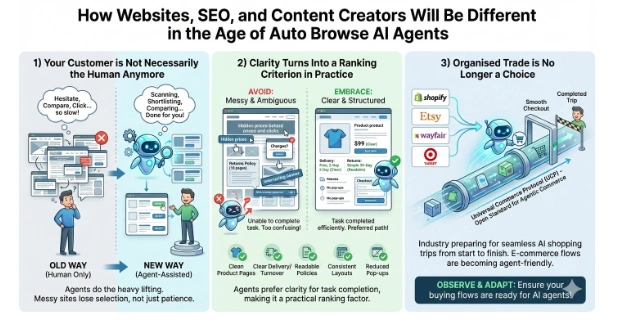
How Websites, SEO, and Content Creators (Hereby) Will Be Different
This is where your lengthy article makes its dividend. Since auto browse is not a mere feature. It is a fresh filter between individuals and the web.
1) Your Customer is Not Necessarily the Human Anymore
One used to scroll, hesitate, compare, and then click. The scanning, shortlisting and comparing are now done by an agent. The choice is made by humans, but the choice of what the agent wants to present to them is also becoming more and more important. Messy, slow or incomprehensible sites do not merely make one lose patience. They lose selection.
2) Clarity Turns Into a Ranking Criterion in Practice (Although it Might Not Be So in Theory)
When your price is hidden, your charges are ambiguous, and your policy on returns is convoluted, agents are unable to get things done. They will prefer spending their time in places where the results are clear. That means:
- Clean product pages
- Clear delivery, and turnover.
- Readable policies
- Consistent layouts
- Reduced number of pop-ups between steps.
Not because agents “like” them. Since the work can be completed by agents.
3) Organised Trade is No Longer a Choice
Google indicates that Chrome will have Universal Commerce Protocol (UCP), an open standard intended to facilitate agentic commerce, created with Google partners like Shopify, Etsy, Wayfair and Target.
That is an indicator of something significant: the industry is getting ready to undertake shopping trips with AI agents that carry them through to the end.
You do not need to panic, in case you run an e-commerce. Nonetheless, you must observe what is happening: flows of buying are being agent-friendly.
4) Conversion Rate Optimisation Acquires a New Competitor
Traditional CRO is human behaviour optimisation: badges of trust, the positioning of buttons, reassuring copy. The agentic browsing provides a new level: each action is interpreted by the agent and constrained by him or her, and the agent attempts to accomplish the task in a clean manner.
So CRO starts to include:
- Fewer grey buttons (Continue to what?)
- Fewer forced detours
- Reduced end-of-checkout surprise charges.
- Fewer “create account” walls
Friction is simply unacceptable to agents. Friction is a discontinuity of the task.
What This Becomes Next (Without Moving Into Sci-Fi)?
The ambition is not under wraps at Google.
Coverage Gemini in Chrome has the ability to be referenced and/or take action on context based on other services, such as Gmail, Calendar, Maps, Google Shopping and Google Flights (depending on your settings and permissions).
That’s a clear trajectory:
- The browser reads your activities.
- And then it knows what thou hast desired.
- Then it begins doing it on the web.
A larger personal intelligence direction is also stated in reporting, that is, deeper reasoning than personal context and great emphasis on permissions.
The “stop clicking of the mouse” is not, then, after all, never again touching a mouse. It has to do with clicking as an exception rather than the norm.
Also Read: Britain’s AI Compute Race: The UK Supercharges Cambridge’s DAWN and the Startup Boom That Follows
Rudimentary Guidelines to Follow in Its Use
This part is also entertaining to both experienced and non-experts.
Use it for:
- Price comparisons (prices, specifications, delivery time)
- Admin (discontinue, demote, update information)
- planning (travels, events, schedules)
- recurring form stages (with review before submission)
Avoid it because (unless you are taking notes):
- Anything that entailed hefty payments
- Anything that has legal agreements.
- Anything touching on personal files in foreign locations.
- Anything that concerns account recovery measures.
And one more: when you’re tired.
The majority of the mistakes that occur online are when we are tired, in a hurry or when we are distracted. Agents don’t remove that risk. They are able to magnify it when you cease to pay attention.
Is it Already Available in Australia?
Recent reports and rollout details on Google indicate that only AI Pro/Ultra subscribers can have access to it in the US right now, and that it will be expanded to the rest of the world later.
Wrap: Why This is the Web Tipping Us Under
The reason why people love the internet is that they love tabs. This is because they love the internet since it gets things done.
Google is saying: “Stop navigating, auto browse. Start delegating.”
When this falls into the hands of ordinary users, it works to alter default behaviour rapidly.
And, as the behaviour of default alters, all the surrounding it affects will change, too: shopping flows, content formats, search engine strategy, and even the feel of a good website.
The cessation of clicking is not some sensational headline. It is a silent change of duty: Your hands off to your browser.
Frequently Asked Questions (FAQs)
- What does Chrome mean by Gemini Auto Browse?
Ans: It’s an agent capability that lets Gemini in Chrome complete multi-step web tasks, like research, comparing options, filling forms, and booking, directly inside the browser. - Is Auto Browse available in Australia?
Ans: Not yet. It’s currently rolling out in the US for eligible AI Pro/AI Ultra users, and Google is releasing it gradually. - Can it buy things for you?
Ans: It can add items and move through checkout steps, but it pauses for confirmation on sensitive actions like completing a purchase. - Does Gemini in Chrome steal my passwords?
Ans: No. With your permission, it can use Google Password Manager to sign in, and Google says Password Manager does not share your passwords with Gemini in Chrome. - Does it work in Incognito mode?
Ans: No. Google’s documentation says Auto Browse isn’t available in Incognito mode. - Is Gemini Auto Browse the same as Gemini in Chrome?
Ans: Not exactly. Auto Browse is a feature within Gemini in Chrome that performs multi-step actions (clicking through tasks), not just page summaries. - Can I use Auto Browse with my work or school Google account?
Ans: No. Google says Auto Browse isn’t available when you’re signed into Chrome with a work or school account. - Can it log me into websites?
Ans: Yes, with permission. Google says it can sign in via Google Password Manager, and Password Manager doesn’t share your passwords with Gemini in Chrome. - Will it confirm sensitive actions like purchases or posting on social media?
Ans: Yes. Google says it requires confirmation for sensitive actions such as purchases and posting on social platforms. - What is prompt injection, and why is it relevant?
Ans: It’s when hidden or malicious instructions are embedded in web content to trick an AI agent into doing something unintended. Google flags this as a risk for browsing agents like Auto Browse and says safeguards exist, but user oversight still matters.