
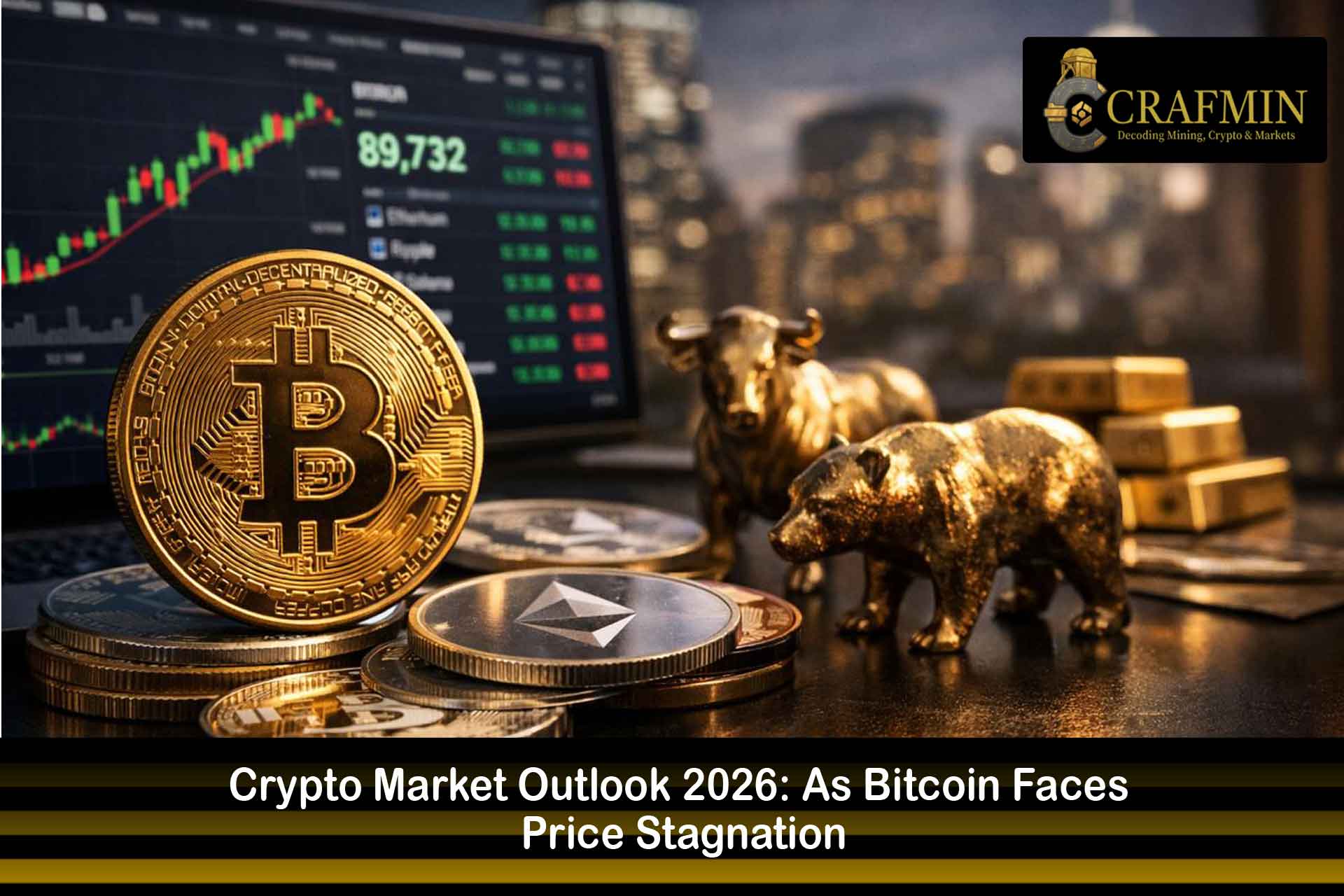
The crypto market outlook 2026 is getting more uncertain as the fading of momentum across major digital assets and the decrease in risk appetite are the main factors that influence it. Bitcoin is changing hands at around $90,600 after hitting a peak of $93,000 for a short period of time at the beginning of the week.
The total crypto market cap has decreased by about $35 billion or 1.14% and now stands at $3.06 trillion. More than 80% of the top 100 altcoins are falling behind, which indicates a general decline in the market.
The analysts associate this cooling off with global caution and unclear signals from the traditional markets. The investors are weighing the growth expectations against the rising geopolitical tensions and the shifting interest rate outlook.

Market sentiment weakens as capital rotates into safer assets. [Corporate Finance Institute]
How Are Traditional Markets Influencing Crypto Sentiment?
Trends in equity and commodities are making up the new crypto investment insights for the authorities. The S&P 500 index has been up more than 14% for three years in a row, therefore.
However, on the other hand, the analysts point out that the AI-driven rally might be losing power in the future. Gold price jumped more than 60% in 2025, and it is now looking at the resistance level of $4,500 per ounce.
This surge is a result of increased risk aversion due to the unclear economic situation. Usually, when gold is the preferred asset for investors, the speculation in other markets diminishes. There is a strong possibility that the crypto traders are changing their risk strategy along with the allocation shifts in their portfolios.
Bitcoin ETF Flows Show Fragile Institutional Confidence
The institutional participation factor is still the main driver of the crypto market outlook 2026. Bitcoin ETFs had $1.2 billion in inflows during just the first couple of trading days of 2026.
On the very first day, the inflows reached as high as $697 million, which is the largest single-day bump in inflows since October. Confidence, however, ebbed quickly on day three, witnessing $243 million outflows. Another $476 million was withdrawn from the ETFs the following day.
The fast pace of this shift is indicative of the large investors’ uncertainty. While demand for the crypto is still there, the commitment that the investors show seems to be dependent on the short-term price fluctuations.

Large inflows are followed by sharp reversals in ETF activity. [MEXC Blog]
What Does The Death Cross Mean For Bitcoin Price Stagnation?
Technical indicators suggesting that the Bitcoin price is going to be stuck in a consolidation for a long time have backed up its price stagnation. The digital currency is now at a price of $90,673, registering a loss of approximately 0.66% on the day.
On the other hand, Bitcoin has enjoyed a rise of 3% over the last week due to a substantial spike. The so-called death cross trend is still valid, which means that the 50-day EMA is below the 200-day EMA. This is a signal that usually indicates further price corrections or prolonged price ranges.
The prices are below both moving averages, thus increasing the technical distance. The reduction in the possibility of a golden cross developing in the near future is a consequence of this.
Bulls And Bears Remain Locked In A Tight Range
Currently, the moving averages are close to each other, illustrating a balanced fight going on between buyers and sellers. In the case of bears winning, the trending experience may get twice as slow as the previous history.
Bitcoin has once dropped from an all-time high above $126,000, and now the situation reflects less volatility than in the case of the previous sell-offs. Traders are now betting on the question of whether Bitcoin will be able to regain the $3.2 trillion market cap. A continuous move above this threshold could be the starting point of more extensive recovery talks.
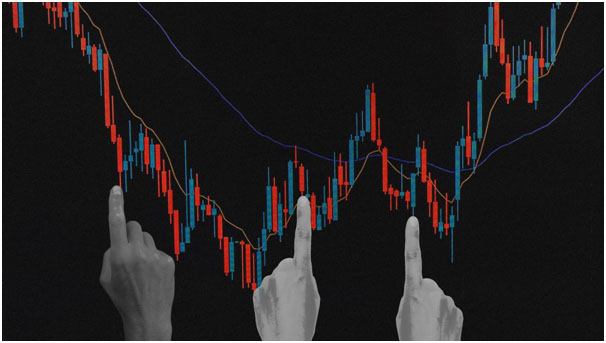
Narrow moving average gaps reflect market indecision. [Fast Company]
What Should Investors Watch In The Coming Months?
The future of the cryptocurrency market in the year 2026 will be widely dependent on the factors of macroeconomic stability, institutional money flows, and, to some extent, the nature of regulations.
The interest in ETFs will continue to be one of the major indicators of professionals’ confidence in the market. The direction of the commodities might continue to be a leading factor for the changes in risk appetites across different portfolios.
The patterns in technical analysis will be mainly used for short-term trading strategies. Buying and holding investors will take notice of the trends in adoption and infrastructure development. Consistency in capital inflows, along with stabilisation of the sentiment, might be a catalyst for market stability.
Also read: Crypto Market Forecast 2026: How Markets, ETFs And Lawmakers Could Drive The Next Rally
FAQs
Q1: What Is Driving Bitcoin Price Stagnation In Early 2026?
A1: Weak technical signals, cautious institutional flows, and broader risk-off sentiment are limiting upward momentum.
Q2: Why Are Bitcoin ETF Flows Important For The Crypto Market Outlook 2026?
A2: ETF flows reflect institutional confidence and can significantly influence liquidity and price stability.
Q3: Does The Death Cross Guarantee Further Price Declines?
A3: No, but it often signals extended consolidation or slow downward movement rather than sharp rebounds.
Q4: Are Investors Moving From Crypto Into Safer Assets?
A4: Rising gold prices suggest some capital is shifting toward traditional safe havens during uncertainty.