
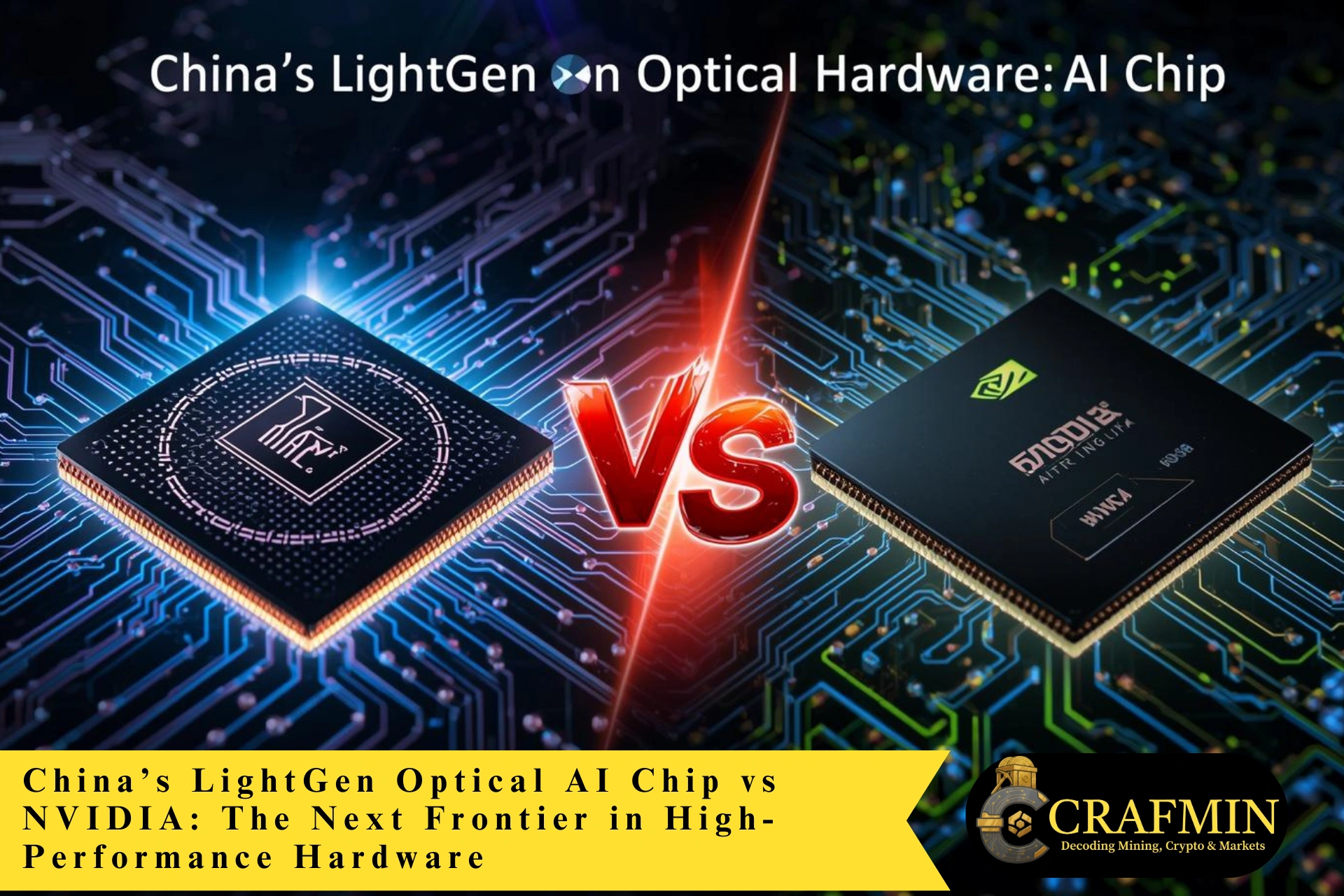
The current generation of computing hardware is being observed by the world today and it utilises the use of light to outperform traditional silicon chips in both performance and efficiency. Top Chinese scientists have developed a new optical AI chip called the LightGen, which has sparked controversy in the global market due to reports that it can outperform the A100 GPU currently used by NVIDIA to run generative AI in data centres.
It is not a mere technical breakthrough. It may transform the development of computing in the wake of skyrocketing energy requirements, increased generative tasks and geopolitical pressures on semiconductor manufacturing chains. What is LightGen and how does it compare to conventional GPUs? What does that say about the status of NVIDIA in the high-stakes hardware race? These questions will be unpacked with facts and real-life implications.
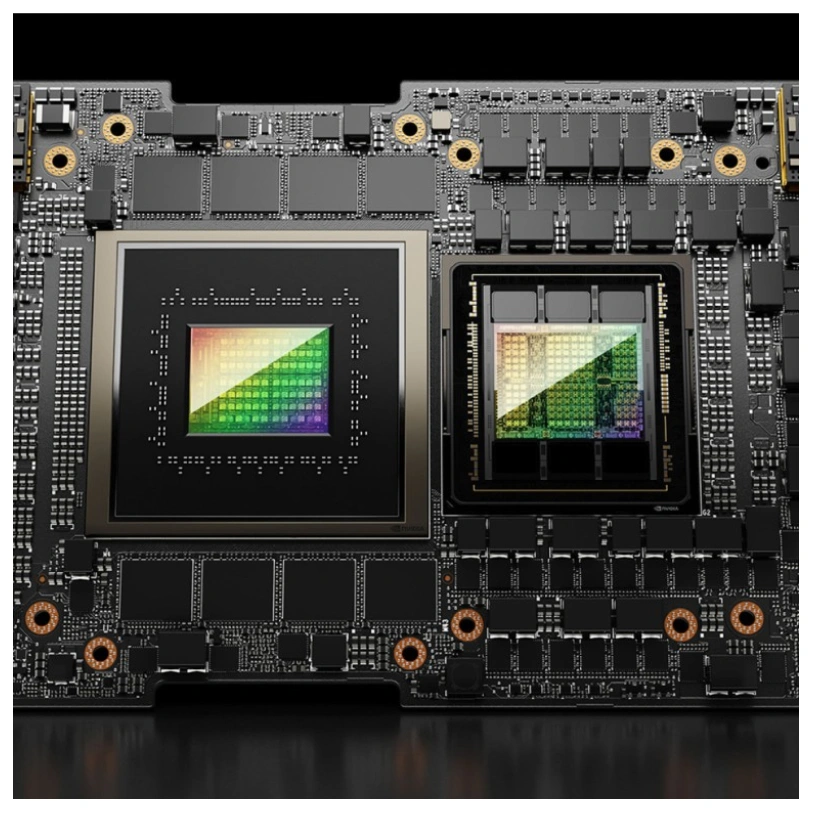 China’s LightGen optical AI chip uses light to boost speed and efficiency, challenging NVIDIA’s A100 in select AI workloads. (Image Source: South China Morning Post)
LightGen: What, Why, and What
LightGen is a photon (particles of light) processor, where calculations are performed with photons instead of electrons. This shift provides significant improvements in speed and efficiency of particular tasks since light is faster and less resisted than electrical signals.
Shanghai Jiao Tong University and Tsinghua University created LightGen, which transfers millions of neurons of photonic origin onto a single chip to deal with large-scale generative tasks, particularly image generation, semantic processing, and 3-D visual tasks.
LightGen is not a traditional GPU. It is a photonic accelerator, which in laboratory experiments demonstrates speed and energy-efficiency numbers that are several orders in astonishing numbers, exceeding those of the NVIDIA A100. Let’s look at the details.
Being Faster Than the A100 of NVIDIA: Real Advantage or Lab Curiosity?
According to recent studies in the field of science, LightGen provides nearly 35,700 trillion computations and 664 TOPS/watt energy consumption, which exceeds that of NVIDIA in selected generative benchmarks used to drive image and video generation.
It is argued that in some applications, LightGen would be 100 times faster than the NVIDIA A100. Nevertheless, one should realise the subtext:
- A very specialised workload: LightGen has its best applied strengths on smaller generation workloads, such as semantic generation of images, auto-denoising, reconstruction in 3D scenes, and style transfer. These activities are intensive, but narrow as compared to the use of wide-purpose GPUs.
- Not a universal replacement: Although those benchmarks are impressive, LightGen is not a universal replacement for GPUs yet. The NVIDIA GPUs, together with ecosystems like CUDA, are still the leading choice to train and perform inference, simulation, and production workloads of general AI.
To put it bluntly, LightGen is a masterpiece of specialised performance and not the general dominance of a sword. However, in the case of workload that relies on speed and energy efficiency, this new category of hardware may be a game-changer.
Photons Vs Electrons: Why Light Changes the Game
Conventional chips, such as those offered by NVIDIA, A100 or Blackwell, process data with the help of the flow of electrons inside silicon. This method was scaled effectively over decades until it was prohibitively difficult due to factors like heat and resistance. These constraints are causing Moore to slow down its Law.
LightGen also avoids some of these restrictions by employing photonic computing, whereby light beams transmit data and interact within chip infrastructures to execute computations.
Key advantages include:
- Velocity of light transmissions: Photons travel at a speed that is equal to the speed of light, reducing the operation times.
- Low heat and energy waste: Light produces a lesser thermal load compared to the electrons, and thus less energy is lost and less energy is needed to cool.
- Massive parallelism: The data can be processed concurrently using different wavelengths and paths, increasing throughput on operations on matrices that are used in generative AI.
LightGen is particularly useful in generative tasks based on matrix multiplications, which is especially good, and makes LightGen, theoretically, highly efficient in workloads powering recent AI expansion.
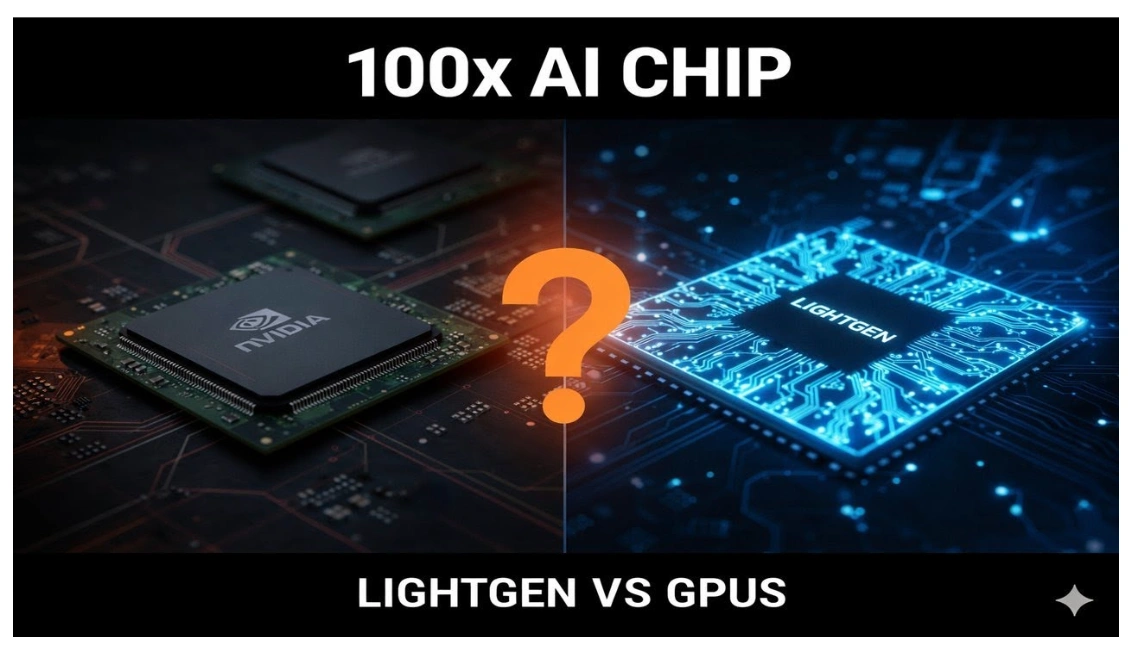 LightGen uses photons instead of electrons to deliver faster, cooler, and more efficient AI computing, especially for matrix-heavy generative workloads. (Image Source: YouTube)
Story Behind the Trenches: Why Photonics was Pushed By Researchers
To get the human picture: Imagine those engineers who are frustrated by the power level of the traditional GPUs. When models had billions of parameters and data centres were crippled by electricity, the question was: what will we do and not use electrons at all?
LightGen was triggered by the question in Shanghai and Beijing.
One of the research leaders, Dr Chen Yitong, added that the task involved three main challenges: coupling photonic neurons onto a chip, realising all-optical dimensional transformations, and developing training algorithms that do not require conventional labelled datasets, all of which obstructed optical computing and workers of the general AI in the past.
Their discovery was a gradual one that was based on physics, materials science, and computational theory. What comes out of this is hardware that does not merely process data- it reinvents the process of what it can do to process data.
Energy, Environment and Economics of Computing
Among the largest current messages in computing is that the energy demand exceeds supply. Generative services run by data centres incur billions of dollars of electricity per year, and as the workload of AI increases, so do the expenses.
The promise of efficiency is timely by LightGen. Photonic chips, by executing operations at extremely reduced energy cost, could render large-scale computing more sustainable and economical, with significantly superior efficiency metrics.
Energy efficiency is an advantage to businesses whose operations require the continuous generation of work, such as in the production of media, or inthe simulation of autonomous systems. This is the reason as to why LightGen is under the watch of many CTOs and cloud architects.
Market Geopolitics Undercurrents: Beyond Engineering
It is more than just pure engineering behind this story. NVIDIA, a US-based company, has suffered since it was placed under export restrictions to restrict the supply of advanced GPUs in China. Such controls are meant to delay the flow of state-of-the-art computing hardware to the strategic rivals.
It is in that context that indigenous innovations such as LightGen can be seen as a strategic drive towards decreasing reliance on foreign hardware. Provided that China can create chips that outperform or equal NVIDIA in certain domains, it might alleviate the pressure on its technological ecosystem – and redefine the supply chains that have been dominated by Western semiconductor companies over the years.
The Way NVIDIA Will Probably React: And Why it is Important
Photonic computing does not come as a surprise to NVIDIA. As a matter of fact, it has long been recognised that electronic scaling is incapable of keeping up with the rate of AI development. Accelerating the timeline is what LightGen does.
The present approach of NVIDIA focuses on the concept of heterogeneous computing, i.e. a combination of CPUs, GPUs, DPUs and specialised accelerators. The architecture of Blackwell already borders on the edge of electrical efficiency. However, photonic innovations present a limitation that NVIDIA cannot afford.
NVIDIA will not be kicked out; instead, it most probably assimilated optical acceleration into its ecosystem. There are also future systems in which photonic co-processors can be used to execute particular generative tasks, and the training, memory and general inference are coordinated by GPUs.
This is typical of NVIDIA: it is a company that conquers by integrating.
The threat to NVIDIA is not LightGen. It’s fragmentation. If optical chips will become more of a reality than an anticipated one and remain closed ecosystems, NVIDIA may lose control over the following compute layer.
And that is why LightGen will be important even in the case that it never directly replaces GPUs.
The Reason Why This Moment is Different to the Previous Hardware Hype
Photonic computing has long been the topic of discussion. Why then does LightGen seem more real?
Three reasons stand out.
To begin with, LightGen is not just a prototype theory. It illustrates end-to-end generative activities, rather than discrete activities. That’s a crucial leap.
Second, the data centre energy crisis has hit an impasse. It is a new world in which power is becoming a factor that defines infrastructure choices rather than performance.
Third, geopolitical pressure has made hardware innovation a strategic requirement. Countries do not presuppose foreign companies any longer.
These forces combined will help LightGen no longer be treated as a science experiment but more as the opportune solution to structural requirements.
This isn’t hype. It’s alignment.
What Optical AI Chips Are Doing To Data Centres In The Here And Now
There is nothing that can stop modern data centres. They are constrained by power, heating and cooling.
Optical AI chips deal with all of them.
Photonic accelerators will provide reductions in electrical resistance and heat by:
- Lower cooling overheads
- Higher rack density
- More deterministic scale costs.
- Reduced carbon footprints
This is cloud gold to cloud providers.
One optical accelerator capable of generating images or semantically transforming images at a small fraction of the current energy requirements will leave the GPUs free to train or do mixed workloads.
Such productivity alters the price models.
Hybrid racks cannot be replaced in the near term. Photonic chips are inserted into existing architectures where they assume workloads.
That is the way revolutions actually occur, as quiet revolutions, coexisting with old systems.
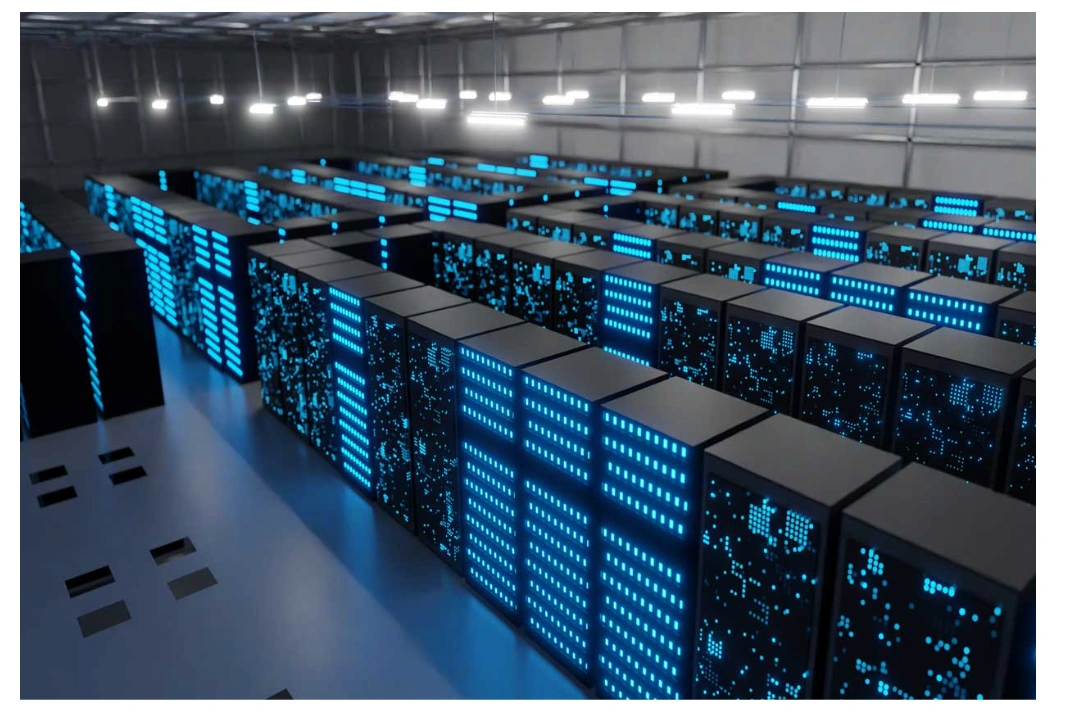 Optical AI chips reduce heat, power use, and carbon footprints in data centres, letting GPUs focus on training while boosting efficiency and density. (Image Source: MVV Energie AG)
The Software Issue: The Biggest Challenge at LightGen
Innovation in hardware is not the whole battle. Software decides adoption.
The silicon on its own does not give NVIDIA its market dominance. It is a product of CUDA, developer tooling, libraries and deep integration in industries.
This is a steep climb that LightGen has to face.
Photonic computing demands new programming models, programming abstractions and optimisation strategies. The developers will not redo the work on pipelines unless it is indisputable.
It is in this sphere that the coordination of the research-industry in China is vital. When the LightGen ecosystem is ready soon, that means in a matter of months, then its adoption will be much faster than most people anticipate.
Otherwise, LightGen will be a strong yet speciality accelerator.
The next 12-24 months will tell.
Why Generative Workloads are the Ideal Playing Ground
There is a reason as to why LightGen targets generative workloads.
These applications have features that can be handled by optical computing:
- Heavy matrix operations
- Predictable data flows
- Parallel-friendly transformations
- Tolerance to specialised acceleration.
The architecture of LightGen is useful in image generation, 3D reconstruction, semantic mapping, and diffusion models.
The massive foundation model training might be GPU-dominated in the near future. Photonic chips can be useful in inference at scale, wheremost the cost and speed are important.
This is where LightGen can sneak in on the market share.
Implications on the Industry in China and Not NVIDIA
The appearance of LightGen has an impact on more than a rivalry.
Cloud providers need to review infrastructure roadmaps.
Chip designers are under pressure to take photonics seriously.
The higher the diversity of computers, the more leverage a startup has.
There is a reevaluation of technology sovereignty policies in governments.
Even AMD, Intel and ARM are keeping an eye on it.
As soon as one of the players demonstrates a possible alternative compute path, the whole industry recalibrates.
That is the way the tectonic shifts start.
A new wave of Chinese photonic (light-based) AI chips is getting attention because it swaps electrons for photons, using optical interference to compute insanely fast while wasting far less energy as heat.
Photonic accelerators could slash the cost and power footprint of… pic.twitter.com/WC495sktNA
— Chubby♨️ (@kimmonismus) December 21, 2025
Human Angle: Pressure and Purpose, Engravers
LightGen has people toiling behind with high expectations.
Scientists are not out to make headlines. They are finding solutions to bottlenecks which they experience in their daily lives – overheating racks, soaring power bills, lack of access to cutting-edge GPUs.
When discussing LightGen, a similar note can be heard: necessity is the mother of invention.
Options are reduced, so is innovation.
It is not simply about winning over NVIDIA. It is a matter of creating systems that exist within actual constraints of reality- economic, political and physical.
The attitude rings much further than China.
Next Phase: The Real Test Phase
The following stage does not concern benchmarks. It’s about deployment.
Can LightGen:
- Mass production dependably?
- Integrate into the current infrastructure?
- Attract developer adoption?
- Perform under uncontrolled conditions?
Should the responses be skewed to the positive, optical AI devices transitioned into reality.
Otherwise, it continues to push the industry onto new paths by provoking new thinking.
Either way, the impact is real.
Also Read: AI Boom in 2026: The Global AI Race, Chip Wars, IPOs and Jobs
The Reason Why This Moment is a Turning Point
LightGen is in an uncommon cross-section:
- AI demand is exploding.
- Energy conservation is paramount.
- There is a limitation to hardware scaling.
- The competition in the world is sharp.
Innovation is quick when the constraints meet.
This is why it is a different development.
Not louder, sharper.
Concluding Idea: Light is Not Replacing Silicon but Actually Growing it
One architecture will have no place in the future of AI hardware.
It will be part of systems which will combine strengths – electronic reliability, optical speed and intelligent orchestration.
LightGen has no final word on NVIDIA. It expands the plot.
And to those observing the future of computing it is what is worth taking note of, not because of competition, but because the rules are being quietly rewritten.
Frequently Asked Questions
Q1. Is LightGen really 100× faster than NVIDIA GPUs?
Ans: In narrow benchmarks and specific generative workloads, yes. However, direct comparisons across all workloads are not valid due to fundamental architectural differences.
Q2. Is LightGen a replacement for NVIDIA GPUs?
Ans: Not yet. NVIDIA GPUs remain essential for general-purpose workloads and benefit from a mature and widely adopted software ecosystem.
Q3. Why use light instead of electricity for computing?
Ans: Light travels faster and generates significantly less heat than electrical signals, enabling faster computation and better scalability at lower energy costs.
Q4. When will photonic chips become mainstream?
Ans: Industry observers expect specialised photonic accelerators to see commercial deployment within the next few years, particularly in cloud and edge environments where energy efficiency is critical.
Q5. What is the LightGen optical AI chip used for?
Ans: LightGen is designed for high-performance generative workloads, including image synthesis, semantic processing, and 3D reconstruction.
Q6. How does LightGen compare with NVIDIA A100?
Ans: LightGen delivers higher performance and energy efficiency in select tasks, while NVIDIA A100 remains stronger for broad, general-purpose computing workloads.
Q7. Is electronic computing superior to optical computing?
Ans: Electronic computing is more versatile overall, while optical computing excels in speed and efficiency for highly parallel operations.
Q8. Will optical AI chips be deployed in data centres?
Ans: Yes. Initial adoption is expected in hybrid systems, where photonic accelerators handle specific, targeted workloads alongside traditional hardware.
Q9. Does LightGen threaten NVIDIA’s market dominance?
Ans: It challenges existing assumptions but does not yet disrupt NVIDIA’s ecosystem or market leadership.