
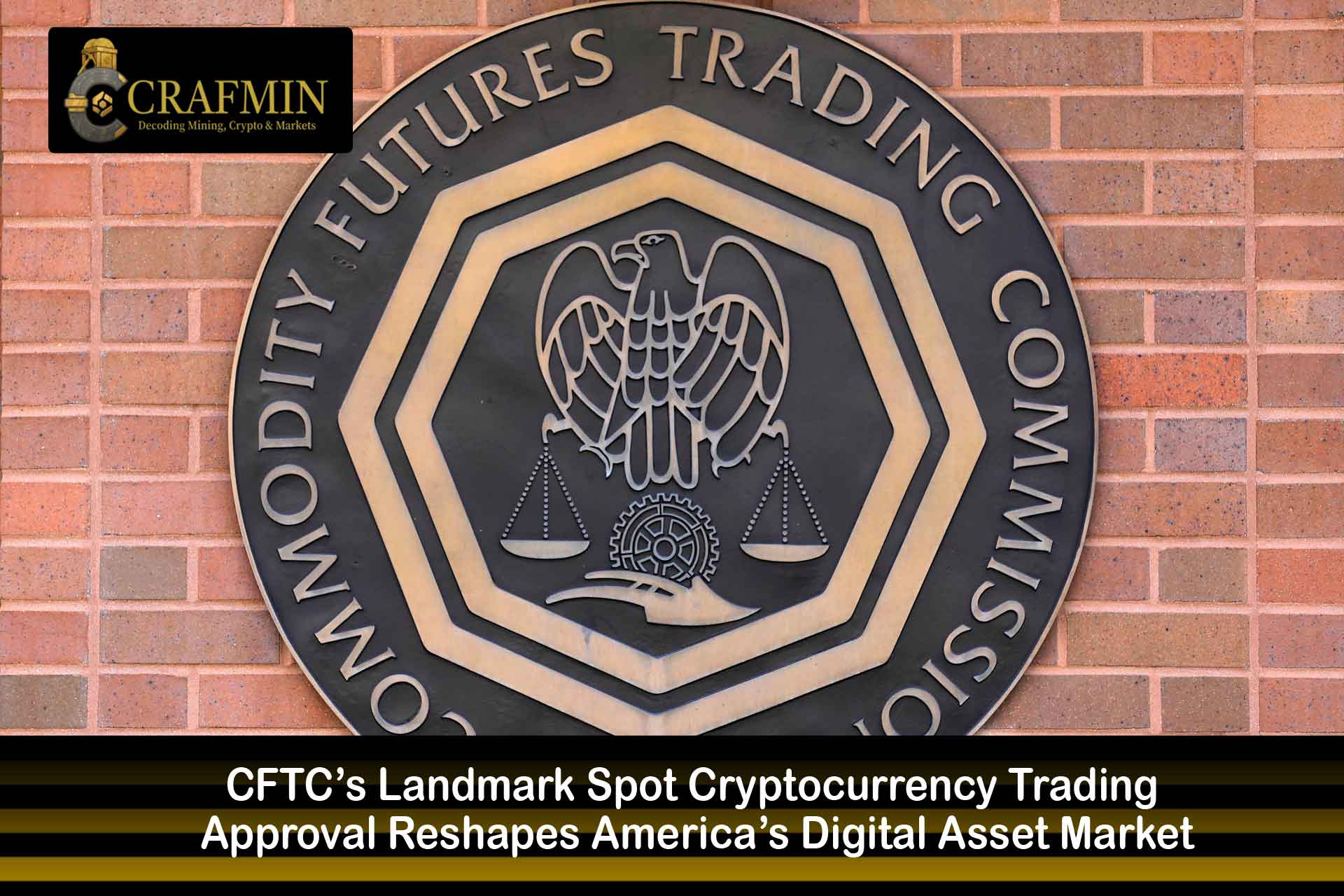
The authorisation for spot cryptocurrency trading is a significant milestone for regulated digital asset markets in the United States. The CFTC has permitted registered futures exchanges to conduct spot crypto trading under its federal oversight.
By doing so, the spot market for digital assets now has a framework with stricter supervision comprising provisions on custody, settlement and trading activity. The initial exchange to work under this framework is Bitnomial, which has been authorised to list spot crypto products with net settlement and margining.
The ruling allows exchanges to handle spot and derivatives trading under a single regulatory umbrella, which could facilitate market activity and diminish operational division. Furthermore, the approval, which is a major step forward for the exchanges, also involves new safeguards for traders since the exchanges are to comply with federal regulations before making spot digital assets available for trading.

CFTC authorises regulated US exchanges for spot crypto trading.
Why Are CFTC Crypto Regulations Important Now?
American CFTC crypto regulations have turned out to be the key player in the growing and capital-seeking global market. The lack of a definitive regulatory framework for years led many traders to opt for offshore or lightly supervised platforms. Such a situation posed continuous risks regarding liquidity, consumer protection and market integrity.
The regulations have taken care of the mentioned issues by moving the spot markets to a well-established regulatory environment. The exchanges willing to list spot crypto assets are now required to maintain compliance with the documented standards that include reporting, risk management, and transparent custody processes.
The transformation solidifies the market and, at the same time, decreases the risks associated with unregulated players. It not only indicates the great understanding among US regulators who are trying to lay down a uniform digital asset framework, but also affords greater collaboration. The action might clear uncertainty for the institutions that have been waiting for a straightforward route before they can enter the sector.
Will Spot Trading Approval Attract Institutional Investors?
The approval of spot cryptocurrency trading by the CFTC can be seen as a signal for the massive and gradual institutional engagement to come. The major players had stayed out of the spot market of digital assets largely due to the lack of clear governance and widely differing legal definitions.
Now that the CFTC has made trading of spot digital assets a federally supervised matter, they has created an environment that is more predictable for large investors. Not only would they need compliance assurances, but the high standards set by the CFTC could also be the factors for the institutions to participate in the new asset class. Besides, the regulated spot trading gives the firms the confidence to weave digital assets into risk-managed portfolios.
This trend may lead to the birth of new products in the market, such as structured funds, institutional spot markets, and trading lines regulated by law. The greater acceptance of cryptocurrencies could end up with better liquidity in the major ones, thereby increasing the market’s long-term prognosis.

Institutions reconsider crypto as CFTC clarifies governance.
Retail Participation May Expand Under Stronger Oversight
The mobile wave that might transport the crypto world is the retail traders gaining access to the spot digital assets more safely. Trading in regulated exchanges has thus far been a major method that is both transparent and controlled through risk controls and margining standards.
Retail investors are nowadays able to participate in products where the risks are significantly lowered due to constant supervision and operational integrity. Besides, the planned leveraged retail-spot model of Bitnomial is a clear indication of the future potentialities that can come up with the new policy framework.
All these pave a secure pathway for retail participation; however, they still impose strict compliance measures on the exchanges. The better standards may act as a guide for the retail traders in the digital kiosks marketplace place thereby granting them the double benefits of greater confidence and lesser risks.
Crypto Trading Compliance Strengthens Under Unified Structure
Under the newly implemented rules, cryptocurrency trading compliance has been elevated to a much higher level. By subjecting spot markets to the same regulations as futures, the CFTC essentially creates a common regulatory policy across the board. The exchanges that get to operate under this new rule will all have to comply with the same oversight standards that include, amongst others, clearing, settlement, custody, and reporting.
Consequently, the opportunities for engaging in manipulative practices and illicit activities are minimised. Federal surveillance tools have been introduced, which serve as a first line of defence against the detection of irregular trading of a certain type.
All these changes are working together to provide more barriers to entry for the wrong kind of traders while at the same time improving the entire industry’s reputation as well as protecting the market participants. In addition, they have also taken away the legal uncertainty factor, which has been one of the bottlenecks in the emergence of investment decisions in the entire digital asset space due to its wide-ranging nature.

Exchanges must meet strict CFTC standards for crypto oversight.
The Next Steps For US Spot Crypto Markets
The first successful model will lead to more exchanges applying for regulatory approval for spot trading in Bitcoin and other cryptocurrencies. The user competition might not only be among those who were always there but also among those who decided to invest in technologies that could bring them into compliance.
Regulators may give more advice about the collateral rules, stablecoin, and advanced reporting obligations that are advanced. It could finally lead to better inter-agency cooperation when it comes to government bodies that want to oversee the industry consistently.
As a result, the global attraction to the regulated spot markets will probably lead the industry to a new state in its development cycle. The existing trend towards innovations in the areas of custodianship, clearing, and institutional services for digital assets may receive a greater boost from the shift in the market scenario.
Also Read: Monad Cryptocurrency Rises As Crypto Rally December 2025 Accelerates
FAQs
Q1: What is the process of getting approval for spot cryptocurrency trading?
It is the CFTC that will permit the regulated futures exchanges to offer spot crypto trading under the supervision of the federal government.
Q2: Does this mean that all digital currencies are under the CFTC jurisdiction now?
No, the only products that can be traded on the approved exchanges are the ones that are currently regulated.
Q3: Will this new regulation be an advantage to retail investors?
Absolutely. Retail traders will be able to use the safer, regulated platforms that have compliance safeguards in place.
Q4: Will the institutions that are involved in crypto trading be more active now?
More institutional trading might happen as the new regulatory environment will be clearer and less risky.