

Amazon is aggressively pursuing a new frontier: artificial intelligence. Not quietly. Not cautiously. But with a leadership reset that signals intent.
The firm is reshaping its approaches to developing, managing, and scaling sophisticated AI systems, paying more attention to those that reason, plan, and behave across tasks, known as Artificial General Intelligence, or AGI. This is not an ordinary reshuffling. This is Amazon, planting its flag at the center of one of the most critical technology races in the current decade. (reuters)
And it is occurring even today.

Amazon resets its AI leadership, signalling a bold push in the race for Artificial General Intelligence. (Image Source: AOL.com)
The Essential Facts: What Changed Inside Amazon
Amazon shakes up AI leadership team as competition heats up in Silicon Valley. Critical responsibilities of the AI are currently grouped in a much tighter and centralized command structure. The objective is obvious: fast-track the development of cutting-edge models and integrations to AWS.
This change brings three priorities into play:
- More progress in systems for higher-level reasoning
- Greater integration between AI research and cloud infrastructure
- Improved coordination between the consumer, enterprise, and developer-level AI tool suites
Amazon wants fewer silos and more momentum. And a clearer path towards AGI-level capabilities.
What This Moment Means More Than It Appears
Every major technology company is talking about AI. Only a few rearrange their leadership to pursue general intelligence.
AGI deals not with chatbots capable of writing an email more quickly. It entails:
- Contextual awareness across various fields
- Continuously learning from experience
- Planning multi-step actions
- Ability to adapt without retraining
Such a degree of autonomy impacts work, decision-making, and online infrastructure. Amazon knows this. And it also knows the importance of timing.
The landscape of AI is changing from fixed models to more agent-like systems capable of functioning autonomously in software, supply chains, laboratories, and enterprises. This leadership change puts Amazon on the right track for the future.
The Pressure Cooker: Why Amazon Cannot Afford to Hesitate
The AI race has become real. Competitors act quickly. Cloud companies are competing on model intelligence today, not just storage and compute. Businesses are interested in artificial intelligence models capable of reasoning about documents, processes, and decisions.
Search behavior is changing. Productivity tools are developing. Software is going proactively, not reactively.
Amazon, if it slows down, risks becoming the infrastructure for another person’s intelligence. That’s the real threat. The fear factor exists. Therefore, Amazon acts.
Moving From Assistants to Agents: The Strategic Pivot
The direction that Amazon is taking with AI involves greater emphasis on depth rather than surface-level qualities. This implies moving away from traditional assistants to systems that can:
- Handle complex workflows
- Follow ambiguous instructions
- Optimize outcomes over time
- Work on multiple tools independently
This fits with what is increasingly being referred to as “agentic AI” – systems which can act, as opposed to simply answering queries. AGI does not emerge in one single breakthrough. It manifests through levels of autonomy. Amazon is creating those layers. (arcweb)
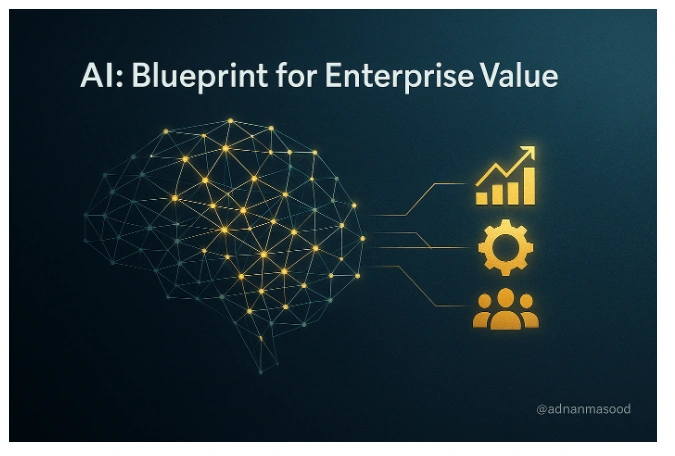
Amazon pivots from assistants to autonomous AI agents, building the layers needed for AGI. (Image Source: Medium)
Why Is AWS the Centre of Everything?
Amazon’s AI strategy is not an isolated thing. It runs on AWS. Every serious AI system requires three things:
- Massive compute
- World-class infrastructure
- Scalable deployment
AWS presently leads the global cloud service market. But now Amazon wants to be the one that dominates intelligent cloud services. It also requires a much closer linking of AI models, developer tools, data flows, and business systems.
In practice:
- Companies operate more intelligent automation on AWS
- Developers construct agent-based systems more quickly
- Scalable deployment of AI models without friction
AGI is not victorious by itself in the laboratory. It always wins when it runs.
Internal Operational Shifts
This leadership transition also marks an internal shift. Amazon is changing the way it considers risk, reward, and ownership with artificial intelligence.
For so long, the AI groups functioned in parallel: research in one place, products in another, infrastructure in yet another. Yet, this methodology hampers faster development as systems become more complex.
AGI requires unity. This requires quicker cycles of feedback between:
- Researchers
- Engineers
- Product teams
- Enterprise customers
Amazon’s restructuring draws these threads closer together. This is far more important than any model release.
What This Means for Businesses Today
This is not abstract news. Already, companies are being affected. The increasing use of artificial intelligence by Amazon will bring about the following changes to business:
- More autonomous tools within AWS
- Smarter data analysis systems
- Optimization by AI for logistics, finance, and operations
- Less need to monitor complex processes manually
For enterprise leaders, this introduces a further question: Are we preparing for AI technology itself, or for the decision-maker? Amazon’s approach tends towards the latter.
Developers Feel the Shift First
Developers are always aware of the changes before they are reflected in the headlines. The Amazon AI direction symbolizes future shifts in:
- APIs
- AI model access
- Agent frameworks
- Automation tooling
This brings opportunities. It also creates pressure. With increasing autonomy in AI systems, new ways of thinking about:
- Control
- Safety
- Transparency
- Accountability
The shake-up in the management of Amazon suggests a further involvement in these sectors, and not for ethics theatre.

Developers spot the shift early as Amazon reshapes APIs, AI agents, and automation. (Image Source: Medium)
The AGI Question Everyone Asks (But Rarely Answers)
Now, let’s consider the immediate question. Is Amazon building its own AGI?
The honest answer: not yet.
No company has achieved AGI. However, the conditions are being created by Amazon. This includes:
- Long-term reasoning models
- Autonomous system design
- Deployment scenarios and processes
- Feedback from millions of use cases
AGI arises out of processes that are real-world based versus theory-based. The benefit for Amazon is reach.
Why This Reshuffle Signals Confidence, Not Panic
There are usually rumors of difficulties when there are leadership changes. This one doesn’t. Amazon is not acting out of weakness. They are acting out of clarity.
The company recognizes where the AI industry is heading, so the firm wants the internal structure of the company to align with that vision. This is what confident organizations do. They restructure before the stagnation phase. They do not wait to be disrupted. They prepare to be disrupted.
The Competitive Pressure Cooker: Who’s Driving Amazon and Why It Matters
Amazon’s restructuring moves within a cruel combat. Google, Microsoft, Meta, and OpenAI are already strong drivers of aggressive model and product plans. They have research complemented by massive cloud and product distributions, making their competitors integrate research, silicon, and services more quickly.
The hiring of an infrastructure veteran to oversee AI, silicon, and quantum computing at Amazon indicates that the company wants to play catch-up, but on its own turf. This has particular relevance because the present scenario in the race favors entities with two kinds of capabilities: innovating new systems and implementing these systems at the same time.
Amazon’s advantage is straightforward: the internet runs on AWS today. Add reasoning systems to this infrastructure, and the economics of software, logistics, and businesses change completely. The succession plan is an effort to integrate innovation with where things actually run.
Catching up, however, is costly and tricky. Custom chips, scaling model training, and enterprise adoption require a lot of orchestration. The selection of a cloud infrastructure leader to run the custom chips effort at Amazon is a statement that hardware, data pipelines, and customer integrations hold keys to competitiveness.

Amazon’s AI reshuffle reflects intense competition and a push to turn AWS into its key advantage. (Image Source: Business Today)
What It Means to the Open Web, SEOs, and Content Authors
This new development upends the rules for all those who write for the web. Entirely dependent on cloud platforms and directly serving the populace, systems of this caliber challenge the traditional pattern of searching, which targeted publishers directly.
An agent and intelligent service might summarize, carry out, or highlight an answer and response without redirecting users to a page with the answer. This indicates less page traffic for certain content publishers and increases the importance of content on which models and platforms have faith.
Enterprise Reality: Where Amazon Will Have the Biggest Impact Quickly
The customers of Amazon have clearly indicated the immediate wins. Retailers are looking for inventory optimization solutions that are automated. Meanwhile, the logistics operations are wanting and needing a predictive routing solution that optimizes a day’s worth of deliveries and then reallocates the trucks as required based on demand. The accounting department is looking for a model that prepares reconciliation statements to highlight any discrepancies.
These are not distant dreams. These are low-friction, high-value use cases that scale within AWS. By integrating model development with the cloud layer, Amazon accelerates these outcomes, and companies employing AWS gain these advantages sooner.
This would translate to companies utilizing AWS adapting to new services and offerings that would allow them to focus less on model development and more on combining intelligent workflows. For CIOs, a pressing issue is now one of governance: who is responsible for approving autonomous actions, and who accepts liability for decisions made by models? These questions swing quickly into the world of procurement checkboxes.
Governance, Safety, and the “Move Fast, Check Twice” Problem
Autonomy increases risk. When systems make decisions rather than suggestions, the results of those errors have teeth. Wrongly routed shipments, automated wrong payments, and the wrong optimization solution costing millions are real possibilities.
This is what Amazon understands, too. The firm’s ambition is matched by governance, incorporating safety and governance into the fold rather than relying upon good intentions alone. This is why the restructuring focuses upon integration, allowing product, research, and legal groups access to the table earlier.
However, this has to be accompanied by more than just governance. There will be a need for transparency in terms of logs, human-in-the-loop reviews, and rollback procedures. To have these technologies inside its core business operations, Amazon must enable them to be understandable, controllable, and accountable at scale. Amazon can therefore be expected to invest in tools related to observability, explainability, and compliance in its AWS platform.

Amazon embeds safety and governance in AI, emphasising transparency and accountability. (Image Source: LinkedIn)
The Creative Workforce: Risk, Opportunity and Re-skilling
While change rattles jobs, change also creates jobs. Certain repetitive tasks decrease. Other work becomes more strategic as the following roles arise: model auditors, prompt engineers, integration specialists, and human-machine workflow designers.
The creative sectors experience a double impact. Repetitive content and templated copy experience pressure to compress. High-quality storytelling, in-depth journalism, immersive journalism, and culturally smart writing experience a surge in demand. Such types of writing and journalism cannot be commoditized and have a human at the forefront.
The takeaway here is to upskill yourself in terms of things that involve context, judgment, and relationships. The key here will be to learn how to work with smart systems, not replace them. The winners will include individuals who will make systems trustworthy and useful.
The Tech Stack: Chips, Models, and Quantum: A Three-Pronged Strategy
Amazon’s action relates to three technological levers.
First, custom silicon. Graviton and Trainium provide Amazon with control over cost and performance. Second, frontier models and research, which will advance capability. Third, quantum computing, which represents a longer-term acceleration mechanism for some optimization problems.
This will cut latency and cost per inference as it brings together all innovations in model deployment via tight hardware and software integration under one leadership. For enterprises, this implies novel price-performance curves. For competitors, the benchmark has been raised.

Amazon uses chips, advanced models, and quantum computing to boost performance and cut costs. (Image Source: Medium)
Real Examples: What Might Change in Your Day-to-Day Life
Suppose that a supply-chain manager gets a plan daily, which is composed by the system overnight. The plan adjusts deliveries according to live traffic and weather and warehouse delays. The plan also negotiates spot storage rates and initiates spot procurement of delayed products.
A marketing leader receives an automatic campaign brief analyzing the purchases of the last quarter, churn risk for cohorts, and a set of content suggestions for different communication channels that the team further refines.
The journalist is able to get the transcripts as well as the confidence measures produced by the system from large datasets.
These examples illustrate the practicality, not philosophy, in the move Amazon makes. This impacts workflows in short-range, tangible ways.
What Regulators and Policymakers Should Watch
Governments certainly will not be passive. In the case of an infrastructure provider operating autonomous systems that affect markets, procurement, and public life, the concern becomes accountability.
The policy interventions may pursue three courses:
- Rules of operation regarding critical infrastructure and finance.
- Standards of transparency and auditability.
- Frameworks of liability for autonomous behavior.
The integrated approach adopted by Amazon is beneficial, though it centralizes responsibility. This makes engagement with regulation both inevitable and required. The standards that are necessary for innovation cannot be created by either party; this should happen together.
Also Read: The AI Layoffs: How Amazon’s 14,000 Job Cuts Signal a New Era for the Corporate Workforce
Strategic Takeaways for Leaders, Creators & Developers
If you are a business leader:
- Begin identifying the workflows for which autonomous reasoning is applicable.
- Invest in governance structures now.
- View cloud suppliers as strategic partners, rather than commodity sellers.
If you are a content creator or publisher:
- Invest in original reporting, proprietary data, and interactivity.
- Optimize for direct integration: structured data, APIs, and open licenses.
If you’re a developer:
- Develop skills for building with observability and human monitoring in consideration.
- There will be platform-level SDKs for agents and autonomous workflows.
- Emphasis on integration rather than model parameter tuning.
If you’re a policymaker:
- Early involvement to establish clear rules regarding audits and liability limits to secure the population despite innovative activities.

Leaders plan, creators innovate, developers integrate, policymakers set rules. (Image Source: MWX)
Final Thought: This Is a Systems Competition, Not a Feature Race
The future of technology lies in systems, not features. The players that succeed will not only develop innovative models; they will also construct the pipelines and chips necessary to execute the models.
To businesses, creators, and policymakers, this is a time that demands preparation, imagination, and a lot of practical thinking. The reshuffle is not an ending. It is a directional wager on where the next decade of digital infrastructures is going to reside, and who is going to control the pipelines that enable those systems to work.
Frequently Asked Questions
- Will the leadership changes at Amazon expedite the creation of AGI?
Ans: The changes speed up capability expansion and deployment, but AGI remains an emergent, long-term challenge. The shift improves the odds by aligning invention with scale. - What is Amazon’s strategy on AGI?
Ans: Amazon focuses on developing self-executing, reasoning AI systems that integrate deeply with AWS infrastructure and enterprise workflows. - Is Amazon competing with OpenAI and Google?
Ans: Yes. The competition now centres on advanced AI capability and infrastructure, not just consumer-facing products. - Should firms move to AWS because of these changes?
Ans: Not automatically. Organisations should assess whether AWS’s evolving AI roadmap aligns with their specific use cases. Many firms will benefit from the platform’s integrated offerings. - How will this impact existing AWS customers?
Ans: Customers can expect smarter automation, more advanced AI tools, and increased availability of agent-based services. - Will content vanish from the open web?
Ans: No, but patterns will change. Authors producing unique, high-value content with strong technical signals such as structured data and clear provenance will retain and grow their reach. - How do we ensure safety when AI systems take action?
Ans: Organisations should require human oversight, maintain auditable logs, implement rollback mechanisms, and demand transparency around service-level agreements. Governance is non-negotiable. - Does this leadership reshuffle signal redundancies at Amazon?
Ans: Not directly. The move reflects a new approach to collaboration and coordination among AI research, engineering, and infrastructure teams. - Is AGI near?
Ans: There is no clear timeline. Progress remains incremental, with advances arriving through layered improvements rather than sudden breakthroughs.