

Bitcoin fell below 78,000 dollars during trading on Saturday. The token dropped 2.5 per cent over twenty-four hours, while Ethereum dropped 1.9 per cent to 2,430 dollars. Market capitalisation across cryptocurrencies declined 2.57 per cent to 3.07 trillion dollars, according to data from CoinGecko.
Derivatives exchanges closed 488 million dollars in positions across twenty-four hours. Longs accounted for more than 360 million dollars of these liquidations. The drop in the price of Bitcoin below 77,000 dollars forced sales through liquidation engines.
Tokens including BNB, XRP, Solana, Dogecoin, and Cardano declined by amounts reaching 4.2 per cent. Data from analytics providers shows liquidations of 641.79 million dollars across venues over seven days.
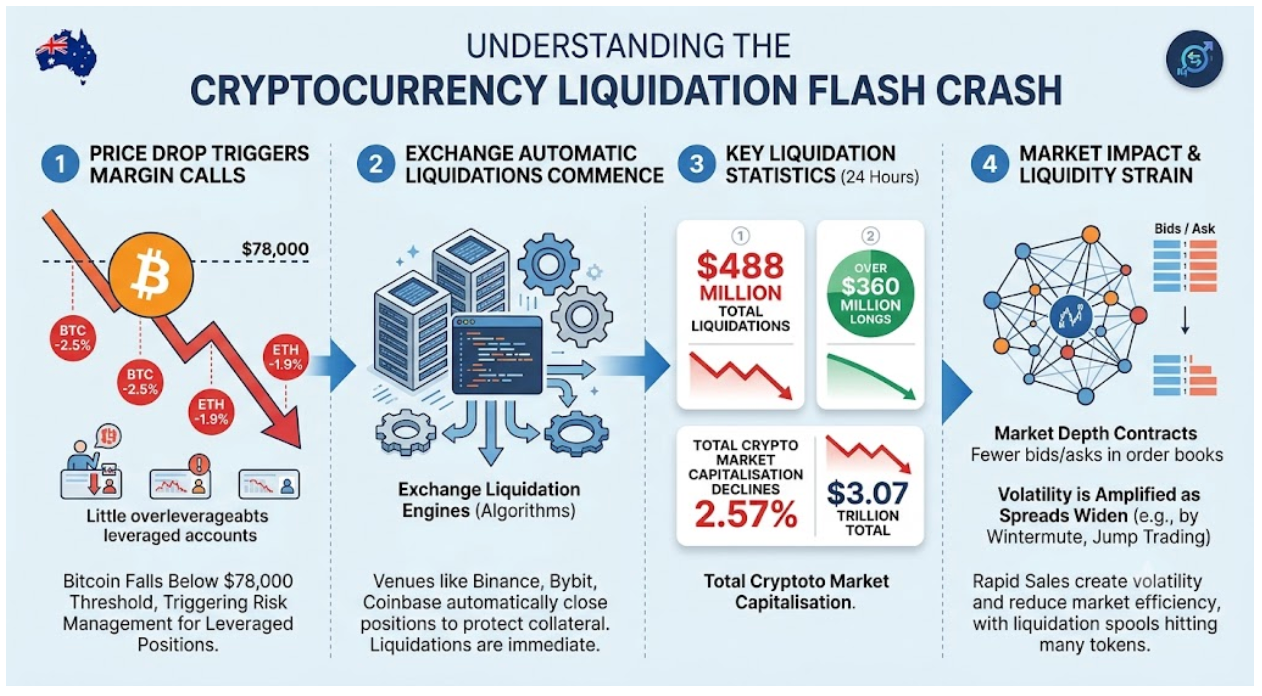 Anatomy of a Cryptocurrency Liquidation Flash Crash
- Exchanges closed 488 million dollars of customer contracts within one day. The closures eliminated accounts that lacked margin balance.
- Bitcoin fell from 81,000 dollars to 77,384 dollars over seven days. Ethereum tracked this retreat by falling below 2,440 dollars.
The Ripple Effect: Why This Volatility Matters
Market volatility alters the value of holdings for individuals who allocate capital to cryptocurrency in retirement accounts and savings funds. Price swings trigger margin calls that wipe out capital balances within seconds. Investors lose access to funds when platforms halt withdrawals during periods of volume stress.
Price changes in cryptocurrency influence sentiment across equities and debt instruments. Drops in asset values reduce purchasing power for households that maintain exposure to tokens. Therefore, losses on exchanges affect spending and wealth accumulation throughout communities.
Volatility alters collateral ratios on borrowing protocols across blockchains. When asset values drop below liquidation thresholds, software code auctions off deposits to repay lenders. This process creates losses for market participants who deposit assets into liquidity pools.
- Fluctuations in asset prices decrease account equity for market participants. These events force investors to add cash or surrender collateral.
- Protocol interest rates rise as token supplies drop inside liquidity pools. Borrowers face penalties when loan collateral values fall below borrowing limits.
Key Players Driving the Market Shift
Exchanges including Binance, Bybit, OKX, Coinbase, and Deribit process the majority of derivatives volume. Binance handled 39.2 per cent of spot volume among ten exchanges during 2025. These platforms execute liquidation orders through software algorithms when accounts breach collateral minimums.
Liquidity providers including Wintermute and Jump Trading supply bids and asks across order books. When volatility accelerates, these firms widen spreads to protect capital reserves against losses. This reduction in liquidity amplifies price swings across spot markets and futures markets.
Research analyst Riya Sehgal from Delta Exchange tracked the leverage that accelerated selling across venues. Founder of WazirX, Nischal Shetty, documented market contractions and liquidations exceeding 640 million dollars. Fund managers at BlackRock and Fidelity also oversee billions of dollars in Bitcoin exchange-traded funds.
- Exchange operators manage liquidation engines that close margin contracts during sell-offs. These systems process thousands of orders each minute to limit platform deficits.
- Market makers withdraw quotes when market swings increase risk exposure. Their action reduces market depth and magnifies price drops.
Tracking the Global Market Impact
The transactions took place across cryptocurrency exchanges with servers in Asia, Europe, and North America. Venues in the United States and Singapore processed trading volumes measuring in billions of dollars. Venues outside the United States handled the bulk of swaps and futures trading.
Trading venues on the Ethereum, Solana, and Arbitrum blockchains executed token liquidations through code. These systems operate without headquarters, routing trade data across computer nodes across the globe. Validators confirmed transactions onto ledgers without reliance on company offices or bank clearinghouses.
Investors in Australia monitored markets through exchanges that hold registration with AUSTRAC. Trading pairs involving the currency of Australia followed price drops during business hours in Sydney. Trading desks in London and New York accelerated transaction velocity as equity markets opened.
- Venues across the United States, Europe, and Asia recorded order executions. Volume spikes triggered congestion across data centres on three continents.
- Blockchains settled contract liquidations through validator nodes across nations. These blockchain networks processed transactions without interruptions to operations.
Timeline of the Recent Downturn
The sell-off occurred between 25 August and 30 August 2026. Bitcoin reached a peak of 126,198 dollars on 6 October 2025 before price levels entered a downturn. Prices declined through months in 2026, falling past 60,000 dollars in June.
Liquidations accelerated on 26 August 2026 as market capitalisation fell 1.27 per cent. Trading venues recorded 641.79 million dollars in liquidations across that twenty-four-hour period. Selling intensified on Saturday, 29 August 2026, as Bitcoin broke below 78,000 dollars.
The downturn coincided with the symposium in Jackson Hole, Wyoming. Federal Reserve Chair Kevin Warsh delivered remarks on inflation and interest rate policy on Friday, 28 August. Traders sold tokens over the weekend as bond markets closed and futures spreads expanded.
- Bitcoin touched a summit of 126,198 dollars on 6 October 2025. That valuation preceded months of price declines across 2026.
- Market liquidations topped 641 million dollars on 26 August 2026. Selling continued into the weekend as Bitcoin fell below 78,000 dollars.
The Mechanics of the Sell-off and What Comes Next
Leverage across derivatives markets sparked a cascade of liquidations. Traders borrowed capital from exchanges to magnify position sizes beyond cash balances. When prices fell, exchange software sold collateral to prevent debt.
Announcements on interest rates from reserve banks influenced risk appetite among asset managers. Federal Reserve officials indicated that inflation remains above the target of two per cent. United States Treasury yields rose after the speeches, drawing capital away from cryptocurrency into cash instruments.
 Deconstructing Crypto Market Volatility: Drivers & System
Market analysts expect traders to track policy announcements by the Federal Reserve and the Reserve Bank of Australia throughout September. Increases in interest rates raise yields on government debt, creating competition for tokens that pay no dividends. Lawmakers in Washington also continue debate on the CLARITY Act, which establishes rules for cryptocurrency trading venues.
Inflows into spot exchange-traded funds will steer market trajectory over the remainder of 2026. Funds accumulated 482.13 million dollars on 25 August, showing that asset managers buy assets during price drops. Meanwhile, investors continue accumulation of Bitcoin while traders exit margin contracts.
- Borrowing on margin triggers liquidations during periods of market stress. Exchange code closes positions to prevent balance deficits.
- Reserve bank rate policies influence the flow of capital between bonds and tokens. Policy shifts alter risk appetite across institutions worldwide.
- Exchange-traded funds absorb token supplies during phases of selling pressure. These investment vehicles provide entry points for pension capital and wealth managers.
Disclaimer: The information provided in this article is for educational purposes only and does not constitute financial or investment advice. Trading cryptocurrencies and using leverage carry significant risk, including the potential loss of principal capital. Readers should conduct their own research or seek independent financial advice from a qualified advisor before making any investment decisions.