

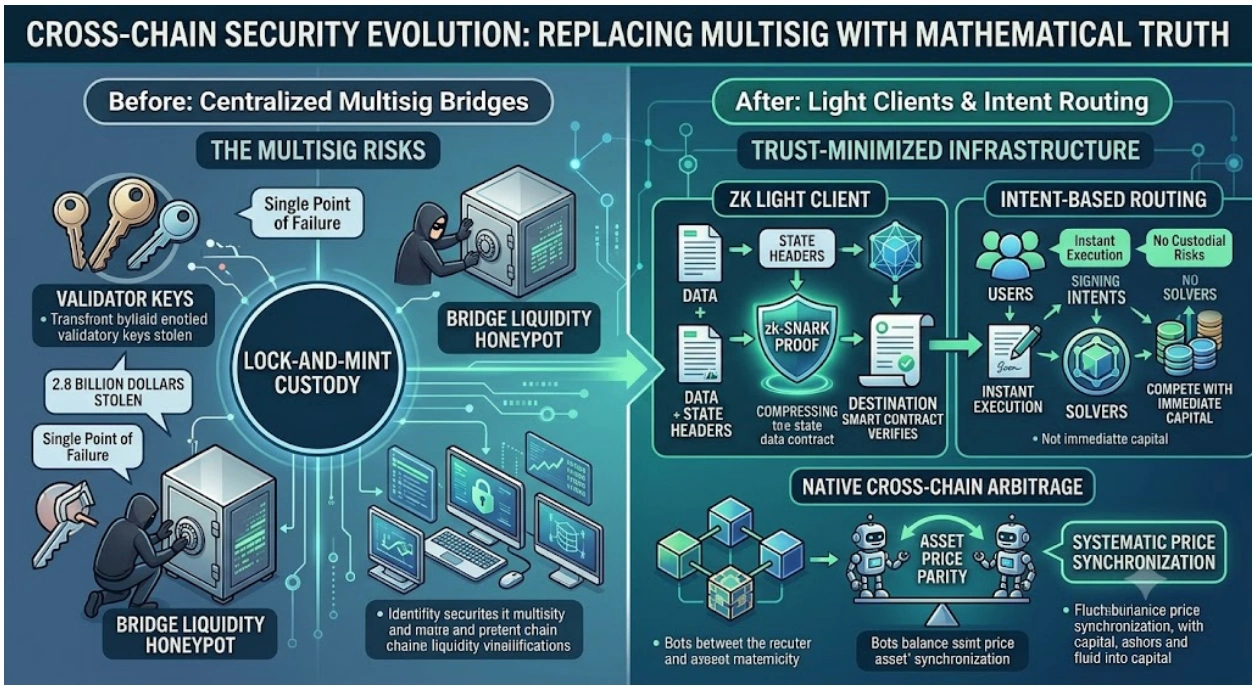
Blockchain engineering teams across the digital asset sector deployed light clients and zero-knowledge proofs to replace multi-signature bridges. These software protocols eliminate reliance on validator committees by executing cryptographic verification directly inside destination smart contracts. Industry research firms record that bridge exploits previously drained over 2.8 billion dollars from liquidity pools through private key theft and contract verification failures.
Decentralised finance networks shifted architectural design away from lock-and-mint systems toward native message passing and intent routing. Financial institutions and automated market makers integrated arbitrage algorithms directly into these cross-chain communication layers. These algorithms synchronise asset prices across independent consensus engines without exposing underlying capital to custodial bridge honeypots.
Deployments by developer groups building with the Inter-Blockchain Communication protocol and the Chainlink Cross-Chain Interoperability Protocol establish automated fraud proofs and state proofs across major networks. Software engineers confirm that on-chain mathematical execution now validates state transitions across Ethereum, Solana, and layer-two rollups.
 The Evolution of Cross-Chain Security Architecture
The High Stakes of Asset Security
Capital security across multi-chain ecosystems directly influences liquidity depth, protocol solvency, and user balances. Historical data shows that bridge exploits accounted for over 64 percent of all funds that hackers stole across decentralised finance during 2022. Cryptographic verification upgrades protect both institutional capital allocations and everyday user deposits from sudden exploit events.
Light client technology allows a smart contract on a target blockchain to verify the consensus state and block headers of an originating blockchain directly. This mechanism removes intermediary custody risks because no third-party multisig committee holds administrative keys to user funds. Users retain sovereign ownership of their digital assets while executing swaps across separate network architectures.
Native cross-chain arbitrage mechanisms maintain price parity across decentralised exchanges on disparate blockchains. Systematic price synchronisation prevents value extraction by predatory bots and reduces execution slippage for participants trading digital assets.
Infrastructure resilience allows global capital to flow between distinct execution environments without creating systemic contagion risks. Investors require absolute certainty that collateral bridged between Layer 1 blockchains and Layer 2 networks retains mathematical parity during periods of extreme market volatility. Continuous advances in zero-knowledge proof generation lower transaction fees and increase settlement speed across all decentralised market venues.
Pioneers Shaping the Interoperable Frontier
Core protocol developers, cryptographic researchers, and quantitative trading firms lead this sectoral transition. Organisations including Chainlink, LayerZero Labs, Wormhole, the Cosmos Interchain Foundation, and Succinct Labs develop the underlying verification infrastructure. Decentralised finance platforms, liquidity aggregators, and institutional market makers integrate these verification frameworks directly into their production codebases.
The cross-chain sector relies on specific participant groups that manage risk, capital allocation, and transaction verification:
- Cryptographic researchers engineer zero-knowledge circuits that compress consensus validation steps into succinct mathematical proofs. These circuits enable destination contracts to verify transactions without trusting off-chain validator sets.
- Infrastructure relayers transmit state data, block headers, and execution receipts across execution environments. These relay operators move transaction information rapidly without possessing custodial control over user funds.
- Quantitative trading desks operate automated arbitrage programmes that monitor price discrepancies across liquidity pools. These programmes capture market spreads, balance token reserves across chains, and supply liquidity to intent solvers.
Independent security auditing firms such as OpenZeppelin and Trail of Bits evaluate code implementations to verify mathematical invariants before mainnet deployment. Ecosystem foundations allocate millions of dollars in bug bounties and research grants to support open-source cryptographic verification software.
The Global Web of Interconnected Networks
This technological shift occurs across global blockchain networks, developer ecosystems, and decentralised financial venues. Production deployments operate across the Ethereum mainnet, the Solana network, Cosmos application chains, and Ethereum layer-two rollups including Arbitrum, Optimism, and Base. Engineering teams located in Australia, the United States, Europe, and Singapore coordinate software releases via distributed open-source code repositories.
On-chain execution takes place across global liquidity venues and distributed validation networks. Quantitative trading desks in Sydney, London, and New York deploy cross-chain arbitrage bots that connect decentralised exchanges such as Uniswap, Osmosis, and Raydium. Cloud server clusters and validator hardware running in global data centres process zero-knowledge proofs and state-relay pipelines.
Blockchain networks previously functioned as isolated transaction silos with fragmented capital and disjointed state machines. Modern interoperability protocols now link these separate execution environments into a unified global computing market.
A Chronology of Transformation
The industry push toward light client verification intensified following a series of high-profile bridge exploits between 2022 and 2024. Attackers breached the Ronin Bridge in March 2022, stealing 624 million dollars through compromised private keys. Hackers drained 326 million dollars from Wormhole in February 2022 and extracted 190 million dollars from the Nomad bridge in August 2022.
Academic institutions and protocol engineering teams accelerated zero-knowledge light client research throughout 2023 and 2024. Production implementations of zk-SNARK light client proofs and trust-minimised IBC connections reached active mainnet deployment during 2025. By 2026, leading decentralised finance protocols shifted their transaction routing to intent-based execution systems and state-verifying bridges.
Cross-chain arbitrage systems adapted alongside these cryptographic verification milestones and block-time reductions. Automated algorithmic trading programmes now execute cross-chain arbitrage transactions within single-block settlement windows across modern rollup architectures.
The Blueprint for a Trustless Future
Legacy cross-chain bridges relied on multisig signers or centralised custodians to validate asset transfers across blockchains. Attackers targeted compromised administrator keys or exploited code vulnerabilities to mint unbacked wrapped tokens on target networks. These structural failures forced engineers to design verification protocols that enforce mathematical truth rather than human trust assumptions.
 The Unified 3-Layer Secure Cross-Chain Framework
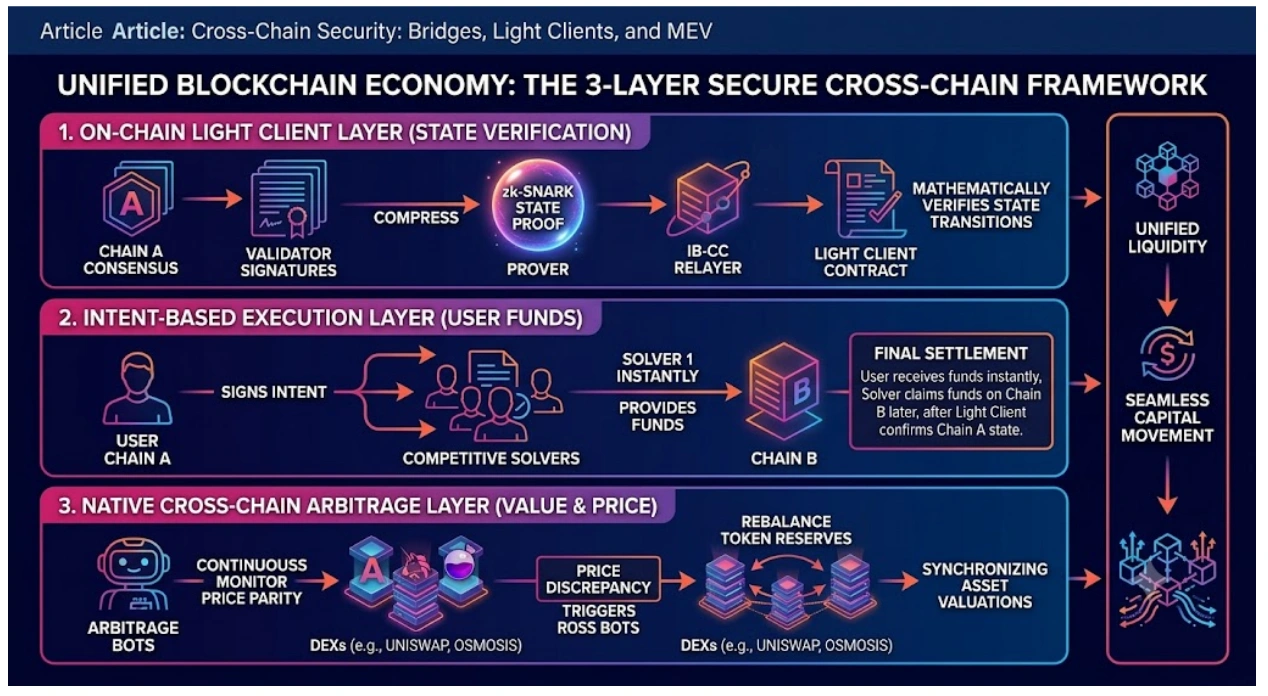
Modern cross-chain architecture functions through three coordinated technical layers:
- On-chain light clients parse block headers and validator signatures from external blockchains directly inside destination smart contracts. Zero-knowledge provers generate cryptographic proofs of state transitions, allowing destination networks to verify data while consuming minimal gas.
- Intent-based routing architectures allow users to broadcast desired transaction outcomes to a competitive market of independent solvers. Solvers provide instant capital on the destination network and claim locked funds after fulfilling the trade, removing settlement latency for users.
- Native cross-chain arbitrage software monitors pricing variations between automated market makers and order books across multiple ledgers. These programmes execute rebalancing trades across chains, which stabilises asset valuations and routes maximal extractable value into protocol ecosystems.
The broader adoption of zero-knowledge technology will alter the structure of decentralised financial markets over the coming years. Centralised multisig bridges will disappear from production environments as proof generation costs fall and hardware acceleration speeds up proof times. Interoperability standards will unify fragmented capital pools, enabling seamless asset movement and stable liquidity across all connected networks.
Decentralised finance applications will integrate zero-knowledge verification and intent routing directly into their user interfaces. Market participants will trade assets and deploy collateral across hundreds of distinct rollups and base blockchains through single-click execution secured by mathematical consensus proofs.
Disclaimer: This article is for informational purposes only and does not constitute financial, investment, or legal advice. The blockchain and decentralized finance sectors are highly volatile, and technologies involving cross-chain bridges, smart contracts, and cryptographic verification carry inherent risks, including the potential for total loss of funds. You should conduct your own independent research and consult with qualified professionals before making any investment decisions or integrating these technologies into your protocols. The information provided reflects industry developments and should not be considered an endorsement of any specific platform or project.