
Ethereum core developers deployed the ERC-4337 standard to transition network participant accounts from Externally Owned Accounts to smart contract accounts. This technical standard eliminates the requirement for twelve-word and twenty-four-word seed phrases during wallet creation and asset management. Users interact with blockchain applications through contract accounts that execute arbitrary code rather than relying entirely on ECDSA cryptographic key pairs.
The system introduces a framework that routes user actions through an alternative mempool before executing them on the Ethereum blockchain. Specialised actors known as bundlers package these user actions and deliver them to a single smart contract named EntryPoint. The EntryPoint contract verifies transaction signatures, checks account state balances, and executes transactions without requiring consensus-level changes to the core Ethereum protocol.
- Deployment of smart contract wallets to supersede private key pairs
- Introduction of the EntryPoint contract architecture across EVM networks
- Elimination of physical seed phrase storage requirements for end users
- Establishment of alternative mempools to process custom transaction formats
This deployment modernises user account management across the entire Ethereum ecosystem. Developers can now program custom validation logic, security restrictions, and automated workflows directly into user accounts. The standard aligns Ethereum wallet infrastructure with existing Web2 security standards.
 Conceptual Comparison
Breaking Barriers: The User Experience Revolution
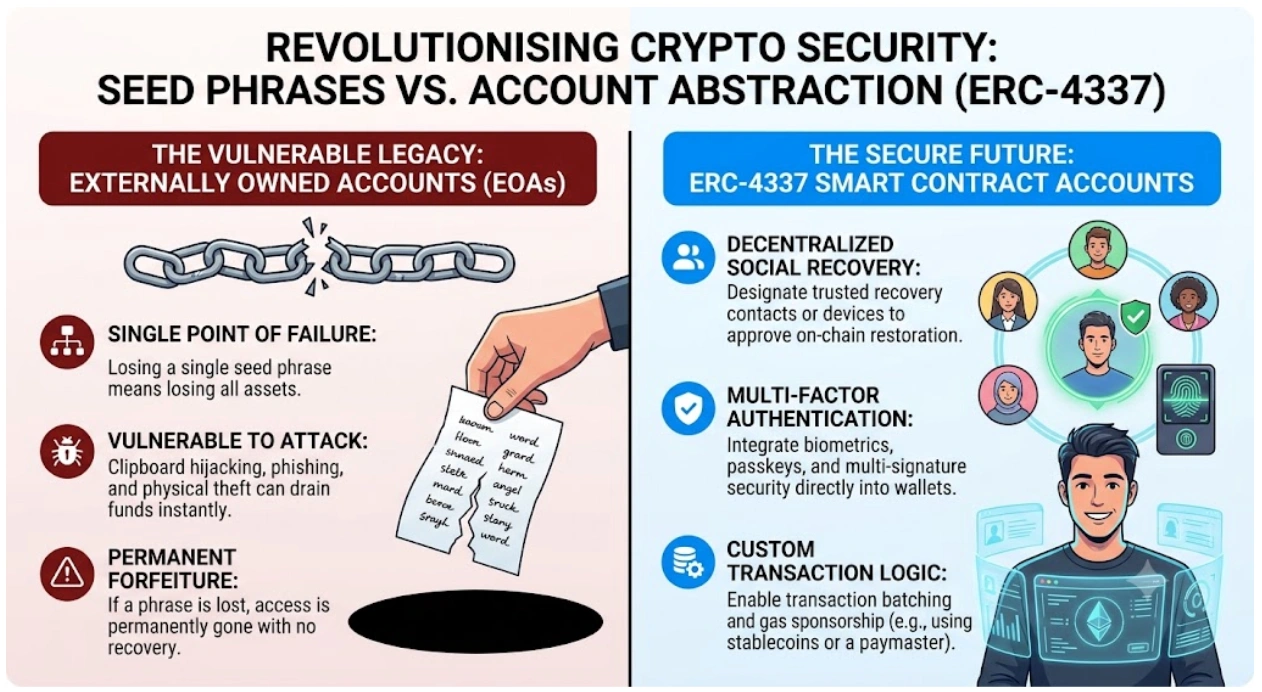
Blockchain analytics firm Chainalysis documented that malicious actors and user misplacement accounted for the loss of several billion dollars in digital assets between 2021 and 2024. Under previous account models, an individual who lost a seed phrase permanently forfeited access to all capital stored at that address. Seed phrases also exposed participants to clipboard hijacking, physical theft, and phishing schemes that drained funds instantaneously upon phrase exposure.
ERC-4337 resolves these vulnerability vectors by enabling social recovery mechanisms directly within wallet code. Users designate trusted recovery contacts, secondary devices, or institutional custodians as guardians for their account. If a user loses their primary device, these designated guardians approve an on-chain state update to restore account access without exposing underlying private keys.
- Implementation of multi-party social recovery mechanisms for lost credentials
- Integration of biometric passkeys and WebAuthn hardware modules
- Sponsoring of network transaction fees through third-party paymasters
- Settlement of gas fees using stablecoins instead of native tokens
- Execution of multi-call transaction batching in a single on-chain interaction
The new architecture also permits paymaster entities to subsidise or sponsor network gas fees for end users. Consumers can settle transaction fees using ERC-20 stablecoins such as USDC or USDT rather than maintaining reserves of native Ether. Furthermore, smart accounts enable batch transactions, allowing participants to approve and swap tokens in a single transaction step.
The Architects and Allies Behind the Shift
Ethereum co-founder Vitalik Buterin authored the ERC-4337 specification in collaboration with security researchers Yoav Weiss, Dror Tirosh, Alex Forshtat, and Kristof Gazso. Security firm OpenZeppelin conducted code audits on the core EntryPoint repository to verify contract resilience against re-entrancy and denial-of-service vectors. The Ethereum Foundation developer teams supervise ongoing protocol documentation and cross-client standardisation efforts.
Infrastructure providers and venture-funded development firms build software development kits and operational tools around the standard. Companies including Biconomy, ZeroDev, Stackup, Alchemy, and Safe supply bundler nodes, paymaster relays, and smart account templates to application developers. These software tools allow engineering teams to embed smart account capabilities directly into consumer mobile applications.
- Core Authors: Vitalik Buterin, Yoav Weiss, Dror Tirosh, Alex Forshtat, and Kristof Gazso
- Security Auditing Organisations: OpenZeppelin
- Infrastructure Providers: Biconomy, ZeroDev, Stackup, Safe, and Alchemy
- Institutional Participants: Visa, payment processors, and global fintech platforms
Global payment networks and financial technology corporations also conduct deployment pilots utilising the ERC-4337 architecture. Visa developed prototype smart accounts on Ethereum test networks to evaluate automated recurring subscription payments and merchant settlement solutions. These institutional pilots demonstrate how programmable transaction logic accommodates commercial requirements that base blockchain accounts could not support.
Charting the Geography of Innovation
The primary deployment took place across the global Ethereum mainnet environment through the instantiation of the canonical EntryPoint smart contract. Leading Layer 2 rollup platforms, including Arbitrum, Optimism, Base, Polygon, and zkSync, integrated compatible EntryPoint contracts across their networks. These scaling networks process ERC-4337 transactions at lower computation costs than the base layer.
International developer summits provided the coordination venues where software teams tested, refined, and launched the account abstraction standard. Programmers from Australia, Europe, Asia, and the Americas collaborated on client software repositories to establish interoperability across nodes. Global validator networks and independent node operators now run bundler infrastructure across multiple geographical jurisdictions.
- Deployment across Ethereum mainnet and Layer 2 rollup platforms
- Integration into developer infrastructure in North America, Europe, Asia, and Australia
- Activation within distributed validator networks and remote client nodes
A Timeline of Transformation
Vitalik Buterin and his co-authors submitted Ethereum Improvement Proposal 4337 in September 2021 to circumvent the hard-fork requirements of earlier account abstraction proposals. Security engineering teams spent 2022 conducting formal verification and public bug bounties to validate the contract logic. The authors officially deployed the EntryPoint 0.6.0 contract to Ethereum mainnet in March 2023 during the ETHDenver conference.
Infrastructure providers and node teams upgraded the ecosystem to the EntryPoint 0.7.0 release during 2024 to optimise gas efficiency and prevent mempool spam. The Ethereum Foundation and Layer 2 developer teams expanded account abstraction tooling throughout 2025 across enterprise payment pilots and decentralised consumer platforms. By 2026, millions of on-chain accounts utilize smart contract execution rather than standard private keys.
Under the Hood: The Mechanics of Change
Standard Externally Owned Accounts depend on a single ECDSA private key to sign and authenticate state changes on the Ethereum Virtual Machine. Bitcoin developers introduced the BIP-39 standard in 2013, creating the mnemonic phrase format that crypto wallets utilised for over a decade. ERC-4337 shifts this authentication process from the protocol level to the smart contract execution level by introducing the UserOperation object.
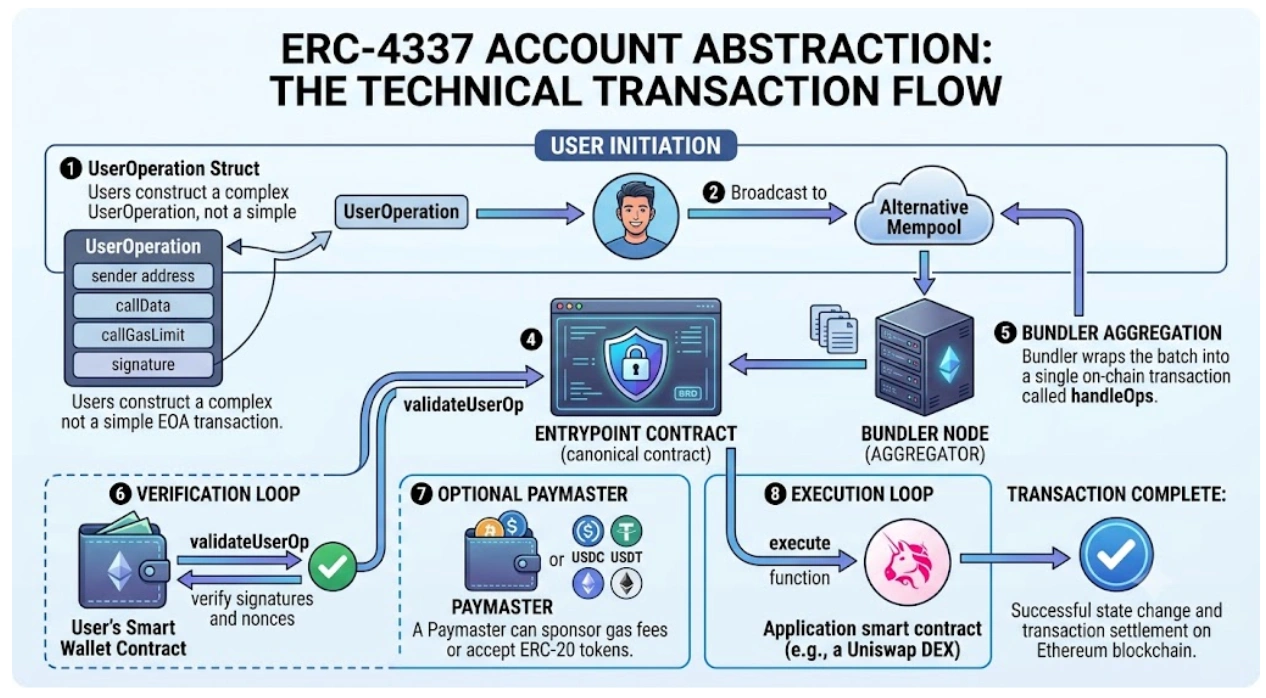
A user initiates an action by generating a UserOperation payload that specifies execution data, gas limits, and signature verification parameters. The client application broadcasts this payload to a dedicated alternative mempool rather than the standard transaction mempool. Bundler nodes collect these operations, simulate execution outcomes, and wrap multiple operations into a single transaction directed at the EntryPoint contract.
 Technical Process Flow
- User client constructs and signs a UserOperation struct containing transaction parameters
- Client broadcasts the payload to an alternative peer-to-peer mempool
- Bundler aggregates multiple UserOperation payloads into a batch transaction
- Canonical EntryPoint contract verifies signatures, nonces, and account balances
- Optional Paymaster contract validates sponsorship parameters and pays miner fees
- EntryPoint invokes target wallet smart contracts to execute specified transactions
The EntryPoint contract coordinates the verification and execution cycles across all included accounts. During the verification loop, the contract queries the target account to confirm signatures and verifies that the account or a paymaster holds sufficient funds for execution fees. During the execution loop, the contract unpacks call data and executes the instructions on the target destination addresses.
Software engineers predict that account abstraction will expand across all mobile and web decentralised interfaces over the next decade. Mobile operating systems will store cryptographic credentials inside hardware enclaves using WebAuthn protocols, linking biometric authentication directly to smart accounts. As custodial exchanges and payment gateways integrate these contract interfaces, consumer reliance on physical seed phrase backups will cease across the blockchain industry.
Disclaimer: This article is provided for informational purposes only and does not constitute financial, investment, legal, or professional advice. Blockchain technology, including ERC-4337 and account abstraction, is experimental and involves significant risks, including the potential loss of assets. Always conduct your own research and consult with qualified professionals before making any financial decisions or implementing new technology.