
The global market capitalisation for dollar-pegged digital currencies exceeded 180 billion US dollars across public blockchains. Financial technology firms and decentralised protocols distribute annualised percentage yields between four percent and fifteen percent to balance sheet holders.
Market participants demand operational transparency regarding the capital sources behind these return figures. Research data categorises these returns into four distinct capital sources: government debt obligations, decentralised borrowing markets, trading pool transaction commissions, and perpetual futures funding spreads.
Independent audit firms and industry analysts evaluate these revenue models to distinguish legitimate commercial cash flows from token subsidy programmes. These verification procedures establish benchmark standards for institutional balance sheet integration across digital financial markets.
Why This Shift Demands Your Attention
Capital allocators face balance sheet losses when protocols obscure their underlying income streams. The collapse of unsecured algorithmic tokens in 2022 wiped out sixty billion US dollars in equity and exposed the operational hazards of circular revenue loops.
Transparent accounting mechanisms allow investors to evaluate the solvency risks of counterparties and smart contract architectures. Depositors calculate accurate risk-adjusted returns when they distinguish sovereign interest payments from speculative margin debt.
Corporate treasuries increasingly hold digital cash instruments to settle cross-border trade transactions. Understanding the origin of distribution payments protects balance sheets from sudden liquidity disruptions and protocol default events.
Key Players Shaping the Stablecoin Ecosystem
Multiple institutional market participants and decentralised software networks manage the financial infrastructure for stablecoin yield generation. These market participants deploy liquidity across traditional money markets and digital asset execution venues.
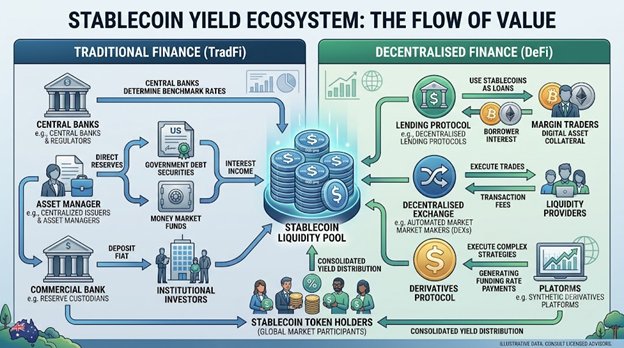
Figure 1: Stablecoin Yield Ecosystem: The Flow Of Value
- Reserve Custodians and Traditional Asset Managers: BlackRock and Franklin Templeton manage tokenised liquidity funds that hold short-duration government notes. These asset managers distribute interest dividends directly to institutional wallet addresses.
- Centralised Stablecoin Issuers: Tether and Circle hold reserve assets in United States Treasury bills and bank deposits. These companies generate billions in corporate interest income and structure specific yield-bearing products for qualified foreign markets.
- Decentralised Lending Protocols: Aave and Compound maintain automated liquidity pools where traders borrow stable assets against crypto-asset collateral. These platforms channel borrower interest fees directly into depositor balances.
- Decentralised Exchange Infrastructure: Uniswap and Curve Finance operate automated market maker protocols that execute billions in daily spot volume. The systems allocate fractional trading commissions to liquidity providers on every swap.
- Synthetic Derivative Protocols: Ethena Labs implements automated cash-and-carry positions across centralised derivatives exchanges. The protocol combines Ethereum validator rewards with short perpetual futures funding rates to produce yield.
Prudential regulators, including the Australian Securities and Investments Commission and the European Banking Authority, supervise these market participants. These authorities enforce strict reserve segregation standards and demand clear disclosure documents from asset issuers.
The Global Geography of Digital Finance
This capital deployment activity occurs across global financial centres and decentralised ledger networks such as Ethereum, Solana, and Arbitrum. Institutional trading desks in Sydney, Singapore, London, and New York direct liquidity flows through these digital networks.
Jurisdictions with established digital asset licensing regimes host the primary custodial and settlement operations. The European Union under the Markets in Crypto-Assets regulation, the United Arab Emirates through the Virtual Assets Regulatory Authority, and Australia enforce compliance frameworks within their borders.
Offshore banking hubs and multi-jurisdictional trust structures facilitate the purchase of sovereign debt securities for non-domestic token issuers. These distributed arrangements link conventional banking channels with on-chain settlement registries.
Timeline: The Evolution of Stablecoin Yields
The yield transformation accelerated during 2023 when global central banks elevated benchmark interest rates above five percent. This rate adjustment shifted capital demand from speculative decentralised finance rewards to sovereign debt-backed assets throughout 2024 and 2025.
The market established real-world asset integration as the dominant stablecoin yield standard by late 2025. Financial institutions project that tokenised money market instruments and hybrid yield tokens will expand through 2026 and 2027.
Unlocking the Future of Yield Generation
Stablecoin protocols generate cash returns through five distinct operational pathways across the financial ecosystem. Each mechanism requires specific capital commitments and exposes token holders to distinct balance sheet dependencies.
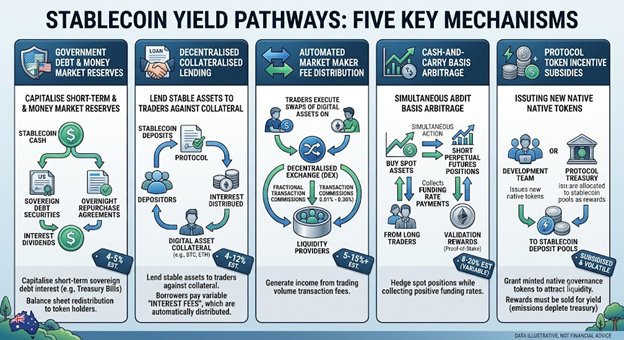
Figure 2: Stablecoin Yield Pathways: Five Key Mechanisms
- Government Debt and Money Market Reserves: Asset issuers direct fiat reserves into short-term sovereign debt securities and overnight repurchase agreements. These instruments generate four to five percent annual yields from sovereign treasury interest payments. Issuers transfer this revenue to token holders through programmatic balance rebasing or smart contract redemption vaults.
- Decentralised Collateralised Lending: Margin traders deposit digital collateral into smart contracts to borrow stablecoin liquidity for leverage strategies. Borrowers pay variable interest rates that supply and demand algorithms calculate within the liquidity pool. The protocol automatically distributes this gross interest income to liquidity suppliers after deducting a reserve fee.
- Automated Market Maker Fee Distribution: Traders execute token conversions against liquidity pools on decentralised trading venues. The protocol levies a fixed commission between 0.01 percent and 0.30 percent on the transaction value. The smart contract immediately credits this transaction fee income to the pool balance of liquidity providers.
- Cash-and-Carry Basis Arbitrage: Protocols purchase spot digital assets and simultaneously open short positions in perpetual futures markets. Long traders pay funding rates to short traders when perpetual contract prices trade at a premium to spot prices. The protocol collects these regular funding distributions alongside underlying proof-of-stake network validation rewards.
- Protocol Token Incentive Subsidies: Development teams mint native governance tokens and allocate them to stablecoin deposit pools to attract capital. Depositors sell these secondary tokens on open exchanges to realise nominal percentage yields. This promotional mechanism diminishes as protocol token emissions exhaust their designated treasury budgets.
The stablecoin market will integrate automated real-time proof-of-reserves and on-chain identity systems over the next three years. This regulatory and technical convergence will channel enterprise treasury funds into audited yield-bearing instruments while eliminating non-transparent balance sheets.
Institutional adoption will drive margin spreads lower across decentralised money markets as global liquidity pools deepen. Protocols with diversified income sources and legal reserve protections will secure the largest market share among corporate participants.
FAQs: Frequently Asked Questions
- How do stablecoins generate yield?
Stablecoin protocols generate returns through five main pathways: sovereign debt investments, decentralized lending, trading fees on decentralized exchanges, cash-and-carry basis arbitrage, and protocol token subsidies. - What are the primary risks for investors?
Investors face risks such as liquidity disruptions, potential protocol defaults, and the operational hazards associated with non-transparent revenue models. - Who regulates these financial activities?
Various bodies supervise the market, including the Australian Securities and Investments Commission and the European Banking Authority, which enforce reserve segregation and disclosure standards. - What is cash-and-carry arbitrage in this context?
This strategy involves purchasing spot digital assets while simultaneously opening short positions in perpetual futures markets to collect funding rates when prices trade at a premium. - What trends will shape the future of stablecoin yields?
The market is moving toward greater automation, real-time proof-of-reserves, on-chain identity systems, and increased institutional adoption of audited, transparent instruments.
Disclaimer: The information provided in this document is for educational purposes only and does not constitute financial advice. Investments in digital assets carry significant risk, including the potential loss of principal. Readers should conduct their own research and consult with qualified financial advisors before making investment decisions.