
In early 2026, a new business script is reaching a higher volume: “We are downsizing due to the ability of AI to perform the task.” According to a report, economists and labour analysts are countering, calling it AI-washing – the deployment of AI to serve as a handy excuse to make cost-cuts.
The figures are the reasons why the story is memorable. Tens of thousands of job losses in the US in 2025 are going to be counted as being AI-related, but it will be a very small portion of overall layoffs. Analysis estimates AI to be circa 4.5 percent of the 2025 job losses, which is substantial, but by no means the “AI took over everyone” narrative.
Meanwhile, AI tools are gaining momentum, and businesses are purchasing them in large numbers. Enterprise “agent” platforms do not just answer questions, but now automate pieces of work. The reality of the tools, coupled with ambiguous layoff allegations, is precisely where AI-washing comes in.

In early 2026, some firms blame layoffs on AI, but analysts call it AI-washing, since AI drove only a small share of 2025 cuts, even as companies rush to adopt new agent tools. (Image Source: HR News)
The Real Meaning of AI-Washing
AI-washing isn’t a secret plot. It’s a pattern.
An organisation declares a reorganisation. It refers to the efficiency of AI or automation. Investors get to hear about productivity rather than over-hiring and stagnated growth. Customers are served with innovation rather than service cuts.
Recent reporting indicates that some companies are banking on the AI line despite not having well-developed systems to take the place of the departing people. Another tell, which is a perception of the trend, is that executives will tend to discuss what AI will accomplish, not what it does currently.
This does not imply that AI does not affect anything. It means the label is being used as a catch-all – even in cases where the actual driver is known: profit targets, re-organisations, duplication of functions or moving work to cheaper suppliers.
The Reason Why Firms Choose the AI Explanation
- It peddles progress to investors. Leaders understand that the story is important. When a company positions cuts as an upgrade to AI, it appears forward-moving and decisive rather than reactive. Discussion that builds on tracking shows that AI layoffs remain minor by comparison with the overall reduction, but the message is still compelling.
- It gives executives cover. The phrase AI made us faster sounds strategic. We missed targets, which does not sound good. According to reports on AI-washing, some leaders have incentives to portray layoffs as technological advancements rather than financial or management decisions.
- It is the same as what companies are purchasing. Coverage of significant data-platform alliances over the last week will allow employees to ask questions of the company’s data in natural language and run controlled agents on top of it. Simultaneously, enterprise agent platforms are launching under the brand name of AI co-workers, which are operated across business systems with permissions and limits.
So the idea that AI did it is a clean account and sounds believable – even when the chronology does not work.
The Clash In Question: Artificial Intelligence is a Reality, Yet the Spin is the Reality
And here is the uncomfortable truth: both parties may be right at the same time.
AI minimises some of the workloads. In other teams, the individual with good tools now deploys work that had previously been done by several people to organise.
Nonetheless, there is current evidence suggesting a slower, smoother transition. According to economists interviewed in recent layoff stories, the effect of AI is currently thin and small, and most systems are support systems, not direct substitutes.
This is why AI-washing is a reality: layoffs today, the ability to do it is later, sometimes not at all.
The Future Of Automation In 2026
To make a judgment about what is plausible, look at what enterprises implement.
The idea of a significant collaboration is to incorporate sophisticated models in the cloud data solutions to allow users query questions without writing code and then engage agents in workflows – including governance controls.
A pitch based on an enterprise agent platform emphasises permissions and shared context, ensuring that automated tools do not access sensitive data or operate without restraint.
These products do not eliminate entire careers in a single day. They hack at the work: write-ups, sorting tickets, ticket analysis, routing, internal reporting and repetitive administration.
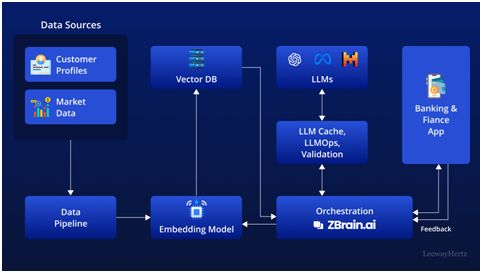
In 2026, enterprise AI doesn’t wipe out jobs overnight; it automates everyday tasks like drafts, ticket triage, routing, reporting, and admin, with tight controls. (Image Source: LeewayHertz)
The Red Flags Implying AI-Washing
Give readers a quick test.
- Red flag 1: Vague language. The announcement mentions AI but does not specify which workflow will be changed.
- Red flag 2: No timeline. Executives state that they are efficient now, yet are also investigating or flying AI.
- Red flag 3: Areas that AI is unable to reliably cover are hit. Compliance work that matters; work involving complicated customer support, or the work that involves deep context across systems that are messy.
- Red flag 4: The company is also reducing costs across the board. Freezes in travel, reduced marketing, and stopped hiring are indicators of a budget story, not one about automation.
Mega employers are losing more workers as the debate continues over whether AI is the actual cause or just a newspaper headline.
An Ad Hoc View of the Layoffs Discussion
The term AI layoffs is ubiquitous at present, driven by the continued layoffs of big names in the news. Recent media coverage discusses how big companies are reducing their workforce, and the public is debating whether AI is a cause or a scapegoat.
Economists in the same report note that the effects of AI to date are negligible, although corporate executives are becoming increasingly vocal about automation.
Individually, the coverage of AI-washing reveals a list of over 54,000 jobs lost in 2025, AI-wise, and that numerous companies have systems ready to take over those positions today.
That tension is the news hook: the AI claim takes effect sooner than the real deployment.
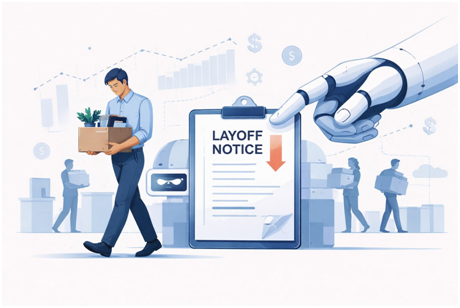
“AI layoffs” are trending as big firms cut staff, but economists say deployment often lags the hype, making AI an easy scapegoat. (Image Source: Artificial Intelligence +)
What Happens Next
In 2026, two things are moving in parallel.
Governed agent tooling is being adopted by businesses because it is guaranteed to save real money and quicken decision-making.
Meanwhile, employees and regulators demand more transparent disclosures: what the system automates, what data it handles, and who is liable for errors.
Such a clarification drive is likely to make AI-washing more challenging to de-smear, or at least more apparent.
Another indicator: When layoffs occur before any retraining plan, the company is probably just trying to save costs before it seeks change.
The AI-Washing Audit (A Practice Checklist)
When AI is accused of layoffs in a company, conduct this audit. It can be used with both experts and non-experts as it poses easy questions that compel one to be straight.
1) What exact work changed?
An actual AI transition labels work, not emotions.
- Credible: We automated the first level of ticket triage and routing. We reduced the monthly manual reporting burden to AI-assisted analytics.
- Suspicious: “Efficiencies within the business, AI.” “We are going that way to automation.”
Why? Since AI in modern enterprises is often a replacement of elements of work, rather than whole functions, primarily, when you consider approvals, risk, and disorganised internal systems. Enterprise platforms are now selling agents that span tools, but they remain focused on permissions, onboarding, and boundaries.
Shortcut test of your article: If the announcement cannot name a workflow, it is likely messaging.
2) Does the timeline make sense?
Considering that layoffs are a modern reality and the AI transformation is on the horizon, you will probably have a budget story dressed up as innovation.
Only once teams are added in terms of context, governance, and feedback loops, do even those who believe in agent systems discuss the issue of moving past isolated pilots into real work.
3) What are the tools, budgets and governance?
Robots that take over jobs leave no work:
- Security reviews
- Data access controls
- Model risk policies
- Training plans
- New metrics
And we are spending seriously here. In a deal reported, a large cloud data platform is incorporating advanced models directly into its environment, bringing AI to the scaling of analytics and workflow automation.
When a company states that AI was the factor that led to layoffs but cannot provide evidence of actual deployment, approvals, or expenditures, this argument becomes weaker.
4) Do the cuts correspond to the tasks that can be replaced by AI?
It is the simplest warning sign to the common readers.
AI is exemplary in:
- Repetitive text work
- Drafting and rewriting
- Triage and routing
- Pattern-spotting of data (right guardrails required)
AI struggles more with:
- High-stakes judgement calls
- Relationship-heavy roles
- Jobs that require tacit knowledge.
- Anything that needs profound responsibility
Thus, if layoffs occur on teams where AI cannot safely perform the work without strict supervision, the AI’s excuse begins to look like a cover.
Why This Moment Will Be Different in 2026
AI-washing is increasing because two events accompany it:
- The companies are under pressure to reduce.
- Artificial intelligence devices also seem believable enough to accept the culpability.
And in early 2026, AI tools will become more competent, particularly agent systems that will purport to perform work across business tools rather than just chat.
The new enterprise platform is defined as agents that share a common context, onboard, feedback, and explicit permissions, or, more simply put, guardrail software workers.
In the meantime, large enterprise collaborations are seeking to bring AI right to the workplace: within data platforms, enabling teams to query data using natural language and execute agent tasks on managed datasets.
So the story isn’t “AI is fake.” It is called AI is real – and that is precisely why it is so tempting to abuse it.
The Effect of AI-Washing on Human Beings (A Human Lens)
Imagine a manager attempting to compose the layoff memo.
Option one is honest:
The reason is that revenue is not meeting targets; we are reorganising and cutting expenditures.
Option two sounds sharper:
“Modernising with AI, headcount streamlining.”
The latter one is sore in other terms. It doesn’t just cut roles. It also:
- Spooks workers who stay.
- Empowers jobseekers into powerlessness.
- Gives people mistrust in practical means.
- Distracts the policy debate since no one can point out what is real.
And it backfires internally. When leadership sells “AI efficiency” but fails to provide the tools, the rest of the staff will continue to work the same number of hours with fewer hands-on, not to mention they have to believe it should be done by AI.
That is how burnout develops under a bright flag.
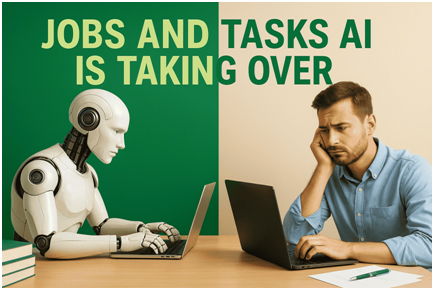
AI-washing spooks staff and erodes trust, and if the “AI efficiency” tools don’t show up, fewer people carry the same workload, leading to burnout. (Image Source: Colaberry School of Data Science & Analytics – Colaberry Inc)
A Criterion of Proof That Companies Are Allowed to Satisfy (and Journalists Are Allowed to Insist On)
In case you need a powerful, authoritative section, take this.
When a business claims that it is the AI that led to layoffs, request one of the following pieces of evidence:
- A workflow named that was changed (before vs after).
- An implemented tool (as opposed to a pilot) and location of operation.
- A measure (ticket resolution time, report cycle time, cost per transaction).
- Governance statement (permissions, audits, human-in-the-loop).
- A tools-specific reskilling plan.
This is important because contemporary enterprise AI is more of a controlled system than uncontrolled experimentation. It is part of the selling point.
No proof points? That is when AI-washing turns into a legitimate assumption.
What Workers Will Be Able to Panic Over
It is very crucial that workers know the extent of what the can control. In this case, workers will be able to do the following:
1) Track tasks, not job titles
AI eats tasks first. Assuming that your job involves repetitive writing, triage, scheduling, simple reporting or template work, anticipate change.
2) Build “AI-adjacent” strength
The less risky approach is not to try to become an AI engineer. It’s:
- Become the one who checks quality.
- Owns the workflow.
- Knows the data.
- Is the customer knowledgeable?
- Can explain decisions.
3) Ask better questions at work
When the leadership states that AI is making things efficient, then ask:
- Which workflow?
- What’s the target metric?
- Who owns failures?
- What training do we get?
In case of vague answers, the AI line will likely serve as the basis for a cost decision.
The Question to Leaders is What They Should Do to Gain Trust
When you have founders, managers, or executives among your readers, offer them a simple choice:
- If layoffs occur due to financial reasons, please state so.
- In case AI can alleviate the workload, indicate the workflow change.
- In case AI is supposed to be useful in the future, do not assume it has done so.
Why? Analysts are already pointing out cases where AI is used as a convenient explanation, even when systems are not yet mature enough to fulfil those functions today.
Conclusion: The Candid Title of the 2026
AI is not a myth. It’s also not a magic excuse.
At this particular moment, AI-washing is proliferating due to its ability to provide a futuristic narrative to the layoffs – a narrative that sounds strategic, sells well in headlines, and avoids inconvenient facts.
There is no need to hype and doom your readers. They need clarity.
So here’s the real takeaway:
In cases where a company accuses AI of layoffs, details about the demand are sought. Unless they can designate the work, the instruments and the schedule, you are not witnessing an AI revolution; you are witnessing a rebrand.
Frequently Asked Questions (FAQs)
- What is AI-washing?
Ans: AI-washing is when a company frames layoffs as “AI-driven” even though the real drivers are often cost-cutting, restructuring, or overhiring and the AI isn’t yet able to fully replace those roles today. - Do layoffs in 2026 happen because of AI?
Ans: Sometimes, especially where AI automates repetitive work. But many reports suggest AI is only a small slice of total job cuts so far, with broader business factors causing most layoffs. - Why do businesses blame AI instead of cost-cutting?
Ans: Because “AI efficiency” sounds like innovation and progress, while “we missed targets” signals weakness. It also plays better with investors and headlines. - What work is AI cutting right now?
Ans: Mostly repetitive, text-heavy tasks like drafting, summarising, ticket triage, basic analytics queries, and internal reporting, especially when AI tools have controlled access to company data. - What should I look for in an “AI layoffs” claim?
Ans: Ask: What tool? What tasks? What timeline? What controls? If the answers are vague, it’s likely messaging rather than measurable automation. - Is AI-washing a real trend in 2026?
Ans: Many companies cite AI when downsizing, while economists often point to cost-cutting and post-pandemic overhiring as the bigger causes. - What share of layoffs are AI-related compared to total layoffs?
Ans: AI-related cuts are meaningful but not dominant. Challenger tracks AI-cited plans and reports 54,836 AI-cited layoff plans in 2025 and 7,624 AI-cited cuts in January 2026 (about 7% of that month’s total). - Which jobs does AI replace first in 2026?
Ans: Repetitive tasks first: drafting, summarisation, triage, routine reporting, and simple analytics, especially where firms use governed, data-integrated AI systems. - What’s the clearest sign a company is AI-washing?
Ans: Big claims with no specifics: no defined workflow change, no timeline, and no evidence of implementation, governance, or training. - AI agents: are companies really using “AI co-workers”?
Ans: Yes, some enterprise platforms now market agents that perform tasks with permissions and limits, and connect directly to business data. It signals real change — but not instant replacement of whole departments. - Should workers fear AI in 2026?
Ans: Fear won’t help. Expect tasks to shift. The smart move is to build skills in workflows, quality control, customer context, and decision-making — areas that are harder to automate.