

Visa has rolled out a Visa blockchain payment solution for U.S. financial institutions. Banks are now able to settle transactions using Circle’s USDC stablecoin. This takes place on blockchain infrastructure but does not alter the consumer card experience.
The initiative is aimed at hastening the acceptance of USDC stablecoin in the U.S. market. The first participants are Cross River Bank and Lead Bank, with wider accessibility planned through 2026. Settlement volumes have already reached an annualised amount of US$3.5 billion (AU$5.39 billion).
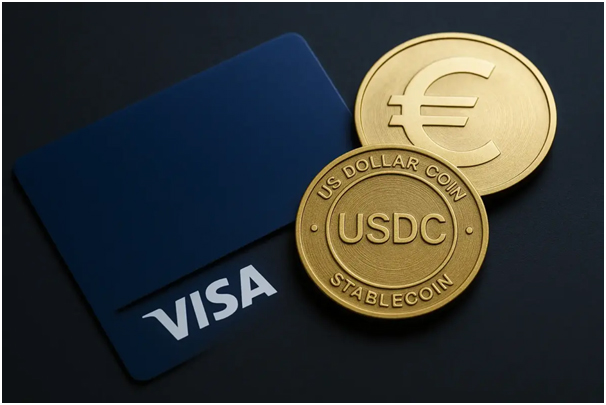
Visa launches blockchain solution enabling USDC bank settlements.
How Will Visa’s Blockchain Payment Solution Impact Banks?
The Visa blockchain payment solution permits quicker and more reliable fund migrations. Liquidity timing and treasury operations can now be improved by the institutions. The current settlement takes place on the Solana blockchain.
Moreover, Visa guarantees that a larger number of U.S. banks will be successively added through 2026. The system is capable of settling on weekends and holidays. This means that there is always the availability and efficiency in operations for back-end payments.
What Are Visa’s Goals With USDC Integration?
Visa is focusing on bringing stablecoins into the payment system and, subsequently, the modern world. The company has been carrying out pilots in different regions like Europe, Latin America, Asia-Pacific, and CEMEA.
The adoption of USDC gives an option other than traditional fiat-based settlement processes. In addition, Visa will utilise Circle’s Arc Layer-1 blockchain. The company would run a validator node to back the network. Arc is a global commercial payment designed for high performance.
Stablecoin Settlement Volumes Hit US$3.5 Billion
Visa’s settlement volume with USDC has grown to an annualised US$3.5 billion (AU$5.28 billion). As a result of the announcements, Circle’s stocks jumped 8.9%, reaching US$82.16 (AU$123.96). On the other hand, Visa’s shares experienced a slight decline of 0.6% even after the launch.
The project is regarded as a turning point for digital currency payment infrastructure in the U.S. financial sector. Institutions are already making preparations of various kinds for the adoption of stablecoin settlements.
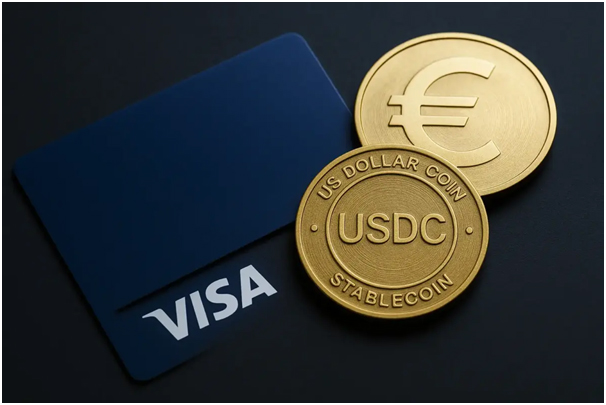
Visa pilots stablecoins globally to modernise payment systems.
Could USDC Adoption Transform U.S. Payments?
Visa’s project could be a big boost for the U.S. stablecoin market. Quick settlement will mean lower operational costs and a higher level of efficiency. Bank and merchant alike will reap the rewards of constant processing through the blockchain.
Digital payments may gain a higher level of transparency and security. The ushering in of USDC is in line with the upswing of financial markets worldwide that prefer digital currency payment infrastructure.
Visa Strengthens Blockchain Infrastructure Role
Visa is not only allowing its blockchain involvement to grow but also partnering with Circle. Its involvement in Arc’s network launch and backing validator activities will be proof of that.
All this culminates in a long-term role of stablecoins in the world of finance for retail as well as institutions. Without a doubt, Visa’s actions speak of a drive to modernise settlement systems.
Will Stablecoins Become Mainstream in U.S. Banking?
Stablecoins are being recognised more and more as a functional settlement tool. Visa’s experiment might lead other banks to think about the same kind of solutions. Integrating USDC might even have a say in the setting of policies and regulations as well as the scope of the institutions.
Adoption will be based on three factors: the ability to scale, security, and institutional readiness. The digital currency payment infrastructure will see a substantial increase in the coming years.

Stablecoins gain traction as banks consider USDC integration.
Visa Promotes the Use of Stablecoins by Institutions
Visa has taken a step forward with its project that is to trigger stablecoins adoption by more U.S. finance institutions. The firm has come up with solutions and support that will make it easier to incorporate them into the present banking infrastructure.
By removing obstacles, banks can enjoy quick settlements and reduced costs of operation. Forecasting the above, experts think that there will be a large-scale acceptance of the USDC stablecoin in the U.S., which in turn shall enhance the liquidity of the market as a whole.
Necessary Changes in Digital Currency Payment Infrastructure
This event is a turning point on the road toward a solid digital currency payment system in the U.S. Visa’s partnership with Circle is an invitation to more cooperation among other international banks. The more acceptance there is, the more innovation and transparency will be found in the payment ecosystem.
It is believed by the experts that the blockchain settlement might one day be in use everywhere commercial finance is needed, which would profoundly change the flow of money in the digital age.
Also Read: USDC Payouts For Freelancers: Visa Crypto Payout Pilot Expands Globally
FAQs
Q1: What is Visa’s blockchain payment solution?
It enables banks to use USDC for settling transactions on the blockchain.
Q2: Which banks are the first ones to use USDC for settlement?
Cross River Bank and Lead Bank are the first ones to operate in the U.S.
Q3: What is the current USDC settlement volume?
Settlement volumes are now estimated at an annualised US$3.5 billion (AU$5.39 billion).
Q4: What blockchain is being used for Visa’s USDC settlement?
At present, the settlements are made through the Solana blockchain, and later on, there are plans to use Circle’s Arc.