
The Significance Of ADGM’s Multi-Chain Approval Of USDT In The Upcoming Global Stablecoin Trend
The Big Picture: Why it Matters Now
The Abu Dhabi Global Market (ADGM) has recently expanded its regulatory approval of Tether USDT, giving it the status of an “Accepted Fiat-Referenced Token” within nine blockchain platforms.
This is more than a box to be ticked, however. The fact is that licensed financial institutions in the ADGM environment will be able to utilize the USDT stablecoin on the following blockchain networks: Aptos, Celo, Cosmos, Polkadot, Tezos, TON, Near, and TRON.

ADGM approves USDT on nine blockchains, boosting its role in global regulated finance. (Image Source: FinanceFeeds)
This is, in effect, opening the stablecoin ecosystem to a much wider audience than the previously supported blockchain platforms (such as Ethereum, Solana, and Avalanche) – a truly global platform for regulated digital asset finance.
For businesses, investors, and people aware of the crypto world, this marks the beginning of a bigger thing: The stablecoin is no longer a niche tool, but a part of the fabric of finance-as-we-know-it, in and across chains and across borders.
What Does This Mean in Practice?
Institutional liquidity: Now that USDT has been cleared in several large chains, the facilities of companies in the zone will be able to provide the following services: trading, holding, settling, and remitting funds through the use of USDT.
Increased interoperability and access. USDT can move across different blockchain platforms, creating new channels for global settlements, cross-chain transactions, and decentralized applications (dApps) and institutional utilization.
Signal to the global markets: ADGM’s decision could provide an incentive to other countries to establish stablecoin regulations, enabling a stable and clear environment in the digital assets space.
At the same time, the approval is a part of a wider trend: other stablecoins, for example, Circle and Ripple stablecoins, also work towards regulation, and companies, for instance, Binance, aim to receive traditional licenses to function in the regulatory environment.
On The Ground: Why It Matters Beyond The Headlines
For a region such as the Middle East and the emerging global financial centers, this is more than an update in regulations. It is a message of intent.
Think about this: many economies face problems relating to the instability of their currencies, low banking penetration, and high costs associated with sending remittances. For the average entrepreneur and individual, the availability of a stable digital currency in the form of the dollar-denominated USDT qualifies as an attractive option.
Instead, picture a stablecoin that is not bound to a specific blockchain and can move across a variety of platforms and be stored in a regulated environment for a wider variety of applications, such as payments, remittances, global trade, and corporate treasury services, to name a few.
This is a change that has real-world implications. For those in emerging economies, and in turn, the continent of Africa, there will be the provision of stable value stores and the facilitation of cross-border transfers to a global liquidity platform.
For institutions, this means an immediate solution for corporate treasury, global trade finance, and a more integrated way to interact between traditional finance and blockchain-based systems. (IMF)
Why This Marks a Turning Point for Stablecoins
Regulation + Flexibility = Scale.” Stablecoins in many countries remain in a “grey area” where they are “partly unregulated and partly speculative.” But the fact that ADGM has taken the step demonstrates that regulation is in no way a hindrance to innovation but an enabler of scaled and credible applications.
Multi-Chain is the Future
The blockchain industry is no longer a winner-takes-all environment. Each blockchain has strengths in a unique area: either it is faster, less expensive, more scalable, or more privacy-centric.
In recognizing that the real world requires a flexible solution that works across a variety of platforms, ADGM has made an important statement through the approval of USDT on the various chains.

ADGM approves USDT on multiple blockchains, recognising each chain’s unique strengths. (Image Source: Nexax Medical Coding Training Academy)
Deep Impact: What All This Means for Real Markets
The ADGM’s regulatory status elevates stablecoins from prototyping infrastructure to regulatory plumbing.
Regulated companies within ADGM are now able to custody, trade, and settle their USDT on the newly listed chains, giving a clear message that stablecoins will no longer be viewed as a side tool in the cryptoverse but a financial functionality to be reckoned with.
This resolves the issue instantly. Institutional liquidity that was wary of even mentioning on-chain dollars is now able to see a regulatory solution to interact with on-chain dollars. Treasuries, market makers, and custodians have the chance to create instruments that utilize stablecoins but remain within a regulated box.
Emerging market economies are impacted practically. The company involved in cross-border payment and employment services will be able to utilize faster and less expensive rails without forcing their clients to go to unregulated offshore firms. For a country where the correspondent banking process is slow and expensive, the stable corridor will be a pragmatic solution.
Scaling Interoperability: The Importance of Multi-Chain Connectivity
- The blockchain space is fragmenting along technically driven lines: some chains are optimized for low costs, while others aim to process many transactions, and some focus on finality and contracts.
- The approval of USDT on various networks implies an acceptance of this fact: It allows a regulated entity to choose the chain that works best in a particular use case: cheap transfers on the TRON chain, high-assurance settlements on the Polkadot chain, and dev-friendly composability functions on the NEAR chain.
- This acceptance across several chains also impacts the design of the product: Cross-chain bridges, asset wraps, and liquidity pools will be natural components of a regulated services offering instead of hacks. They will be able to offer multi-rail treasury services that will allow funds to be automatically routed to the cheapest or fastest chain while staying within the rules.
gm fam
most chains still behave like they’re the center of the universe. “build here, live here, stay here”. @useTria is the opposite. it assumes apps will live across many ecosystems and just use tria for the functions that other chains can’t handle.
the core function tria… https://t.co/ZKzKWybaaj pic.twitter.com/o7FqQYasDb
— Andy the Jet | MemeMax ⚡️ (@GpaAndy) December 9, 2025
Practical Applications Driving the Adoption Process
- Payments and Remittances: Companies can provide near-instant cross-border payments with reduced FX costs. There is also easier facilitation for partnerships between banks/payment services and cryptos due to a regulated process.
- Corporate Treasury: The treasurers of corporations can park their fiat risks in an on-chain dollar without leaving the jurisdiction of the regulators.
- The provision of services regarding off-ramps and on-ramps has been made easier because the regulated exchange and custodians in ADGM will be able to list and provide the custody of USDT on a variety of chains.
- Decentralised Finance (Institutional DeFi): Institutional investors who need a regulated form of custody solutions for lending, liquidity provision, and automated market makers (AMM) based on USDT in a supervised environment. This is a significant remover of barriers for the regulated participants.
- Cross-Border Trade Finance: Exports from smaller countries will be able to receive stablecoins directly on the blockchain, enabling faster settlements and fewer intermediary costs if the other side is ready to receive digital dollars.
Additionally,
Winners and Losers: The Ever-Changing Landscape Of Competition
Winners
- Tether/USDT: The regulatory acknowledgment will enhance its incumbency and acceptance, especially in a country where regulatory sovereignty is cherished.
- Well-Developed Regional Hubs With A Clear Crypto Regulatory Framework: Attract licensing, talent, and liquidity.
- Payment And Custody Solutions That Move Fast: Those that implement compliant multi-chain solutions will gain first-mover advantages.
Potential Losers
- Purely Decentralized, Unregulated On-Ramps: They face the possible loss of their outlets due to the availability of legally operated
- Countries Lacking in Regulatory Clarity: Capital will move to regulatory safe harbors, hindering local crypto innovation unless regulatory rules are conducive.
The Balancing Act Of Regulators: Clarity Vs. Fragmentation
ADGM’s action points to a paradox.
While the need for legal certainty is important, it should be noted that a clean regulatory environment leads to the success of the services, and companies will provide their services in an area where the
At the same time, a patchwork of jurisdictional approvals risks fragmenting liquidity. Different centers approve the same tokens and/or networks in differing ways, making interoperability a legal process in addition to a technological one.
Expect a phase of regulatory competition. While some hubs will go for large approvals quickly, others will require tougher reserve audits, proof-of-liquidity assessment, and in-house compliance testing.
Market players should expect both the benefits and the complexities of regulatory compliance.
Security & Operational Risks to Watch
- Lack of Transparency and Governance: The approval process mitigates legal risks but doesn’t remove operational and counterpart risks. Verification of attestations regarding the reserves, redemption mechanisms, and governance structure of the stablecoin issuer is necessary.
- Cross-Chain Bridges and Smart Contracts: The multi-chain economy is deeply dependent upon cross-chain bridges and converters. These are also attack points. There will be a need for hardened custodial and bridge monitoring solutions for the regulated companies.
- KYC/AML Friction: The use of stablecoins in cross-border payments has reduced friction in the rails, but the companies are still required to perform KYC/AML processes. Expect enhanced identity and compliance solutions to be the norm going forward.
- Market Concentration: The predominance of USDT in the market has the potential to create a concentration of systemic risks. The regulators and the institutions will be cautious regarding the exposure to a particular issuer and might encourage the management to diversify and implement
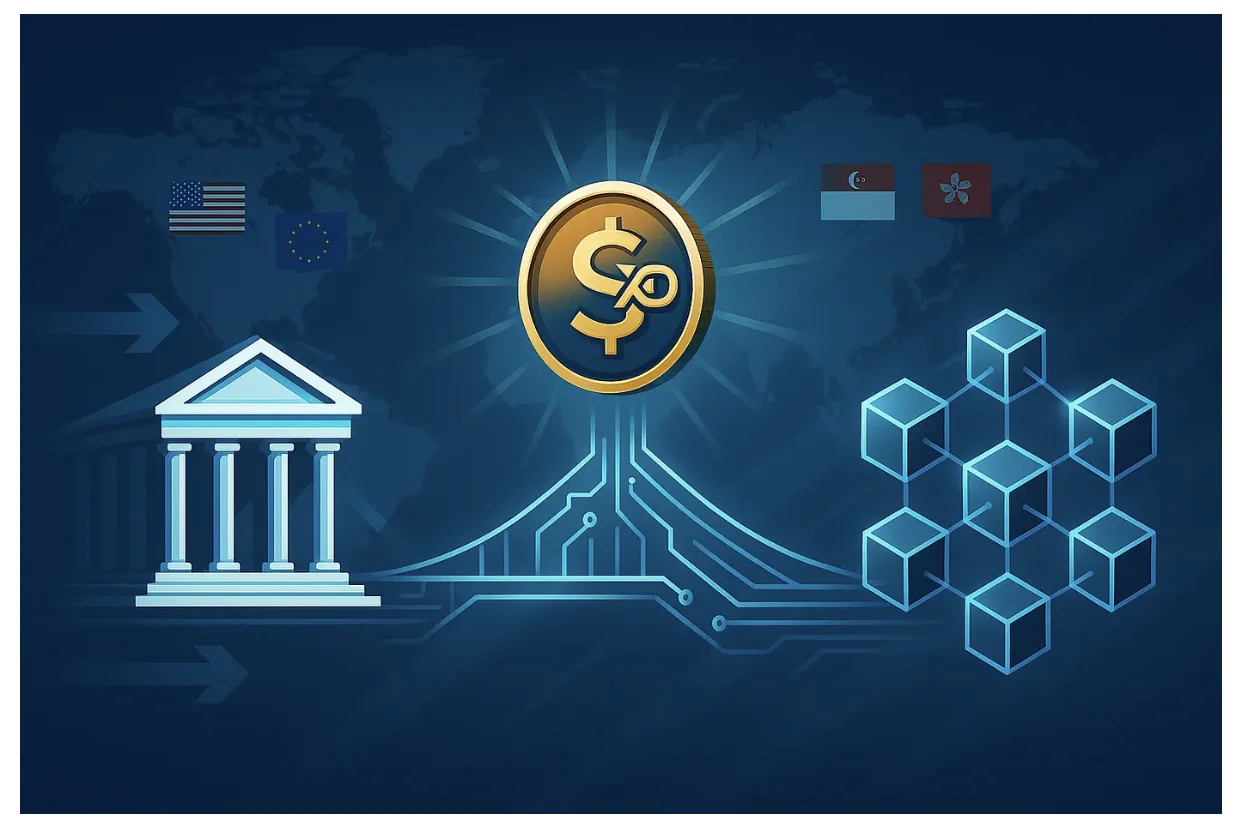
USDT faces ongoing risks in reserves, cross-chain security, and compliance. (Image Source: Medium)
Response of the Banking Sector and the Incumbent Players
Some banks are already piloting the tokenisation of assets and the custody of crypto funds. ADGM’s action invites more partnerships.
Banks will be able to provide custodial wallets, settlement facilities to turn on-chain USDT holdings into cash, and credit lines that are tokenized to link traditional lending and on-chain collateral.
This doesn’t mean that banks will suddenly walk away from traditional rails and the infrastructure they’ve built over the years through traditional banking channels. They’ll simply provide parallel services and selectively offer the benefits of blockchain-based lanes when the business case aligns.
Practical Steps for Businesses
For Treasury Teams
- Pilot a project with a regulated custodian partner in ADGM and similar free zones.
- Chain costs assessment: test the chain settlement speed and costs for various chains supporting USDT.
- Establish a clear process for exit and reconciliation to fiat.
For Fintech Founders
- Construct multi-rail settlements that abstract the choice of chain from the consumer.
- Implement the KYC/AML functions in the application through the respective compliance SDKs.
- Design for auditability: supplying clients with clear proof of regulatory compliance and custody.
Also Read: Potential Bitcoin Pullback To $87,000 Could Set The Stage For A Powerful Market Rebound
Forecast: Adaptation Curve And Timeline
Figure:
- Short Term (6 – 12 Months): Expect more announcements of regulated products from ADGM firms – listing, custody, and payment corridors. Liquidity will focus on the chains supporting low-cost settlement and development tools.
- Medium-Term (12 – 36 Months): The model will be adopted by the wider financial sector because other financial hubs will either copy ADGM’s structure or align their legislation. We will witness more entry points from banking institutions and products involving tokenized assets for corporations.
- Longer Term (3 To 5 Years): Stablecoins might coexist in the payment infrastructure with central bank digital currencies (CBDCs) – interoperability standards bonding them together. How this plays out will depend upon regulatory treatment and trust levels relating to reserves.
Closing: The Human Side
This is much more than a technical issue. It is a convenience and trust issue.
For a small exporter in Lagos, a migrant sending salaries home, or a treasury manager in Sydney considering settlement risk, the margin between a cumbersome FX chain and a regulated dollar on-chain means hours and hundreds of dollars. The approval of the multi-chain USDT by ADGM doesn’t address the issue but works to remove a significant obstacle: the legal ambiguity that scares off institutional investment. “If countries align rules and a careful, audited services architecture is constructed upon these rails, a new phase emerges in which on-chain dollars will be a functional tool of commerce, not a speculative novelty,” he said.
FAQ: Frequently Asked Questions
- Q: Does it mean that payment with USDT is now legal in the UAE?
A: Not necessarily. The approval means that the regulated firms in the financial zone will be allowed to facilitate the trading, custody, settlement, and any other regulated activity through the USDT. Using the USDT in retail payments, however, might require the observance of local payment rules. - Q: Why has ADGM extended approval to nine chains at this point?
A: The growth is in response to the rising need for stablecoins in a variety of blockchain networks, in addition to the regulatory drive to utilize digital assets in the traditional financial sector. The expansion is also a component of the objectives of the state of Abu Dhabi to be the global center for regulated digital assets. - Q: Do the developments in this news affect the global stablecoin market or the UAE and Middle Eastern region only?
A: This regulatory approval impacts ADGM firms directly, but its significance to the wider global stablecoin regulatory landscape is its global reverberations in terms of setting a precedent and setting the tone for other global stablecoin regulatory regimes to follow. - Q: Is USDT the biggest stablecoin?
A: Yes. The increasing acceptance by regulatory bodies will only add to the popularity of the largest stablecoin in terms of market cap and circulation in the dollar-pegged category, USDT. - Q: Which blockchains has ADGM allowed the use of USDT on?
A: The ADGM listing encompasses networks such as Aptos Network, Celo, Cosmos Network, Kaia Network, Near, Polkadot Network, Tezos Network, TON Network, and TRON Network, in addition to the earlier listing of networks such as Ethereum, Solana Network, and Avalanche Network. - Q: Does ADGM approval render USDT risk-free?
A: No. The approval means that the regulated company will be allowed to facilitate the use of USDT in a supervised manner in ADGM, but challenges remain, such as the transparency of reserves and the security of cross-chain bridges in smart contracts. Due diligence remains important in this case. - Q: Will other hubs be compelled to follow suit?
A: Highly probable. The pressure to be an attractive platform for fintech and the need to compete through regulatory frameworks will trigger announcements in the press and licensing decisions in the coming months. - Q: How should the remittance sector adjust?
R: Analyze RCPs, calculate cross-chain settlement costs, and verify the integration of KYC/AML procedures. Hybrid solutions incorporating the option to settle through the banking chain based on prices should be explored. - Q: What should the press focus on next?
A: Examine the first regulated products that utilize the approval, custodian, and treasurer pilots, and remittance corridors where reductions in fees and settlement times occur in the first two years following implementation.